
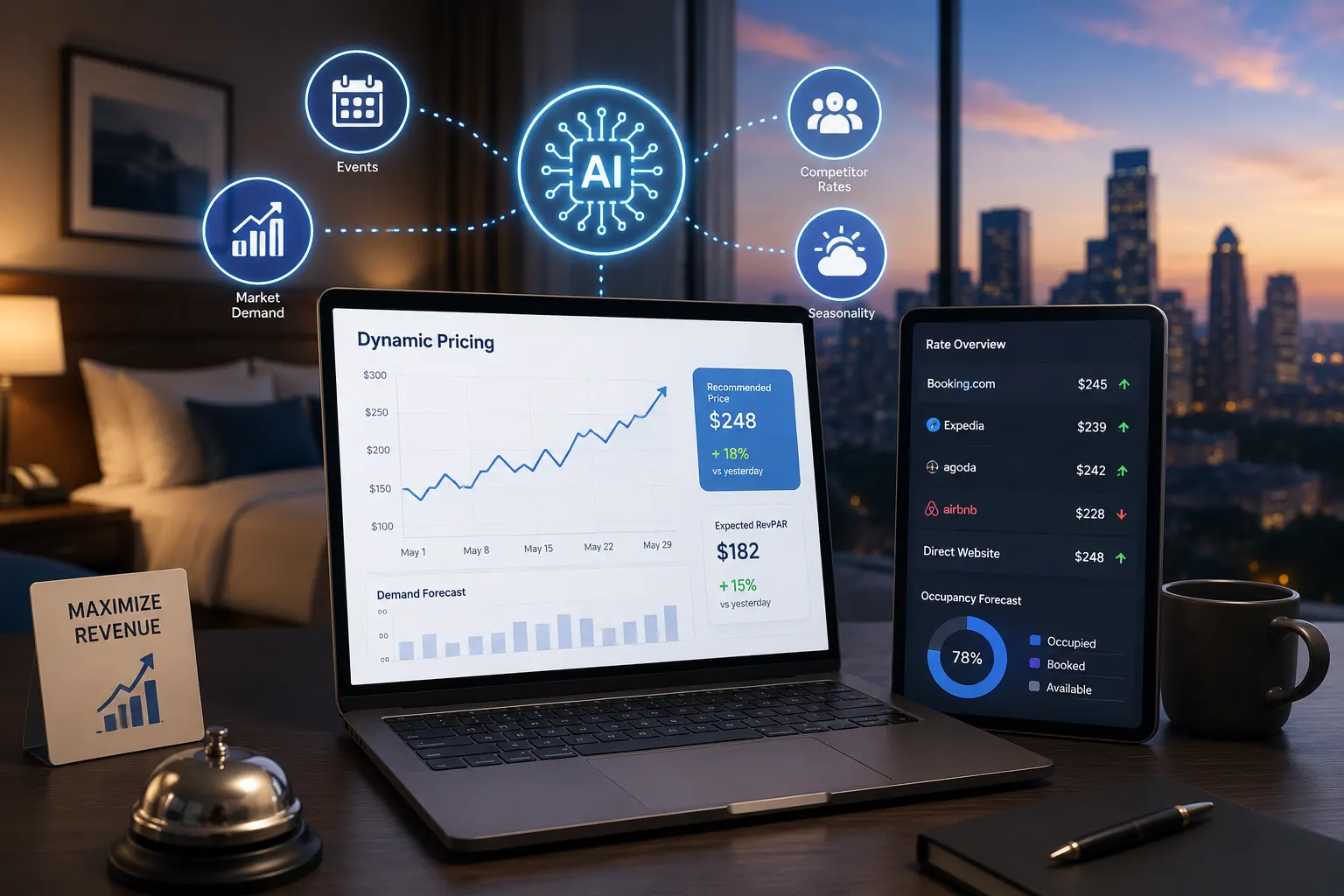
A dynamic pricing platform is software that continuously analyses demand signals — competitor rates, booking pace, local events, historical patterns and cancellations — and recommends or sets room rates for every date and room type to maximise revenue at every occupancy level. The best platforms explain each rate and let your team approve changes before they are published. For independent hotels, boutique properties and hotel groups, it replaces once-a-week repricing with daily, data-driven decisions; how much revenue it adds depends on your starting point, so model it on your own numbers.
📋 What you will learn in this guide
- What is a hotel dynamic pricing platform?
- How AI-driven pricing engines work (step by step)
- Core benefits of dynamic pricing for hotel revenue management
- How real-time pricing engines maximise occupancy during off-peak seasons
- What features to look for in a hotel dynamic pricing tool
- Dynamic pricing for boutique hotels: what is different
- Dynamic pricing platforms for hotels in India
- Dynamic pricing software for hotels in Australia
- Comparing hotel revenue management platforms: what to evaluate
- 5 mistakes hotels make when choosing a dynamic pricing system
- How Propeter’s pricing engine works
- Frequently asked questions
What is a hotel dynamic pricing platform?
A hotel dynamic pricing platform is a revenue management system that uses algorithms — and increasingly, machine learning and AI — to set, adjust and distribute room rates based on current supply and demand conditions. Unlike a static pricing strategy (where rates are set once per season or per promotion) or a rule-based system (where pre-set triggers change rates when occupancy crosses a threshold), a true AI-driven dynamic pricing platform learns from data and makes nuanced, continuous rate decisions.
The platform connects to your Property Management System (PMS), channel manager and direct booking engine, pulls occupancy data, and publishes updated rates to your distribution channels — Booking.com, Expedia, Agoda, MakeMyTrip, your own website — either automatically within rules or after your team approves them, depending on the platform and how you configure it.
The result is that your rates keep pace with demand on every channel — without a revenue manager having to rebuild every rate by hand.
How AI-driven pricing engines work — step by step
Understanding the mechanics helps you evaluate platforms critically — and identify the ones that are genuinely AI-driven versus those that are simply rule-based engines with an “AI” badge. Here is how a real-time hotel pricing engine operates:
1
Data ingestion — pulling signals from every relevant source
The engine continuously ingests: your PMS occupancy and booking data, competitor rates scraped from OTAs (your comp set), local events and conference calendars, historical booking patterns by room type and date, weather data for leisure destinations, macro demand signals from Google Trends and flight search data, and cancellation rates and booking window patterns. The richer this data layer, the more accurate the rate recommendations.2
Demand forecasting — predicting occupancy at each future date
Using this data, the engine builds a demand forecast for every date in the booking window, typically several months ahead. For each date, it predicts expected occupancy at different price points. This is where AI separates from rule-based systems: a rule-based system applies a fixed rate increase when occupancy crosses 70%. An AI model identifies that a specific combination of factors — a Thursday arrival, 14-day booking window, school holiday, and a sold-out competitor — warrants a larger increase than a simple occupancy threshold would trigger.3
Rate optimisation — finding the revenue-maximising price
The engine calculates the price point that maximises expected revenue — not just occupancy — for each room type on each date. It models price elasticity: how much will demand drop if the rate increases by $10? $20? $50? The system seeks the rate at which expected room-nights sold × rate is highest, subject to rate floor and ceiling guardrails.4
Rate distribution — pushing to all channels simultaneously
Once approved (or within your automation rules), the rate is sent via API to your PMS or channel manager, which distributes it to OTAs, GDS and your direct booking engine. How quickly it goes live depends on the connections involved — ask each vendor for the real end-to-end time on your stack.5
Learning and calibration — improving with every booking
Every booking, cancellation, and no-show is fed back into the model as a training signal. Over time, the engine learns the specific demand patterns of your property — which room types are most price-sensitive, what booking window your highest-value guests use, how your occupancy responds to rate changes versus the market average. Forecasts generally improve as the model accumulates more history for your property.6
Explainability — showing why, not just what
The best platforms surface an audit trail of every rate decision: “Rate increased from $185 to $220 because: competitor Hotel A raised rates to $240, booking pace is 18% ahead of same period last year, and a local event on this date has historically increased demand by 32%.” Without this explainability, revenue managers cannot review, override, or trust the system — which is why it is a critical feature to require, not a nice-to-have.
Core benefits of AI-driven dynamic pricing for hotel revenue management
Here is what actually changes in a hotel’s revenue performance when a real AI-driven dynamic pricing platform is properly implemented — not the marketing claims, but the operational reality:
Benefit 1: Rate decisions driven by data, not gut feel
The most common manual pricing mistake is anchoring rates to last year’s prices or a fixed seasonal rack rate, then reacting to occupancy after the fact. AI pricing engines make proactive decisions — raising rates before an event fills inventory, not after. This forward-looking posture consistently captures revenue that reactive pricing leaves on the table.
Benefit 2: Real-time response to competitor rate moves
When a competitor hotel drops rates at 10pm on a Sunday night, a manual pricing team will not see it until Monday morning — after bookings have already shifted. An AI pricing engine picks up the competitor rate change at its next refresh and updates its recommendation, so your response does not wait for the Monday meeting.
Benefit 3: Rate floors that protect profitability at low demand
One of the most destructive manual pricing behaviours is panic discounting during slow periods — dropping rates so low that rooms are filled at a loss after OTA commission, housekeeping, and utility costs. AI pricing platforms with configurable rate guardrails enforce a hard floor — a minimum rate below which the system will not go regardless of occupancy — protecting your GOPPAR even when demand is weak.
Benefit 4: Multi-room-type pricing that manual teams cannot execute at scale
A hotel with standard rooms, superior rooms, deluxe rooms, junior suites, and suites needs different pricing logic for each room type — different demand curves, different price elasticities, different lead times. Doing this manually for 5 room types across 365 dates is physically impossible at the required frequency. AI pricing handles it automatically and continuously.
Benefit 5: Length-of-stay optimisation that improves both ADR and occupancy
By applying different rates to different minimum-stay lengths — a single night on Friday costs more per night than a Friday-to-Monday stay — dynamic pricing tools can simultaneously improve occupancy (by attracting longer-stay guests who fill shoulder nights) and ADR (by pricing solo high-demand nights at a premium). This is one of the most underused levers in independent hotel revenue management and one that AI tools execute automatically.
How real-time pricing engines maximise occupancy during off-peak seasons
Off-peak season is where the difference between a dynamic pricing platform and static pricing is most visible — and most financially consequential. Here is exactly how a real-time engine approaches a slow period differently than a human revenue manager operating manually:
Early warning: detecting booking pace slowdowns before they become a crisis
A dynamic pricing engine monitors booking pace daily — the rate at which reservations are being made for future dates relative to the same period last year and the forecast. When pace falls 15%+ below forecast for a date 30–60 days out, the system does not wait for the GM to notice empty rooms at the weekly meeting. It recommends a controlled, data-validated rate reduction straight away — at the optimal time to stimulate demand, not too early (which trains guests to wait for discounts) and not too late (when the date is distressed).
Micro-demand identification within slow periods
Even during a slow month, there are micro-demand peaks: a regional conference, a school sports event, a local festival, a public holiday weekend. Static seasonal pricing misses all of these. AI pricing tools with event-data integration hold rates firm on those specific dates while reducing rates on the surrounding slow dates — capturing maximum revenue from the demand that does exist rather than blanket discounting the entire period.
Length-of-stay pricing to attract longer-stay guests in slow periods
During off-peak, the most profitable tactic is often not a rate reduction but a length-of-stay incentive: “Stay 3 nights, pay 2” or a discounted 4-night minimum that fills multiple shoulder days in one booking. AI pricing engines apply LOS-based rate structures automatically, identifying which booking window length produces the best revenue outcome per date combination.
Minimum-stay relaxation at precisely the right moment
During peak periods, minimum 2-night stays protect against orphan gaps. During slow periods, that restriction can kill single-night bookings that would otherwise fill empty rooms profitably. AI systems can monitor incoming single-night demand and suggest relaxing minimum-stay requirements when the probability of filling a minimum-stay booking is low — a judgement call that is nearly impossible to make correctly at scale without automation.
The manual pricing trap in off-peak season
The most common manual revenue management mistake in slow periods is dropping rates too aggressively too early — which trains guests to wait for last-minute discounts, compresses the average booking window, and permanently damages ADR perception for future seasons. AI pricing tools apply measured, pace-based reductions rather than panic discounts, producing better occupancy at higher average rates than manual approaches in the same market conditions.
What features to look for in a hotel dynamic pricing tool
This is the section most hotel technology buyers search for and almost nobody writes well. Here is an honest, operational feature checklist for evaluating any dynamic pricing platform — built from what actually matters in practice, not vendor marketing pages:
| Feature | Why it matters | Questions to ask the vendor |
|---|---|---|
| Real-time competitor rate monitoring | Without live comp set data, the engine is flying blind on market positioning | How many competitors can I track? How often are rates refreshed? Does it include OTA + direct rates? |
| Demand forecasting engine | Predicting future occupancy is more valuable than reacting to current occupancy | What data sources feed the forecast? How far forward does it predict? Can I see the forecast vs actual? |
| Rate floor and ceiling guardrails | Prevents AI from pricing below operating cost or above brand ceiling | Can I set floors by room type, day of week, and season? Are floors enforced absolutely or advisory? |
| Native PMS integration | Manual data syncs create errors and delays — native integration is essential | Which PMS does it integrate with natively? What is the sync frequency? What happens if the connection drops? |
| Channel manager push | Rate changes must reach all OTAs and direct simultaneously — not sequentially | Does it push to all channels at once? What is the typical lag time from decision to live rate? |
| Explainability / rate audit trail | If you cannot see why the AI recommended a rate, you cannot trust or override it | Can I view the reasoning behind each rate recommendation? Is there a historical decision log? |
| Multi-room-type pricing | Different room categories need different demand models, not just derived offsets | Does each room type have independent demand forecasting or are suites just a fixed premium over standard? |
| Length-of-stay optimisation | LOS pricing is one of the highest-value levers in independent hotel revenue management | Does the system apply different rates by stay length? Can it auto-relax minimum stays based on pace? |
| Event and local demand data | Events drive micro-demand peaks that generic forecasting misses | What event data sources does it integrate? How far in advance does it load events? Can I add events manually? |
| Direct booking rate integration | Your direct rate must always be competitive — the platform should manage this automatically | Does it push member and direct rates, or only OTA rates? Can it enforce direct rate parity? |
| Reporting and revenue impact dashboard | You need to measure what the platform actually contributed to revenue, not just RevPAR | Does it report on RevPAR vs. forecast, ADR trends, and uplift attributed to pricing decisions? |
| Property-size fit | Models built for large chains may fit small boutiques poorly | What is the average property size in your customer base? Do you have references from hotels our size? |
Dynamic pricing for boutique hotels: what is different
Most dynamic pricing content is written for chain hotels or large independents. Boutique hotels — typically under 50 rooms, no dedicated revenue manager, strong brand identity — have meaningfully different requirements that generic platform reviews do not address. Here is what actually matters:
🖥️ Usability without a revenue manager
- Must be operable by a GM or front office manager
- Sensible out-of-box defaults that work without configuration
- Visual dashboard, not spreadsheet-style interface
- Alert-based — the system calls attention, you approve
📊 Small-property demand models
- 30-room hotel: 1 booking = 3% occupancy change
- Models need noise-tolerance for small data sets
- Comp set must be drawn from similar-size boutiques
- Avoid enterprise tools calibrated on 500-room data
🏷️ Brand protection guardrails
- Boutique brand is damaged by rates that feel “budget”
- Price floor must reflect positioning, not just cost
- AI must not discount below the brand’s perceived tier
- Ceiling controls to prevent alienating loyal guests
🔗 Direct booking engine link
- Boutique guests book more directly than chain guests
- Member rates must be managed by the pricing engine
- Direct and member offers should be visibly attractive, within your OTA agreements
- Upsell pricing (room upgrades, packages) needs pricing logic too
A common mistake boutique hotels make is choosing a dynamic pricing platform for its brand recognition alone, without checking that it fits their team and property. For boutique hotels, the right tool is one built for operators without a revenue management department, not one adapted from a chain-hotel product.
Dynamic pricing platforms for hotels in India: what you need to know
India is one of the fastest-growing hotel markets in the world, and it has demand characteristics that make dynamic pricing platforms especially valuable — yet most content on this topic is written from a Western market perspective and misses the India-specific nuances entirely. Here is what hotels in India need to know:
India’s demand is highly festival and event-driven
Diwali, Holi, Eid, Christmas-New Year, IPL cricket season, Indian wedding season (October to February), and regional festivals like Navratri in Gujarat or Pongal in Tamil Nadu create demand spikes that are highly predictable in timing but highly variable in magnitude year over year. A dynamic pricing engine that integrates Indian festival and event calendars will usually out-earn one that relies on Western holiday data overlaid on an Indian market.
Last-minute booking behaviour is pronounced
Indian domestic travellers — particularly leisure travellers booking via MakeMyTrip, Cleartrip, and Agoda — show a higher propensity for last-minute bookings than Western markets. A real-time pricing engine that monitors 0–7 day booking windows and adjusts rates dynamically within that window can capture more revenue than a system with a weekly update cycle. The speed of rate adjustment matters more in India than in many other markets.
OTA mix is high — and multi-platform
Indian hotel distribution is spread across Booking.com, Expedia, MakeMyTrip, Goibibo, Agoda, Yatra, and EaseMyTrip simultaneously. Rate changes for Indian hotels need to reach all of these channels quickly, usually through the channel manager, not just to the international OTAs. Verify that any platform you evaluate has explicit integration with MakeMyTrip and Goibibo, which are not always supported by Western-market-focused tools.
GST compliance in pricing display
Indian hotels must display GST-inclusive pricing in certain contexts. Ensure any dynamic pricing platform you implement handles GST-inclusive rate calculation and display correctly, and that rate guardrails are set at the inclusive or exclusive level consistently to avoid inadvertent pricing errors when taxes are applied.
Top hotel markets in India where dynamic pricing delivers strongest ROI
| Market type | Cities / Regions | Key demand driver | Dynamic pricing priority |
|---|---|---|---|
| Tier 1 business cities | Mumbai, Delhi NCR, Bengaluru, Hyderabad, Chennai, Pune | Corporate travel, MICE, domestic business | Weekday-weekend rate differentiation, corporate rate codes |
| Heritage & leisure | Jaipur, Udaipur, Agra, Varanasi, Jodhpur | International leisure, wedding tourism | Event-based pricing, international booking window management |
| Beach & coastal | Goa, Kerala backwaters, Pondicherry, Andaman Islands | Domestic leisure, seasonal international | Off-peak recovery, shoulder season LOS pricing |
| Mountain & hill stations | Shimla, Manali, Coorg, Ooty, Mussoorie, Darjeeling | Domestic leisure, monsoon/summer peaks | Micro-demand peaks, school holiday surge pricing |
Dynamic pricing software for hotels in Australia: what is different
Australia’s hotel market is geographically dispersed, seasonally complex, and increasingly dependent on international demand recovery from Asia-Pacific markets. Here is what makes dynamic pricing platforms particularly valuable — and what Australian hoteliers need to evaluate differently than their European or US counterparts:
Australia’s school holiday system creates sharp, predictable demand spikes
With four school holiday periods per year — January (summer), April, July, and October — Australian leisure hotels experience demand spikes that are predictable in timing but vary in magnitude based on interstate travel patterns and inbound international demand. A dynamic pricing engine pre-loaded with Australian state-by-state school holiday calendars will respond earlier and more precisely than one using a generic holiday dataset.
Major event demand is highly concentrated
Australia’s event calendar creates some of the most concentrated demand windows in the world: Australian Open (Melbourne, January), Formula 1 Grand Prix (Melbourne, March), Vivid Sydney (May-June), Melbourne Cup (November), and State of Origin (various) all sell out surrounding hotel inventory weeks in advance. Hotels near these venues without dynamic pricing are almost certainly under-pricing peak nights significantly — the system’s ability to detect early booking pace and raise rates ahead of the market is directly quantifiable in revenue terms for these events.
Regional Australian markets need specialised demand models
The Gold Coast, Cairns, the Whitsundays, Byron Bay, and the Hunter Valley experience extreme seasonal demand swings between peak and shoulder. Generic demand forecasting models trained primarily on urban hotel data underperform in these markets. When evaluating platforms for regional Australian properties, ask specifically whether the forecasting model has been trained on or calibrated for high-variance leisure markets with similar seasonality profiles.
International inbound demand recovery adds forecast complexity
Australian hotels are experiencing strong international inbound demand recovery from China, Japan, India, the UK, and the US — each with different booking windows, price sensitivities, and peak travel periods. A dynamic pricing engine that can segment demand by source market and apply different pricing logic to each segment will outperform one that treats all demand as homogeneous.
Australia-specific GEO note
Hotels in Australia comparing revenue management platforms should verify that any shortlisted tool provides AUD-native reporting, integrates with Australian OTA channels (Wotif, lastminute.com.au in addition to global OTAs), and has local or APAC-region support — critical for resolving issues that fall outside standard business hours in European or US time zones.
Comparing hotel revenue management platforms: a buyer’s framework
The most common question from hoteliers evaluating dynamic pricing software is: how do I compare platforms without being fooled by demo performance? Here is an honest evaluation framework — the questions most vendors hope you do not ask:
| Evaluation criterion | What to look for | Red flag |
|---|---|---|
| Demo on your actual data | Vendor should be willing to run the demo using your historical PMS data | Demo uses a generic sample hotel — cannot show performance on your specific demand profile |
| Reference properties our size | 2–3 references from hotels of similar size, location type, and star rating | All references are large chains or flagship properties |
| Onboarding timeline and cost | A written implementation plan with stages, responsibilities and a scoped, quoted setup cost | No written plan, or vague answers about what setup includes and costs |
| Pricing model | Per-room monthly fee or flat monthly fee with transparent pricing | % of revenue uplift share — aligns vendor incentive with rate increases, not your profitability |
| Contract flexibility | Monthly or 12-month contracts with clear cancellation terms | 24–36 month minimum commitments before you have seen the platform perform on your property |
| Support response time | Live support available during business hours in your time zone; documented SLA for critical issues | Email-only support; offshore helpdesk with no local escalation path |
| PMS integration depth | Native two-way integration: the platform reads occupancy and writes confirmed reservations back | CSV import/export or “integration” that requires a middleware connector your team manages |
5 mistakes hotels make when choosing a dynamic pricing system
Mistake 1: Choosing based on brand name, not property fit
IDeaS and Duetto are enterprise-grade, globally recognised platforms that serve chains and management companies as well as independent hotels. Choose the platform built for your property type and team capability, not the one with the most industry awards.
Mistake 2: Not requiring rate guardrails before go-live
AI pricing systems can make bad decisions. A system without hard rate floors can price rooms far too low during slow periods — destroying rate integrity and triggering a guest expectation of permanently low prices. Before going live on any platform, set your rate floors by room type and date range, confirm they are enforced absolutely, and test that the system will not breach them. This is non-negotiable.
Mistake 3: Evaluating on RevPAR uplift claims without understanding the methodology
Many dynamic pricing vendors quote double-digit RevPAR uplifts. The meaningful question is: compared to what baseline, over what period, for what hotel type, and verified by whom? Ask for the calculation methodology. The honest answer is that uplift varies significantly by property and implementation quality. Be sceptical of any vendor that cannot explain exactly how the uplift figure was calculated.
Mistake 4: Treating it as a set-and-forget system
AI dynamic pricing is not autopilot. It requires: weekly review of forecast vs actual, periodic recalibration of rate guardrails as market conditions change, manual overrides during unusual events (force majeure events, sudden competitor property closures, unusual demand anomalies), and ongoing data quality management in your PMS. Hotels that set up the system and then ignore it for 6 months consistently underperform those that engage with it actively.
Mistake 5: Not including direct booking rates in the pricing strategy
Some dynamic pricing tools manage only OTA rates. If your direct booking rate is not also managed by the pricing engine, you end up in a situation where OTA rates adjust dynamically but your own website rate stays fixed — sometimes higher than OTA, sometimes lower. Both scenarios are damaging: the first loses direct bookings to OTAs, the second violates rate parity agreements. Your pricing platform must manage direct and member rates as part of the same strategy.
How Propeter’s pricing engine works
Propeter is a revenue management and pricing system that works with your PMS. It recommends rates; your team stays in control of what is published. Here is how its pricing works, alongside its Rate Engine for direct booking quotes:
| Platform capability | What Propeter does |
|---|---|
| Recommendation pipeline | Forecasting, price-elasticity and RevPAR pipelines feed a pricing engine with a policy gate; recommendations refresh hourly by default |
| Approval and guardrails | Your team approves recommendations individually or in bulk before publication. Set floors, ceilings, maximum discount caps and maximum daily change; recommendations without guardrails are blocked from publishing |
| Explainability engine | Each recommendation shows its calculation inputs — strategy formula, competitor snapshot, demand forecast, elasticity and guardrail adjustments — plus any risk flags, with an audit log |
| Direct + OTA rate management | Member rates, perks and promotions in the direct booking engine run through the same rate engine as your public rates; approved rates are published through your connected PMS and distribution systems |
| Length-of-stay rules | Min/max length-of-stay rules on rate plans, enforced at quote time |
| Events data | Local events (via PredictHQ, where enabled) are scored and included in demand forecasts; recurring festival patterns are learned from your booking history |
| PMS + Channel Manager + Booking Engine integration | Works with your PMS (RMS Cloud in both directions; other PMSs confirmed during implementation planning) and alongside your channel manager |
| Implementation | Connection → configuration → calibration → go-live; timing depends on PMS connectivity, historical data and scope, and is agreed during onboarding |
| Pricing | USD 5 per room per month, all Propeter software modules included; implementation and setup scoped and quoted separately |
See Propeter’s pricing engine on a property like yours
Test a few pricing scenarios in the dynamic pricing simulator, or book a demo to see how Propeter’s recommendations are made and explained, what guardrails apply, and how approval works for a hotel of your size and type.
Frequently asked questions about dynamic pricing platforms for hotels
How do dynamic pricing platforms improve hotel revenue management?
Dynamic pricing platforms improve hotel revenue management by continuously analysing demand signals — booking pace, competitor rates, local events, weather, cancellation patterns, and historical data — and automatically adjusting room rates in real time to maximise revenue at every occupancy level. Unlike static rate strategies, a dynamic pricing platform re-prices inventory dozens of times per day, ensuring the hotel captures maximum revenue when demand is high and protects occupancy when demand drops.
What are the core benefits of using AI-driven pricing tools for hotel revenue management?
The core benefits are: rate decisions driven by data rather than gut feeling, real-time response to competitor rate moves and demand shifts, rate floors that prevent discounting below the cost of servicing a room, multi-room-type pricing that no manual team can execute at scale, and length-of-stay optimisation that improves both ADR and occupancy simultaneously. The size of the revenue gain depends on how the hotel priced before; model it with your own assumptions in the ROI calculator.
What features should I look for in a hotel dynamic pricing tool?
The essential features are: real-time competitor rate monitoring, demand forecasting engine, configurable rate floor and ceiling guardrails, native PMS integration, channel manager push to all OTAs simultaneously, explainability showing why each rate was set, multi-room-type pricing, length-of-stay optimisation, event and local demand data, direct booking rate management, and a reporting dashboard that shows actual revenue impact. For small hotels, add: simple interface usable without a revenue manager, and small-property demand model calibration.
How do real-time pricing engines help hotels maximise occupancy during off-peak seasons?
During off-peak, a real-time pricing engine detects booking pace slowdowns 30–60 days before arrival and triggers controlled rate reductions at the right time — not too early (which trains guests to wait for discounts) and not too late (when inventory is distressed). It identifies micro-demand peaks within slow periods, applies length-of-stay incentives to attract longer-stay guests, and can suggest relaxing minimum-stay restrictions when single-night demand is insufficient to fill gaps.
What features should I look for in a cloud-based dynamic pricing solution for a boutique hotel?
For a boutique hotel specifically: a simple, visual interface operable without specialist training; demand forecasting calibrated for small-property data (not chain hotel models); brand protection guardrails that preserve rate positioning, not just cover operating costs; direct booking engine integration so member and direct rates are managed by the same pricing strategy; and responsive support during peak periods when something goes wrong. Avoid enterprise platforms built for 300+ room chain hotels.
How do hotels in India benefit from using dynamic pricing platforms?
Hotels in India benefit because demand is highly festival and event-driven (Diwali, IPL, wedding season, regional festivals) and static pricing consistently under-captures these spikes. Indian domestic travellers also show a high propensity for last-minute booking, making real-time 0–7 day pricing adjustments particularly valuable. The platform must integrate with MakeMyTrip, Goibibo, and Agoda (not just global OTAs) and handle GST-inclusive pricing correctly. Tier 1 business cities, heritage leisure destinations and coastal resorts, with their sharp demand swings, are where daily pricing tends to matter most.
What are the best dynamic pricing solutions for hotels in Australia?
For Australian hotels, the most important evaluation criteria are: integration with Australian OTA channels (Wotif, lastminute.com.au alongside global OTAs), Australian school holiday and events calendar data (Australian Open, F1 Grand Prix, Vivid Sydney, Melbourne Cup), regional leisure market demand model calibration for high-variance properties (Gold Coast, Cairns, Whitsundays), and APAC-timezone support. Platforms independent Australian hotels evaluate include RoomPriceGenie, Mews RMS (formerly Atomize) and Propeter. Enterprise tools like IDeaS and Duetto are also evaluated, particularly by larger properties with revenue teams.
How do dynamic pricing tools boost hotel occupancy and average daily rate simultaneously?
AI dynamic pricing breaks the assumed trade-off between occupancy and ADR by setting rates at the exact demand-clearing price — the highest rate at which rooms will still fill given current demand signals. Length-of-stay pricing attracts higher-value multi-night stays at premium rates. Pickup-based triggers increase rates only when booking pace is ahead of forecast. The aim is ADR growth without giving up occupancy; measure it against the same period last year and against your comp set.
Which companies offer dynamic pricing software tailored for hotel businesses?
For independent hotels, boutiques and hotel groups, commonly evaluated options include RoomPriceGenie (simple automation for smaller properties), Mews RMS, formerly Atomize (automated pricing with comp set monitoring), and Propeter (a revenue management and pricing system with explained, approval-first recommendations and a direct booking engine, CRM and loyalty included). For large chains and hotel management companies, IDeaS G3 RMS and Duetto are the enterprise standards. Lighthouse (formerly OTA Insight) offers market intelligence and an automated pricing product (Pricing Optimization with optional Autopilot).
Why are dynamic pricing solutions considered essential for modern hotels?
Dynamic pricing is now essential because: many competing hotels already price dynamically, so static-rate hotels concede revenue every time demand shifts. OTAs use dynamic pricing against hotels — Booking.com algorithmically favours listings with competitive rates. Post-pandemic booking windows are shorter and demand is more volatile, making real-time response critical. And the labour cost of manual revenue management is rising while AI pricing platform costs have fallen, which strengthens the business case for most hotels.
Can a small hotel with no revenue manager use a dynamic pricing platform?
Yes — and dynamic pricing platforms deliver proportionally more value to small hotels without a revenue manager than to large hotels that already have a full revenue team. Without a revenue manager, pricing defaults to the GM or front desk, who cannot monitor competitor rates, booking pace, and demand forecasts continuously. The key requirement is choosing a platform designed for small properties: simple dashboard, sensible defaults, and support that assumes the operator has no specialist training. Propeter and RoomPriceGenie are both designed with this operator profile in mind.
How do I evaluate and compare hotel revenue management platforms?
Evaluate on: native PMS integration (not CSV import); pricing logic transparency and explainability; rate guardrails that are enforced absolutely; simultaneous channel manager push to all OTAs and direct; demand data sources beyond just historical occupancy; property size fit of the forecasting model; onboarding timeline and cost; contract flexibility (avoid 24-36 month commitments); and support response time in your time zone. Always request a demo using your own historical data — not a generic sample hotel — before signing any contract.
About this guide
Written by the Propeter team. Last reviewed: October 2026.
Related Articles

How to choose hotel revenue management software for independent properties in Australia
The best hotel revenue management software for independent Australian properties is not determined…

Hotel Tech Stack for Revenue Optimization: Complete Guide (2026)
The best hotel tech stack for revenue optimization in 2026 has six core…

Propeter vs Competitors: Which Hotel Revenue Management Solution Wins?
Propeter is a revenue management and pricing system for hospitality that works with your PMS, with a direct booking engine, guest CRM, loyalty…
Test a pricing scenario
See how demand-based rate changes affect occupancy and revenue.
Open the dynamic pricing simulator