
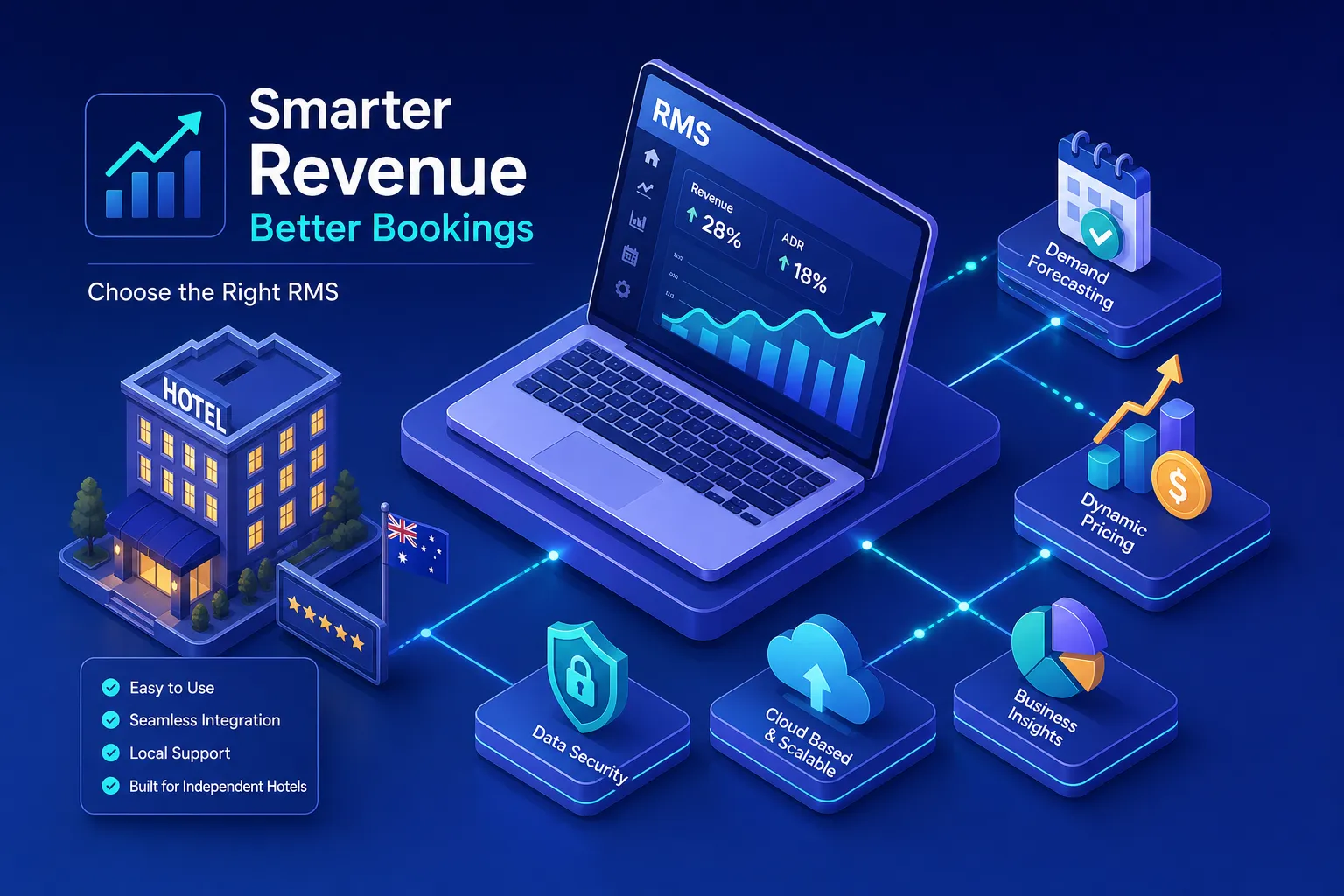
The best hotel revenue management software for independent Australian properties is not determined by the biggest marketing budget — it depends on your PMS stack, your inventory type, and how much automation your team wants versus how much it wants to approve. Build the shortlist by matching those factors to vendor capabilities. Key evaluation criteria are a working integration with your PMS and channel manager, full rate explainability, per-night demand forecasting with a documented accuracy measure, and a clear answer on how quickly approved rates reach SiteMinder, STAAH or whichever channel manager you use.
📋 What you will learn in this guide
- Why independent Australian hotels consistently underprice their rooms
- The real cost of pricing on a weekly schedule
- What real-time demand data reveals about booking behaviour
- Choosing the best hotel RMS for independent properties in Australia
- PMS and channel manager integrations that matter in Australia
- Explainability: why you need to know why the rate was set
- Bed-level pricing, LOS ladders, and brand rate guardrails
- AI-driven features that genuinely move the revenue needle
- What RevPAR uplift looks like in practice for Australian properties
- How Propeter supports nightly pricing for Australian independent hotels
- How to shortlist, trial, and commit to the right system
- Frequently asked questions
Why independent hotels consistently underprice their rooms
If you’re asking what is the best hotel revenue management software for independent properties in Australia, the honest answer is: it depends on your PMS stack, your inventory type, and how much automation your operation can absorb. Most independent hotels in Australia are still pricing their rooms much the same way they were a decade ago, a base rate, a peak season adjustment, and a gut-feel nudge when the phone stops ringing. Based on what we see across the market, that approach leaves measurable revenue on the table, and the gap compounds every week the practice continues.
Finding the best hotel revenue management software for independent Australian properties isn’t about picking the platform with the biggest marketing budget. It has a framework. Different properties have different PMS stacks, different inventory types, and different tolerance for automation. The right shortlist depends on matching those factors to vendor capabilities.
We built Propeter for exactly this type of property, so what follows is honest. We’ll tell you where our platform fits and where it doesn’t. By the end of this article, you’ll have a shortlist of two to three credible options and a clear process for trialling them.
The core problem is confidence, not data
The problem isn’t a lack of pricing tools. Most properties have access to rate data, comp-set reports, and occupancy dashboards. The real issue is confidence: in our experience, operators don’t trust the data enough to act on it nightly, so they fall back on a weekly review cycle that feels manageable but leaves significant revenue on the table. This is a process issue on the surface. Underneath it, it’s a trust issue.
The real cost of pricing on a weekly schedule
If you reprice once a week, you’re working with six days of missed demand signal per booking window. Events accelerate. Booking pace shifts. OTA competitor rates move. Consider a 30-room boutique hotel on the Gold Coast priced at a flat rack rate during a major event weekend. It isn’t just leaving money behind on Friday night — it’s leaving it behind on Thursday when compression starts, and again on Sunday when late demand is still strong but the rack rate has already signalled low value to bookers.
RevPAR erosion from missed compression nights is a frequent contributor to revenue loss for Australian independent hotels. It doesn’t show up as a single dramatic miss. It accumulates quietly across 52 weekends a year.
6
Days of missed demand signal per booking window on a weekly pricing schedule
52
Weekends per year where compression night revenue is being quietly eroded
What real-time demand data reveals about booking behaviour
A modern hotel revenue optimisation system sees things a human pricing manager typically misses: booking pace acceleration across a 90-day forward window, length-of-stay shifts as demand patterns change, and OTA competitor rate movements within 24-hour windows. These signals compound. Responding to them daily, rather than weekly, is what separates a property pricing at market ceiling from one perpetually priced below it.
What manual pricing misses every week
Booking pace acceleration happens within 48–72 hours of a demand trigger — a major event announcement, a competitor going unavailable, a weather forecast shift for a coastal property. A weekly repricing cycle cannot respond to a 72-hour signal. By the time the next manual review happens, the compression window has already passed.
Choosing the best hotel revenue management software for independent properties in Australia
Think of this section as a briefing before your demo calls. Not every feature matters equally, and the tools that deliver real results don’t always look the most impressive in a pitch deck. The criteria below separate tools that produce measurable RevPAR uplift from ones that simply automate the wrong decisions faster.
PMS and channel manager integrations that matter in Australia
Start here, because integration determines whether an RMS actually works or just adds a new manual workflow. The PMS platforms most commonly used by Australian independents include RMS Cloud, Mews, Cloudbeds, Opera Cloud, and Little Hotelier. On the channel manager side, SiteMinder, STAAH, RateGain, and Channex are the dominant players in the local market.
Any RMS without a native integration to your existing stack will slowly reintroduce the manual data entry you were trying to eliminate. Enterprise platforms often require custom integration scoping for smaller properties, which adds implementation time and cost before you see a single rate recommendation.
| Platform type | Common Australian examples | Integration requirement |
|---|---|---|
| PMS | RMS Cloud, Mews, Cloudbeds, Opera Cloud, Little Hotelier | Two-way integration: occupancy and reservation data in, approved rates out |
| Channel manager | SiteMinder, STAAH, RateGain, Channex | Frequent, reliable rate updates; ask how often approved rates reach each channel in practice |
| Booking engine | Direct website booking engine | Rates consistent with your OTA agreements; parity terms vary by contract, so check yours |
| Accounting | Xero (dominant in Australian SME market) | A supported connection rather than manual re-keying |
Explainability: you need to know why the rate was set, not just what it is
A black-box AI creates real risk for an independent operator. If the system sets $289 on a Tuesday in March and you can’t see the reasoning, you’ll override it. Every override signals a loss of confidence, and enough of them turn the RMS into expensive noise rather than a revenue tool.
Explainability isn’t a nice-to-have — it’s the adoption mechanism. In Propeter, each recommendation shows its calculation inputs (strategy formula, competitor snapshot, demand forecast, elasticity and guardrail adjustments) plus any risk flags, and your team approves before anything is published. When operators can see the reasoning, they trust the output, override less often, and the system starts working as designed.
The override problem in plain terms
A hotel that overrides a large share of its RMS recommendations is effectively running a manual pricing operation with an expensive assistant. Track the override rate from the first week. If it stays high, find out why: either the system is missing context your team has, or your team does not yet trust the reasoning. Explainability is what tells you which.
Bed-level pricing, length-of-stay ladders, and brand rate guardrails
These three criteria narrow the shortlist fast. Bed-level pricing matters for hostels and mixed-dorm properties — pricing at the room level in a dorm operation means averaging away the revenue opportunity in each individual bed. Length-of-stay ladders are critical for serviced apartments and vacation rentals where minimum-stay rules change the yield equation entirely.
Brand rate guardrails protect boutique hotels from inadvertently undercutting their own direct rates on OTA listings. Not every RMS handles all three. Knowing which ones your property needs will cut your shortlist from six vendors to two.
Bed-level pricing
- Essential for hostels
- Mixed-dorm properties
- Capsule hotels
- Shared accommodation
LOS ladders
- Serviced apartments
- Vacation rentals
- Extended-stay hotels
- Corporate apartment hotels
Brand rate guardrails
- Boutique hotels
- Heritage properties
- Lifestyle hotels
- Rate-positioned brands
All three
- Mixed-use properties
- Hotel groups
- Multi-segment inventory
- Complex room-type portfolios
AI-driven features that genuinely move the revenue needle
Most RMS platforms claim AI-powered pricing. Few deliver per-night granularity with documented accuracy. The distinction matters because sophisticated-sounding features don’t always translate to RevPAR outcomes. Here’s how to separate real capability from marketing copy.
Per-night demand forecasting versus rolling average pricing
Rolling-average tools smooth out demand signals and produce safe, conservative rates. They’re predictable, but they often price Thursday night identically to Friday night even when the underlying demand profile is entirely different. Per-night AI forecasting — the kind that functions as genuine dynamic pricing software for small hotels — uses machine-learning models to forecast each night separately. Propeter, for example, blends XGBoost and LSTM forecasts once enough booking history exists, at horizons out to 90 days, and its pricing pipeline runs hourly by default.
That granularity is what lets you price Thursday at $179 and Friday at $259 with data behind both decisions, not instinct. Whatever the model, ask every vendor for a documented forecast accuracy measure (for example, mean absolute percentage error by forecast horizon) from a property like yours, and how it was calculated. If they don’t have one, that’s informative.
Multi-OTA rate sync and the channel parity problem
Rate sync speed is consistently underrated in RMS evaluations. A 15-minute lag between your pricing decision and the OTA update window is enough for a competitor to capture demand at a higher rate during a compression event. Ask every vendor you demo how quickly approved rates reach SiteMinder, STAAH or your channel manager in practice, and whether any figure they quote is backed by a service-level commitment or is a marketing specification.
Also ask how the system enforces parity between your direct booking engine and OTA listings, because rate leakage on direct channels is a compounding cost that rarely appears on any single report. This is where solid hotel yield management tools earn their keep.
The demo question most Australian hoteliers forget to ask
“How quickly do approved rates reach SiteMinder and STAAH specifically — and is that backed by an SLA or a marketing specification?” If the account manager cannot answer clearly, that is itself an answer.
What RevPAR uplift looks like in practice for Australian properties
Published benchmarks from independent Australian hotels
Published vendor case studies give you a rough calibration point, but treat them carefully. IDeaS’s April 2014 press release on The Hotel Windsor reported a 9% RevPAR increase and a 4% ADR increase over five months at the 180-room Melbourne hotel. That is one hotel, in one market, reported by the vendor. Results from any system depend on how the property priced before, its data and its market, which is why the question below matters more than any headline figure.
All vendor case studies are vendor-authored. The most important question to bring to any demo is specific: “Can you show me before-and-after RevPAR data from a property similar to mine, in the same Australian market?” If the vendor can’t answer that clearly, adjust your confidence in their quoted figures accordingly.
Running a 90-day pilot: what to measure and why
Measure four things during a pilot: RevPAR versus same-period prior year, rate acceptance percentage, forecast accuracy variance, and time saved on manual pricing tasks. Rate acceptance percentage — how often your team accepts the system’s recommendations without overriding them; is the clearest signal of whether the platform is earning trust. A good pilot needs at least 30 days before drawing conclusions; demand signals need time to flow through the model. Use day 30 as a checkpoint and day 90 as your decision point.
| Metric | What it tells you | What good looks like | Review point |
|---|---|---|---|
| RevPAR vs STLY | Commercial outcome of the RMS decisions | Ahead of STLY after allowing for market movement | Day 30 and day 90 |
| Rate acceptance % | Whether the team trusts the system’s recommendations | High and rising through the pilot | Weekly during pilot |
| Forecast accuracy variance | How closely the RMS predicted actual demand | Stable or improving error at each horizon | Day 30 and day 90 |
| Time saved on manual pricing | Operational efficiency improvement | Measurable time recovered each week | Day 14 onwards |
How Propeter supports nightly pricing for independent Australian hotels
Illustrative example — not a customer result. Picture a 28-room boutique hotel in regional NSW running on RMS Cloud with SiteMinder managing OTA distribution, where the owner reprices twice a week from a spreadsheet. Here is how the workflow would change.
Recommendations and the Rate Engine in plain English
Propeter forecasts demand for each night, watches competitor rates and recommends a rate for each room type and date. The owner reviews the recommendations, approves them individually or in bulk, and approved rates are published back to RMS Cloud, which Propeter integrates with in both directions. Each recommendation can be opened to see what drove it. If Propeter recommends $179 for a standard room on a Friday night, the owner can see the inputs behind that figure: for example, the occupancy forecast, the comp-set median, and the guardrail cap. Direct booking quotes then run through a multi-stage Rate Engine (base rate, inventory, rate plans, promotions, loyalty, discount stacking, guardrails and tax), with a trace of every stage.
That transparency is what builds operator trust, and operator trust is what makes price optimisation software for hotels actually stick. Properties that can see the reasoning override far less often, which means the system compounds its learning rather than fighting against manual corrections.
Accounting: where Xero fits
Xero is widely used by Australian SMEs. Propeter connects to Xero, maps your chart of accounts per property and keeps accounting logs; the scope of automated posting is confirmed during implementation planning. Your PMS remains the system of record for reservations, folios and the night audit. Propeter is not a PMS and does not run the night audit.
Direct booking engine, loyalty tiers, and reducing OTA commission dependency
Propeter’s direct booking engine sits on the hotel’s own website and quotes from the same rate engine and guardrails, with 0% commission on direct bookings. Its loyalty module supports configurable tiers, points, referral rewards and member-only rates shown to signed-in guests (parity terms vary by OTA contract, so check your agreements). Together, these are designed to help shift the booking mix over time toward direct revenue at a lower cost of acquisition.
How to shortlist, trial, and commit to the right system
Pricing tiers and fit by property type and room count
SMB-oriented tools usually publish a monthly price based on room count; RoomPriceGenie’s pricing, for example, depends on room count and plan. Enterprise platforms typically do not publish pricing and require a custom quote and integration scoping. Propeter publishes its price: USD 5 per room per month, with all Propeter software modules included; implementation and setup are scoped and quoted separately. The cost of entry is clear before you sign anything.
How to trial hotel revenue management software for independent properties
The action path is straightforward.
1
Map your PMS and channel manager stack
Check each vendor’s integration directory against your existing RMS Cloud, Mews, SiteMinder, STAAH, or other platforms before booking a single demo call.2
Request an explainability demo from every shortlisted vendor
Ask them to show you a specific rate decision and trace it back to its source data — occupancy forecast, comp-set signal, guardrail application. If they cannot do this, remove them from the shortlist.3
Ask for the forecast accuracy figure
Request their documented mean absolute error from a comparable Australian property. A vendor without a specific, documented figure should not be trusted to quote RevPAR uplift percentages.4
Run a 30-day pilot measuring the four key metrics
RevPAR versus same-period prior year, rate acceptance percentage, forecast accuracy variance, and time saved on manual pricing tasks. Do not draw conclusions before day 30.5
Use day 90 as your decision point
Not day 30. Demand signals need time to flow through the model. A platform that is working will show compounding improvement between day 30 and day 90 — not just an initial spike.
If you would like to talk through whether Propeter fits your PMS and channel manager, contact us. If it doesn’t fit, the steps above still work for evaluating whoever does.
The right hotel revenue management software for independent properties in Australia integrates cleanly with your existing stack, explains every rate decision in plain terms, and shows measurable progress against a baseline during a defined pilot. Test explainability before you trust automation. Measure the right metrics during a pilot. Prioritise integration depth over feature breadth.
See how Propeter explains every rate
Book a demo to see a recommendation traced from forecast to guardrail, set up for a property like yours. Or start with the RevPAR calculator on your own numbers.
Frequently asked questions
What is the best hotel revenue management software for independent properties in Australia?
The best hotel revenue management software for independent Australian properties depends on your PMS stack, your inventory type, and how much automation your operation can absorb. The right shortlist is built by matching those three factors to vendor capabilities — not by picking the platform with the biggest marketing budget. Key evaluation criteria are a working integration with your PMS and channel manager (for example RMS Cloud, SiteMinder or STAAH), full rate explainability, per-night demand forecasting with a documented accuracy measure, and a clear, honest answer on how quickly approved rates reach your channels.
Why do independent Australian hotels consistently underprice their rooms?
The problem is not a lack of pricing tools. Most properties have access to rate data, comp-set reports, and occupancy dashboards. The real issue is confidence — operators don’t trust the data enough to act on it nightly, so they fall back on a weekly review cycle that feels manageable but leaves significant revenue on the table. This is a process issue on the surface. Underneath it, it’s a trust issue. Explainability — seeing exactly why the RMS set a specific rate — is what resolves the trust gap and drops the override rate.
What does rate explainability mean in hotel revenue management software?
Rate explainability means the RMS shows you the full reasoning behind every rate it sets — which demand signals triggered which adjustments, which stage of the pricing engine applied, and what guardrails resolved the final number. A black-box AI that sets $289 on a Tuesday with no visible reasoning will be overridden constantly. Explainability is the adoption mechanism: when operators can see the reasoning, they trust the output, override rates drop, and the system compounds its learning rather than fighting against manual corrections.
What PMS platforms do Australian independent hotels commonly use?
The PMS platforms most commonly used by Australian independent hotels include RMS Cloud, Mews, Cloudbeds, Opera Cloud, and Little Hotelier. On the channel manager side, SiteMinder, STAAH, RateGain, and Channex are the dominant players in the local market. Any RMS without a native integration to your existing stack will slowly reintroduce the manual data entry you were trying to eliminate — and enterprise platforms often require custom integration scoping for smaller properties, which adds implementation time and cost before you see a single rate recommendation.
What is per-night demand forecasting and why does it matter for Australian hotels?
Per-night forecasting predicts demand for each date separately, typically with machine-learning models such as XGBoost or LSTM networks, instead of smoothing demand into a rolling average. Rolling-average tools produce conservative rates and often price Thursday night identically to Friday night even when the underlying demand profile is entirely different. Per-night forecasting lets you price Thursday at $179 and Friday at $259 with data behind both decisions, not instinct. Ask any vendor for a documented forecast accuracy measure from a comparable Australian property and how it was calculated. If they don’t have one, that is informative.
How fast should an RMS sync rates to OTAs for Australian hotels?
Rate sync speed is consistently underrated in RMS evaluations. A 15-minute lag between your pricing decision and the OTA update window is enough for a competitor to capture demand at a higher rate during a compression event. Ask every vendor how quickly approved rates reach SiteMinder, STAAH or your channel manager in practice, and whether any figure they quote is backed by a service-level commitment or a marketing specification. Also ask how the system keeps your direct booking engine consistent with your OTA listings — rate leakage on direct channels is a compounding cost that rarely appears on any single report.
What should I measure during a 90-day hotel RMS pilot?
Measure four things during a pilot: RevPAR versus same-period prior year, rate acceptance percentage (how often your team accepts the system’s recommendations without overriding them), forecast accuracy variance, and time saved on manual pricing tasks. Rate acceptance percentage is the clearest signal of whether the platform is earning trust. A good pilot needs at least 30 days before drawing conclusions — demand signals need time to flow through the model. Use day 30 as a checkpoint and day 90 as your decision point. Do not commit or cancel before day 90.
What are brand rate guardrails in hotel revenue management software?
Brand rate guardrails protect boutique hotels from inadvertently undercutting their own direct rates on OTA listings. They set a minimum rate floor below which the RMS will not price — protecting the property’s market positioning and preventing the race-to-the-bottom dynamic common during low-occupancy periods. Not every RMS handles guardrails properly. Knowing whether your property needs bed-level pricing, LOS ladders, or brand rate guardrails will cut your shortlist from six vendors to two.
How does Propeter work for Australian hotels?
Propeter is a revenue management and pricing system that works with your PMS. It forecasts demand, monitors competitor rates and recommends a rate for each room type and date, showing the inputs behind each recommendation (for example the occupancy forecast, comp-set median and guardrail cap). Your team reviews and approves recommendations individually or in bulk, and approved rates are published through your connected PMS (Propeter integrates with RMS Cloud in both directions). Direct booking quotes run through a multi-stage Rate Engine with a trace of every stage. That transparency builds operator trust and reduces override rates.
Does Propeter integrate with Xero for Australian hotel accounting?
Propeter connects to Xero: you can connect your Xero organisation, map your chart of accounts per property and keep accounting logs. The scope of automated posting is confirmed during implementation planning. Invoicing, folios and the night audit remain in your PMS, which stays your system of record.
Is IDeaS or Duetto suitable for a small independent Australian hotel?
IDeaS and Duetto both serve independent hotels as well as chains, but neither publishes pricing, so you need a custom quote and integration scoping. Smaller properties often find SMB-oriented tools with published monthly pricing easier to evaluate. Propeter publishes its price: USD 5 per room per month, with all Propeter software modules included; implementation and setup are scoped and quoted separately.
What RevPAR uplift can Australian independent hotels expect from an RMS?
Published figures are vendor case studies, so use them as rough calibration only. IDeaS’s April 2014 press release on The Hotel Windsor reported a 9% RevPAR increase and a 4% ADR increase over five months at The Hotel Windsor in Melbourne. Results depend on how the property priced before, its data and its market. The most important question to ask any vendor: “Can you show me before-and-after RevPAR data from a property similar to mine, in the same Australian market, and how was the baseline set?”
About this guide
Written by the Propeter team for independent hotels and hotel groups in Australia. Third-party figures are linked to their source. Last reviewed: October 2026.
Related Articles

Propeter vs Competitors: Which Hotel Revenue Management Solution Wins?
Propeter is a revenue management and pricing system for hospitality that works with your PMS, with a direct booking engine, guest CRM, loyalty…

Low Season Hotel Strategy: Maximize Occupancy & Revenue (2026)
Maximising hotel occupancy and revenue in low season is not about discounting your…

Best Practices for Integrating PMS and Revenue Management Systems (2026)
Integrating your Property Management System (PMS) with a Revenue Management System (RMS) means…
Transparent pricing
USD 5 per room per month, all Propeter software modules included. Implementation is scoped and quoted separately.