
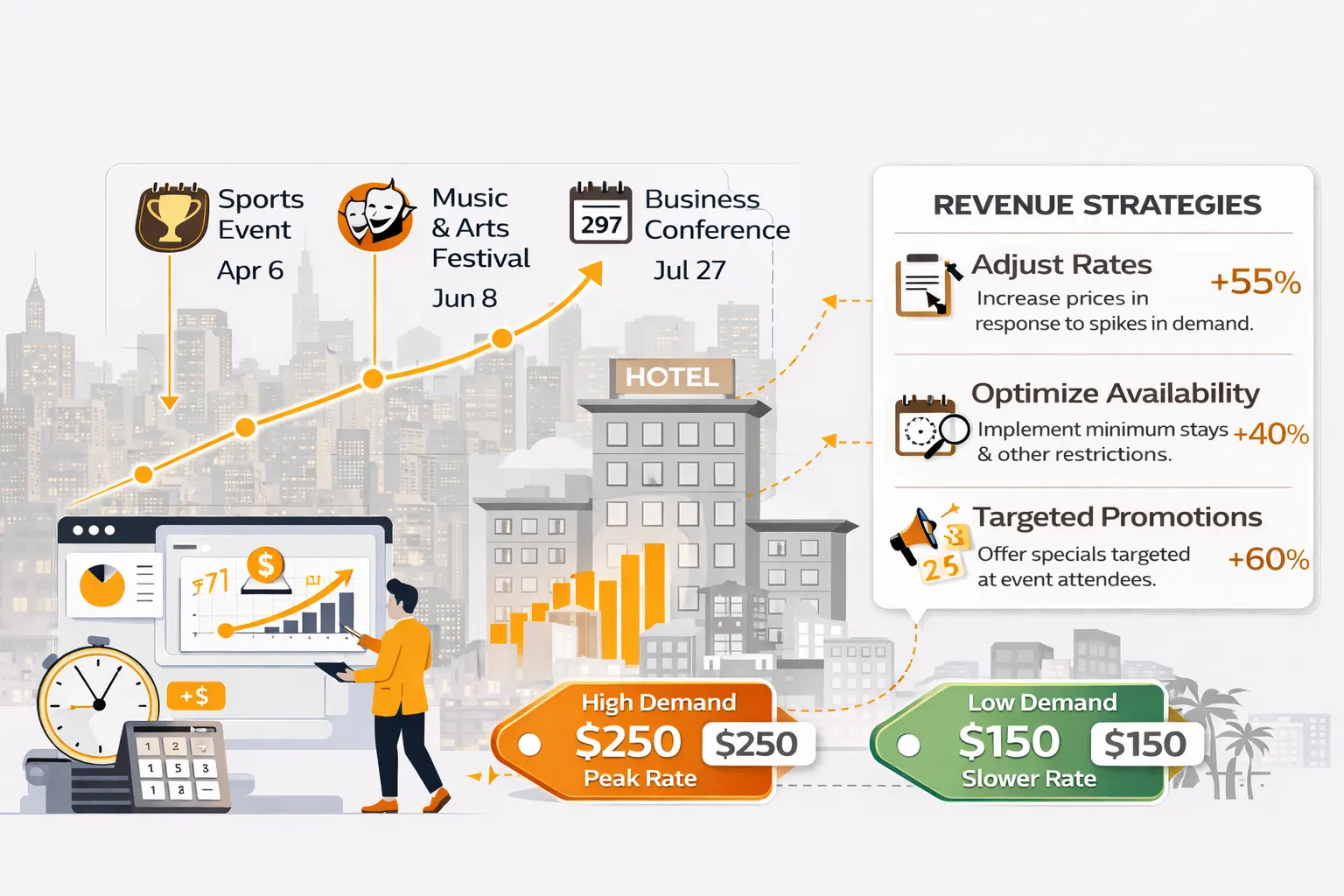
Local events create localised room scarcity, shifting the market’s price elasticity and allowing hotels to price more assertively for the affected dates. When a major concert, sports tournament or convention is announced, forward-looking revenue teams and systems watch leading indicators — booking pace against the same lead time last year, compset closures and rate moves, event calendars — and lift rate floors before inventory is depleted. To protect yield during these periods, hoteliers pair rate increases with revenue controls such as non-refundable deposit fences and minimum length-of-stay (MinLOS) restrictions, which protect margin and reduce late-cancellation risk.
Table of Contents
- The Real Impact of Events on Hotel Demand
- Types of Events and Their Demand Profiles
- Minimum Stay Strategies During Events
- The Rate Ratchet: How to Escalate Pricing as Events Approach
- Competitor Monitoring During High-Demand Periods
- Balancing Group and Transient Business
- AI Event Detection and Automated Response
- Frequently Asked Questions
Events are the most powerful demand drivers in hotel markets. A sold-out stadium concert, a major industry conference, or a championship sporting final can compress months of normal demand into a single weekend — pushing occupancy to 100% across an entire market and enabling rate levels that would be unimaginable in ordinary conditions.
Yet events also represent some of the most commonly mismanaged revenue opportunities in hospitality. Hotels that fail to anticipate event demand early enough get locked out of premium rates. Hotels that raise rates too aggressively alienate guests and attract cancellations. Hotels that ignore minimum stay strategies fill up with single-night bookings that displace higher-value multi-night stays. Getting event pricing right requires a systematic strategy — and, increasingly, AI-powered tools to execute it with precision.
50–300%
Typical rate premium achievable above baseline during major events
The Real Impact of Events on Hotel Demand
Events impact hotel demand through a combination of compressed timing, geographic concentration, and price-insensitive booking behaviour. Attendees at a major sporting event or music festival often have little flexibility in their travel dates — they must be there on specific days, and they know accommodation will be scarce. This combination of date-locked demand and supply scarcity fundamentally changes the price elasticity equation for hotels in the affected market.
Unlike leisure demand, where guests will shift travel dates if rates are unattractive, event demand is largely date-inelastic. A Taylor Swift concert ticketholder who has already purchased a $400 ticket is not going to change their travel dates because your hotel raised rates from $150 to $280. The event creates demand that is effectively captive within a narrow date window, giving hoteliers genuine pricing power that they rarely have in ordinary conditions.
Early Detection Is Everything
The hotels that capture the most revenue from events are not the ones with the highest rates — they are the ones who detected the demand signal earliest and filled their inventory with premium-rate advance bookings before the market tightened. By the time most guests are searching, the best-managed properties are already 60–70% sold at elevated rates.
Types of Events and Their Demand Profiles
Not all events create the same demand profile, and pricing strategies should be calibrated accordingly. Understanding the demand characteristics of different event types is essential to setting the right rates and restrictions.
Concerts and Music Festivals
Large-scale concerts and music festivals typically generate sharp, concentrated demand around one to three nights. The demand window is predictable once the event is announced, and booking pace tends to accelerate in two waves: immediately after tickets go on sale, and in the two to three weeks before the event as last-minute attendees secure accommodation. Hotels within walking distance of the venue capture a significant proximity premium.
Conferences and Trade Shows
Industry conferences and trade shows create more spread-out demand, typically spanning three to five nights, with a higher proportion of corporate travellers. Corporate travellers have higher rate tolerance than leisure guests and often book on company accounts with less price sensitivity. However, conference demand is also more vulnerable to cancellation — corporate travel policies and event schedule changes can cause booking patterns to shift significantly within the 30-day window.
Sporting Events
Major sporting events — championship finals, international fixtures, major tournaments — combine high price insensitivity with significant uncertainty about which specific dates will be high-demand (particularly for knockout tournaments where the schedule depends on results). Hotels near major sporting venues need event intelligence pipelines that can detect schedule confirmations and adjust pricing within hours.
Public Holidays and School Breaks
While not events in the traditional sense, public holidays and school holiday periods create predictable, broad demand spikes that share many characteristics with event demand — high occupancy, elevated ADR potential, and guests with fixed travel windows. The difference is that these periods are known far in advance and should be priced aggressively from the moment the calendar is set.
Minimum Stay Strategies During Events
Minimum length of stay (MinLOS) restrictions are one of the most powerful tools in the event revenue management toolkit — and one of the most frequently misapplied. The principle is simple: during high-demand periods where you could fill your hotel many times over, you want to prioritise multi-night bookings that generate more total revenue per room over the demand window.
Without MinLOS, a hotel approaching a high-demand event weekend risks filling up with single-night bookings on the peak night — Friday or Saturday — while leaving Thursday and Sunday nights empty. A guest who books only Saturday fills your inventory for the highest-demand night but blocks the room from a guest who might have stayed Thursday through Sunday at elevated rates across the full window.
How to Set MinLOS for Events
- Anchor to the event duration: If an event runs Saturday–Sunday, consider a 2-night MinLOS starting Friday to protect the full event window.
- Use shoulder-night MinLOS strategically: Setting MinLOS on the shoulder nights (not just the peak night) prevents partial-stay cherry-picking.
- Release restrictions as the event approaches: If unsold inventory remains 7–10 days from the event, relax MinLOS to capture late bookers rather than leaving rooms empty.
- Segment by room type: Consider applying stricter MinLOS to higher-demand room categories while leaving more flexible restrictions on room types with softer demand.
The Rate Ratchet: How to Escalate Pricing as Events Approach
The rate ratchet strategy treats event pricing as a dynamic escalation process rather than a one-time decision. Rates are set at a premium level immediately after event announcement and escalated upward in stages as the event approaches and available inventory decreases. The logic mirrors airline pricing — early bookers get slightly lower rates than late bookers, but even early-bird rates are meaningfully above baseline.
A typical rate ratchet for a major event might look like this: rates open at 150% of baseline when the event is announced (6–12 months out), step up to 200% at 3 months, to 250% at 6 weeks, and to 300%+ in the final 2 weeks as remaining inventory becomes scarce. These levels depend on event size, market supply, and historical demand data — but the underlying principle of upward escalation tied to inventory availability is consistent.
The Ratchet Only Works One Way
A common mistake is rate ratcheting up and then discounting backward when early pickup is slower than expected. This destroys guest trust and signals to OTA algorithms that your property has availability problems. If early pickup is slow, review your MinLOS and distribution strategy before dropping rates — rate drops are very difficult to reverse once guests see them.
Competitor Monitoring During High-Demand Periods
Events create intense competitive dynamics. Every property in the affected market is simultaneously trying to capture demand from the same pool of price-insensitive guests. Competitive positioning during events requires more frequent monitoring than usual — a competitor that closes availability or sharply raises rates on an event date changes the demand equation for every other hotel in the market.
When competitors sell out for an event date, the remaining available hotels in the market inherit that displaced demand. A revenue manager who detects a competitor sellout early can aggressively push rates upward, knowing that the demand pool has just been concentrated among fewer properties. This is one of the most important use cases for competitive intelligence — and one where automated monitoring, such as Propeter’s competitor rate tracking, gives the quickest payoff in a revenue manager’s day.
Balancing Group and Transient Business During Events
Events frequently trigger both group booking inquiries and individual transient demand. A conference brings delegate blocks. A sporting event brings corporate hospitality groups. Managing the inventory allocation between group and transient business is a critical event revenue decision — one with long-term consequences that can be difficult to reverse.
Group contracts negotiated months in advance typically lock in rates below the event-period market rate. Holding too much inventory in group blocks for an event prevents you from capturing peak transient rates in the final weeks. Hotels need to balance the certainty of group revenue (booked early, no last-minute availability risk) against the higher ceiling of transient event rates (bookable closer in, but subject to pickup risk).
Group Displacement Analysis
Before accepting a group booking for an event period, perform a group displacement analysis: what is the estimated value of the transient bookings you would displace if you accepted this group block at the group’s proposed rate? If the group rate is materially below projected transient rates for the event period, declining or renegotiating the group contract will generate more total revenue despite the pickup risk.
AI Event Detection and Automated Response
Manually tracking the event calendar across a market is a significant operational burden — particularly for hotels in active event markets with dozens of events per year across sports, music, conferences, and public holidays. AI-powered revenue management platforms solve this by automating event detection and pricing response.
Local events up to 365 days ahead (via PredictHQ, where enabled) are scored and fed into demand forecasts. When an event or an unusual pickup pattern lifts projected demand for specific dates, those dates are flagged for attention in the forecast and in the rate recommendations.
The demand forecast incorporates event signals into projected occupancy for the affected dates, and the pricing engine translates that into specific rate recommendations, with suggested minimum-stay and inventory controls. Your team reviews and approves the recommendations, individually or in bulk, and approved rates are published through your connected PMS and distribution systems.
This means the people pricing the hotel do not have to detect every event by hand, build pricing scenarios from scratch and re-key rate plans across multiple OTA extranets. The system does the detection and preparation continuously; the team keeps the decision.
Frequently asked questions
How do hotels protect revenue if a major local event is abruptly canceled?
To protect revenue against sudden event cancellations, hotels must enforce rigid “Non-Refundable” and “Advance Purchase” rate fences specifically for high-demand dates. By anchoring these restrictions to the booking confirmation rather than standard flexible windows, the property legally secures its cash flow and room yields even if the underlying demand driver (such as a music festival or sports match) is postponed or called off.
What is group displacement math, and why is it critical during city-wide events?
Group displacement math is a calculation revenue managers use to determine if accepting a lower-rated group booking during an event window will displace higher-paying transient guests. If a corporate group requests 50 rooms at a discounted rate of $150 during an event where public market demand could easily yield $300 per night, the displacement analysis will signal a net loss, instructing the hotel to either decline the group or quote a higher premium rate.
Can aggressive minimum-stay rules during local events hurt a hotel’s map search visibility?
Yes, over-tightening minimum length of stay (MinLOS) or Closed-to-Arrival (CTA) rules can temporarily lower your visibility on OTA and Google Travel map results. When search engines run queries for shorter stay windows (e.g., a single-night stay) and your property returns zero availability due to a strict 3-night minimum constraint, the algorithm filters your listing out, suppressing your long-term organic placement for that geographic area.
How much can events increase hotel room rates?
Major events can increase hotel room rates by 50–300% above baseline, depending on the size and scarcity of the event. A sold-out stadium concert or major sporting final in a market with limited hotel supply can push ADR to multiples of the normal rate. The key is detecting the demand signal early enough to capture premium rates before availability tightens across the market.
What is a minimum length of stay restriction and when should hotels use it during events?
A minimum length of stay (MinLOS) restriction requires guests to book for a minimum number of nights to qualify for a rate. During high-demand events, MinLOS prevents single-night cherry-picking that would block multi-night bookings at premium rates. For example, if a major event runs Friday–Sunday, setting a 2-night MinLOS from Thursday maximises total revenue from the demand window.
How far in advance should hotels adjust pricing for known events?
Hotels should begin adjusting event pricing as soon as an event is confirmed — often 6–12 months in advance for major recurring events like annual sports fixtures or festivals. Early rate adjustments capture price-insensitive advance bookers at premium rates. Waiting until the event month to raise rates means competing with already-tightened market inventory and missing the highest-margin bookings.
How does Propeter detect and price for upcoming events?
Local events up to 365 days ahead (via PredictHQ, where enabled) are scored and fed into demand forecasts. Booking-pace anomalies add a second signal. The forecast adjusts projected demand for the affected dates, and Propeter recommends rates, minimum-stay restrictions and inventory controls for your team to approve, aiming to capture event revenue while protecting shoulder-night performance.
Never Miss Another Event Revenue Opportunity
Propeter brings event calendars and booking-pace signals into its demand forecasts and recommends rates, restrictions and inventory controls for the affected dates — your team reviews and approves before anything is published.
Related Articles
Practical ways revenue management solution scan boost your hotel’s RevPAR
Revenue management solutions boost hotel RevPAR by replacing slow manual repricing with an…

Low Season Hotel Strategy: Maximize Occupancy & Revenue (2026)
Maximising hotel occupancy and revenue in low season is not about discounting your…
Pricing Parity Strategies for Hotels: Managing Rate Consistency Across Channels
A hotel pricing parity strategy is a legal and commercial commitment to maintain…
Try a demand forecast
See how pickup, seasonality and events combine into a forward demand view.