
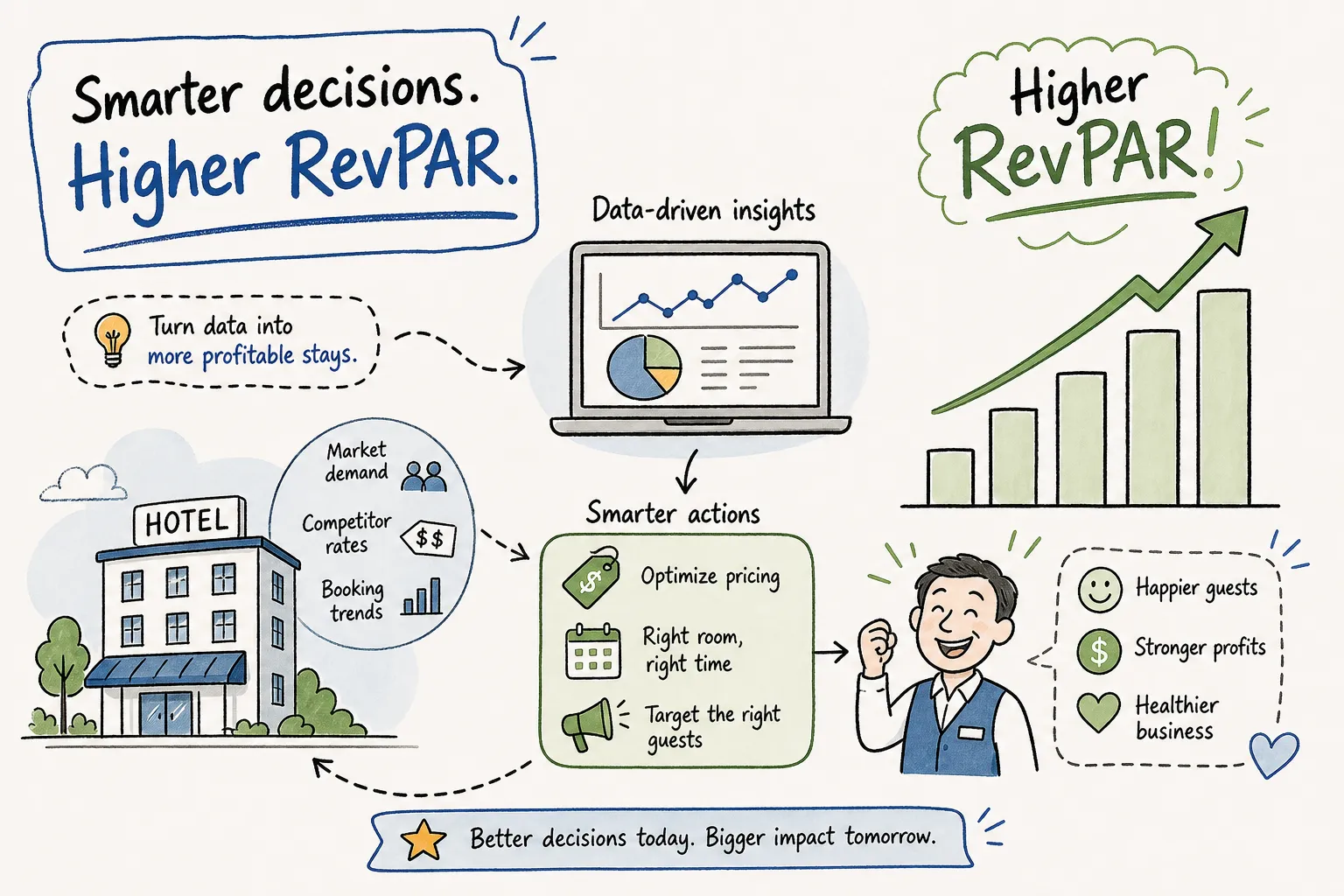
Revenue management solutions boost hotel RevPAR by replacing slow manual repricing with four connected functions: dynamic pricing, demand forecasting, competitor rate monitoring and direct booking optimisation. For Indian boutique hotels, resorts and serviced apartments, the right system also needs to handle length-of-stay pricing, Indian festival and event demand, and a clean data flow to the PMS and accounting tools that handle GST. How much RevPAR improves depends on your starting point, data quality and market, so model it on your own numbers rather than relying on headline percentages.
📋 What you will learn in this guide
- What AI-driven revenue management software actually does
- Dynamic pricing and how it differs from manual rate updates
- Demand forecasting and competitor intelligence working together
- Direct booking optimisation as a revenue protection lever
- Why Indian properties need a purpose-built revenue management system
- LOS-aware pricing, bed-level rates, and event-driven price lifts
- GST compliance, Xero accounting, and multi-OTA sync requirements
- How Propeter approaches revenue management for Indian properties
- Core features that separate strong platforms from average ones
- How to evaluate vendors and run a demo that gets real answers
- Pricing models, ROI and what realistic implementation looks like
- Where to start this week
- Frequently asked questions
Revenue management solutions help Indian hotels close the RevPAR gap created by slow, manual repricing. OTA commissions can be substantial, often running into double-digit percentages, while competitors in the same market adjust their rates multiple times a day. Most independent hotels still update prices on Monday mornings, or whenever the front desk manager has a free hour. This gap can reduce RevPAR meaningfully over time; the effect is directly visible in your monthly numbers.
Modern revenue management software has moved well past spreadsheet-based yield management. For Indian boutique hotels, resorts and serviced apartments, the right platform can make a meaningful difference to RevPAR, though outcomes vary with property type, data quality and how consistently the team uses it. The platforms available now are not incremental upgrades to the old model: they forecast demand, watch the market and recommend rates every day, instead of waiting for someone to find a free hour.
What AI-driven revenue management software actually does
A modern revenue management system does four things continuously: dynamic pricing, demand forecasting, competitor rate monitoring, and direct booking optimisation. The distinction from older tools is that these are not separate dashboards you check independently. They run as a connected pipeline, with each layer feeding the next.
Dynamic pricing
- Reads booking pace live
- Recommends rate changes
- Not weekly — continuously
- Responds to demand spikes
Demand forecasting
- Forward view of the coming weeks and months
- Segment-level curves
- Local event calendars
- Competitor availability patterns
Competitor intelligence
- Scheduled rate monitoring
- Feeds rate recommendations
- Not just an alert
- Pre-set strategy logic
Direct booking optimisation
- Protects rate floor
- Converts OTA guests
- Improves net RevPAR
- Reduces commission dependency
Dynamic pricing and how it differs from manual rate updates
The core mechanism is straightforward. The system reads your booking pace, current occupancy, competitor rates, and live demand signals, then recommends room price changes every day — not weekly. Consider a 40-room boutique hotel in Jaipur as an illustration: it reprices three times a day based on real occupancy data, while a competitor sets rates on Monday and leaves them unchanged. By Thursday, when a corporate group books out three nearby properties and demand spikes, the manual hotel is still running Monday’s rate. The AI-driven property has already captured the uplift. That gap can compound meaningfully across a full year.
The Monday pricing problem — what it costs across 52 weeks
Most independent Indian hotels still update prices on Monday mornings, or whenever the front desk manager has a free hour. By Thursday of the same week, when demand signals have shifted — a corporate group arrives, a competitor goes unavailable, a festival booking window opens — the manual hotel is priced at Monday’s rate. Across 52 weeks, the compounding cost of six missed days of demand signal per cycle is directly visible in monthly RevPAR numbers.
Demand forecasting and competitor intelligence working together
Genuine forecasting is not the same as checking last month’s occupancy. A capable revenue management system uses historical booking data, segment-level demand curves, local event calendars, and competitor availability patterns to predict demand four to six weeks ahead. When competitor intelligence is layered on top, the system does not simply generate an alert asking you to reprice. It turns the signal into a recommended rate change based on your strategy rules, ready for review.
Forecasting at segment level — why aggregates mislead
A strong revenue management system forecasts at segment level, not just in aggregate, because a corporate segment and a leisure segment behave very differently on the same dates. A blanket occupancy forecast that blends the two produces a rate that is wrong for both segments. Segment-level forecasting is what separates genuine demand intelligence from a more sophisticated occupancy report.
Direct booking optimisation as a revenue protection lever
OTA commissions consume margin on every booking they generate, even when a guest has stayed with you three times before. A revenue management platform integrated with a direct booking engine protects your rate floor and converts OTA-acquired guests into direct repeat bookers over time. This improves net RevPAR — not just gross RevPAR — and net RevPAR is the number that actually determines profitability.
Net RevPAR vs gross RevPAR — the number that actually matters
Gross RevPAR is room revenue divided by available rooms. Net RevPAR deducts OTA commissions and distribution costs. A hotel with a gross RevPAR of ₹4,200 paying 18% OTA commission on 70% of its bookings has a net RevPAR closer to ₹3,670. Revenue management that improves your direct booking mix does not just show up in the rate — it shows up in the margin.
Why Indian properties need a purpose-built revenue management system
Generic global platforms are often built for large chain properties in mature Western markets. They assume a dedicated revenue manager, a standardised PMS, and a regulatory environment where GST compliance is not a daily operational variable. Indian hotel operators face a different set of realities, and the platform needs to reflect that.
| Indian market requirement | Why generic global platforms miss it | What purpose-built looks like |
|---|---|---|
| GST compliance | GST invoicing sits in the PMS and accounting system; disconnected tools mean re-keying revenue data | Clean, consistent data flow between the RMS, the PMS that issues invoices and the accounting system |
| Indian festival event detection | Event calendars calibrated for Western markets — IPL, Diwali, Kumbh Mela absent or inaccurate | Indian festival, pilgrimage and regional demand periods included in forecasts well ahead of arrival |
| LOS-aware pricing | Room-level pricing without length-of-stay profitability calculation for serviced apartments | LOS trade-off evaluation: longer stay vs multiple short stays, including turnover cost |
| Bed-level pricing | Room-level pricing only — dorm hostel revenue opportunity averaged away | Per-bed dynamic pricing independent from private room stack |
| Multi-OTA sync speed | Batch update cadence — hours between pricing decision and OTA rate live | Frequent rate updates through your PMS and channel manager |
| No dedicated revenue manager | Enterprise tools assume a trained RM reviews the system daily | Clear, explained recommendations a GM can review and approve quickly, within guardrails |
LOS-aware pricing, bed-level rates, and event-driven price lifts
For serviced apartments and vacation rentals, length-of-stay pricing is not a feature to explore later. A 7-night booking at a slightly lower nightly rate is often more profitable than two 3-night bookings once you account for turnover costs and cleaning — since each changeover adds housekeeping time and consumables. The system should evaluate that trade-off for you, not leave it to a manual calculation. For hostels, bed-level dynamic pricing is a separate discipline entirely: a 10-bed dorm requires its own pricing logic, independent from the private room stack.
Event-driven price lifts are equally non-negotiable. IPL match weekends, Diwali, Onam, Durga Puja, Kumbh Mela, major corporate conference weeks, and destination wedding clusters create predictable demand compression windows. A capable revenue management solution identifies these four to six weeks ahead and adjusts pricing accordingly. Acting on the day the event starts is too late; the inventory has already been captured by properties that moved earlier.
The event timing problem most Indian hotels get wrong
Acting on the day an event starts is too late. Demand compression during IPL weekends, Diwali, and major corporate conference weeks builds 4–6 weeks ahead in booking pace data. A revenue management system that detects this signal and adjusts pricing before the window closes captures the full compression opportunity. A manual hotel that notices full occupancy on the day of the event cannot recapture the rate it should have held two weeks earlier.
GST compliance, Xero accounting, and multi-OTA sync requirements
GST reporting creates real operational friction when your accounting system is disconnected from your booking and pricing stack. In most hotels, GST invoices, including GSTIN-linked invoices for B2B corporate bookings, are issued from the PMS, and many Indian properties keep their books in Tally rather than Xero. A revenue management system does not replace either. What it should do is fit cleanly into that flow: rates and revenue data should match what the PMS and accounting system record, so your accounts team is not reconciling two versions of the truth. Ask every vendor exactly which accounting system they connect to and what data moves.
For operators selling across several OTAs, frequent rate updates through the channel manager are a baseline requirement, because stale rates on one channel create parity problems and lost bookings on others. Ask how often approved rates reach each channel in practice, and through which system.
How Propeter approaches revenue management for Indian properties
Propeter is a revenue management and pricing system that works with your existing PMS. It forecasts demand, monitors your market and competitor rates, and recommends a rate for each room type and date, showing the reasons behind it. Your team reviews and approves recommendations individually or in bulk, and approved rates are published through your connected PMS and distribution systems.
What runs under the hood
Forecasting, price-elasticity and RevPAR pipelines feed a pricing engine with a policy gate. The pipeline runs on a schedule (hourly by default), so recommendations are refreshed overnight and the morning review starts from current conditions rather than last week’s.
Data in
- PMS booking data
- Competitor rate data
- Occupancy signals
- Historical demand
Market intelligence and forecasting
- Competitor rate monitoring
- Market demand signals
- Forward demand forecast
- Segment-level curves
Elasticity and RevPAR
- Price elasticity modelling
- RevPAR optimisation
- Rate recommendation
- Guardrail application
Explanation and approval
- Calculation breakdown
- Why each rate was recommended
- Approve individually or in bulk
- Audit trail
The Rate Engine: from base rate to guardrails
The Rate Engine processes direct booking quotes through a multi-stage sequence that covers base rate, inventory, rate plans, promotions, loyalty and discount stacking, and rate guardrails (floors, ceilings and maximum discounts). The system includes a trace mode: operators can see exactly why any rate was set, which stage influenced the final price, and what guardrail applied. This matters for ownership-level scrutiny and for building trust in the system’s decisions over time.
What a RevPAR improvement is worth: an illustration
Illustrative example — not a customer result. A 30-room boutique hotel at ₹5,500 ADR and 68% occupancy has a RevPAR of about ₹3,740. Every 1% of RevPAR is worth roughly ₹37 per available room night, or about ₹4.1 lakh a year across 30 rooms (30 × ₹37.4 × 365). That sensitivity is the useful number: it tells you what each point of improvement is worth before you look at any vendor’s claims. Use the RevPAR calculator or ROI calculator to run it on your own figures.
Core revenue management solution features that separate strong platforms from average ones
When you are comparing platforms, the feature lists look similar at a high level. The difference is in the depth of each capability and whether the integrations hold together under real operating conditions.
Forecasting depth, channel management, and competitive intelligence
Basic demand reporting tells you what happened last week. Genuine forecasting tells you what demand will look like by segment, by room type, and by channel over the next six weeks. A strong revenue management system forecasts at segment level, not just in aggregate, because a corporate segment and a leisure segment behave very differently on the same dates. Channel management should support independent pricing by room type and channel, not uniform rate pushes. And competitive intelligence should feed straight into rate recommendations, not just alerts that add to your to-do list.
Integration completeness: PMS, OTA, accounting, and loyalty
Integration depth determines real-world ROI more than any individual feature. A platform that syncs rates across OTAs but disconnects from the PMS forces double entry and creates reconciliation errors. A platform that does not fit your accounting flow means your accounts team reconciles manually. A platform without a guest loyalty programme means you keep paying OTA commissions for guests who have already stayed with you — guests you could be converting to direct bookers.
The integrations that matter are: PMS, channel manager, direct booking engine, accounting and a structured loyalty programme with enough engagement mechanics to actually change guest behaviour. Propeter is a revenue management and pricing system that works with your PMS and alongside your channel manager; its direct booking engine and loyalty modules are included in the per-room price, and it connects to Xero for per-property GL mapping.
| Integration layer | What breaks without it | How Propeter fits |
|---|---|---|
| PMS | Double data entry, reconciliation errors, stale occupancy signals in rate engine | Works with your PMS; the data exchanged is confirmed per PMS during implementation planning |
| Channel manager / OTA | Rate parity violations, delayed updates, competitor captures demand during lag window | Distributes approved pricing through supported PMS and channel connectivity, alongside your channel manager |
| Direct booking engine | Rate floor unprotected, OTA guests not converted to direct, commission dependency unchanged | Included: direct booking engine connected to the rate engine and guardrails |
| Accounting (GST) | Manual invoice creation, CGST/SGST reconciliation errors, B2B GSTIN correction requests nightly | Xero connection with GL mapping per property; GST invoicing stays in your PMS and accounting system |
| Loyalty programme | Repeat guests rebooked through OTA, commission paid again, no direct relationship built | Included: configurable tiers, points and member rates |
How to evaluate vendors and run a demo that gets you real answers
Most vendor demos show you the best-case scenario on a clean dataset. Surfacing the gaps before you sign a contract means asking the right questions. Here is where to start.
Questions worth asking before you book a demo
Ask these five questions directly, and listen for specific answers rather than general reassurances:
1
Does the system support bed-level pricing, or only room-level pricing?
For hostels and mixed-dorm properties, room-level pricing averages away the revenue opportunity in each individual bed. A 10-bed dorm requires its own pricing logic, independent from the private room stack.2
How does the rate logic handle length-of-stay rules?
Does it evaluate LOS profitability automatically, or does that require manual rate plan configuration? For serviced apartments and vacation rentals, the answer to this question determines whether the platform is viable for your property type.3
Does the event detection engine cover Indian festivals, pilgrimage windows, and regional demand surges?
Or is it calibrated primarily for Western markets? Ask the vendor to show you specifically how IPL, Diwali, and Kumbh Mela are handled in the event calendar.4
How does the system fit your GST invoicing for B2B bookings?
Where the client needs a GSTIN-linked invoice for input tax credit, which system issues it (usually the PMS), and does the revenue data flow cleanly into your accounting system without manual correction?5
What is the integration method with your existing PMS?
Native API, middleware connector, or manual export? Each has a different impact on data freshness, reconciliation risk, and the ongoing maintenance burden on your team.
The rate trace test — the most important thing to see in a demo
Ask the vendor to show you a live rate trace during the demo. A system that cannot show you exactly why a rate was set is a system you cannot audit — and one you cannot defend to your ownership group. If the demo only shows you a rate recommendation without the reasoning behind it, that is a fundamental capability gap, not a demo flow preference.
Pricing models, ROI benchmarks, and what realistic implementation looks like
Revenue management vendors use four common pricing models: a fixed amount per room per month, a flat per-property subscription, a percentage of room revenue, and custom enterprise contracts. Prices vary widely, so compare the all-in monthly cost for your room count, including integrations and modules that may be charged separately. On ROI, be wary of any vendor that promises a fixed percentage uplift before seeing your data; ask instead how they will measure the change against a baseline.
Implementation timing depends on PMS connectivity, property count, historical data availability, configuration requirements and rollout scope. A sound plan runs through connection, configuration, calibration and go-live, often with a parallel-run period before cutover. Agree the plan and timeline with the vendor up front rather than assuming a fast go-live.
| Pricing model | Typical range | Best for | Watch out for |
|---|---|---|---|
| Per-room / month | Fixed amount per room | Properties that want cost to scale predictably with room count | Add-on fees for integrations and modules not included in base rate |
| Flat property subscription | Fixed monthly fee | Indian SMB properties wanting cost certainty | Tier thresholds — room count or feature upgrades can push to next tier |
| % of room revenue | A share of room revenue | High-RevPAR properties that want vendor aligned to outcomes | Cost compounds with RevPAR uplift — may become expensive faster than expected |
| Custom enterprise | Negotiated | 80+ room properties with a dedicated revenue manager | Long implementation, high setup cost, not designed for owner-operator operation |
Where to start this week
The opportunity is clear: Indian hotels are leaving significant RevPAR on the table by repricing too infrequently, missing event demand windows, and paying OTA commissions for guests they could own directly. Revenue management solutions that address all three problems now exist at price points that make sense for independent properties, not just large chains.
Start with three specific actions. First, audit your current rate-setting process: how often do rates actually update, who owns that decision, and what data informs it? Second, identify your biggest revenue leakage point — OTA commissions, under-priced event nights, or rate parity violations? Third, request a demo specific to your property type and insist on seeing a live rate trace before making any shortlist decision.
Propeter is a revenue management and pricing system built for independent and boutique hotels, resorts, serviced apartments and hotel groups. It recommends rates with the reasons shown, your team approves what is published, and the direct booking engine and loyalty modules are included. If you want to see how that would work for your property and market in India, book a demo.
See the numbers for your property
Start with the RevPAR calculator on your own figures, or book a demo built around your property type, room count and market in India.
Frequently asked questions
How do revenue management solutions boost a hotel’s RevPAR in India?
Revenue management solutions boost hotel RevPAR by closing the gap created by slow manual repricing. Modern platforms run dynamic pricing, demand forecasting, competitor rate monitoring and direct booking optimisation as a connected pipeline rather than separate dashboards. The size of the improvement depends on your starting point, data quality and market, so treat any fixed percentage with caution and model the value of each point of RevPAR on your own numbers.
What does AI-driven revenue management software actually do for a hotel?
A modern revenue management system does four things continuously: dynamic pricing, demand forecasting, competitor rate monitoring, and direct booking optimisation. The distinction from older tools is that these are not separate dashboards you check independently — they run as an integrated pipeline, with each layer feeding the next in real time. Recommendations are refreshed overnight as competitor availability and booking pace change, so the morning review starts from current conditions.
Why do Indian hotels need a purpose-built revenue management system rather than a global platform?
Generic global platforms are built for large chain properties in mature Western markets. They assume a dedicated revenue manager, a standardised PMS, and a regulatory environment where GST compliance is not a daily operational variable. Indian hotel operators face different realities: LOS-aware pricing for serviced apartments, bed-level rates for hostels, event-driven price lifts for IPL and Diwali, a clean data flow to the PMS and accounting systems that handle GST, and frequent rate updates across OTAs. The platform needs to reflect that — a global tool calibrated for Western markets does not.
What is LOS-aware pricing and why does it matter for Indian serviced apartments and vacation rentals?
Length-of-stay pricing means the revenue management system automatically evaluates whether a longer stay at a slightly lower nightly rate is more profitable than multiple shorter bookings. A 7-night booking at a slightly lower nightly rate is often more profitable than two 3-night bookings once you account for turnover costs and cleaning — since each changeover adds housekeeping time and consumables. The system should evaluate that trade-off for you, not leave it to a manual calculation. For serviced apartments and vacation rentals, LOS pricing is not a feature to explore later — it is a baseline requirement.
How does event-driven pricing work for Indian festivals and events like IPL and Diwali?
A capable revenue management solution identifies event demand windows four to six weeks ahead — IPL match weekends, Diwali, Onam, Durga Puja, Kumbh Mela, major corporate conference weeks, and destination wedding clusters — and adjusts pricing accordingly. Acting on the day the event starts is too late; the inventory has already been captured by properties that moved earlier. The system needs an event detection engine calibrated for Indian festivals and regional demand surges, not a Western-market events calendar.
How does hotel revenue management software handle GST compliance and Xero integration in India?
GST invoices, including GSTIN-linked invoices for B2B bookings, are normally issued by the PMS, and many Indian hotels keep their accounts in Tally rather than Xero. A revenue management system does not replace either. What matters is that rates and revenue data flow consistently between the RMS, the PMS and the accounting system, so your accounts team is not reconciling different numbers. Propeter connects to Xero for GL mapping per property; ask any vendor exactly which accounting systems they support in India and what data moves.
What is the difference between dynamic pricing and manual rate updates for Indian hotels?
Dynamic pricing means the system reads your booking pace, current occupancy, competitor rates, and live demand signals, then recommends room price changes every day — not weekly. A 40-room boutique hotel in Jaipur repricing three times a day will capture a corporate group demand spike on Thursday while a competitor running Monday’s unchanged rate misses the uplift entirely. If you reprice once a week, you’re working with six days of missed demand signal per booking window. That gap compounds across 52 weekends a year and is directly visible in monthly RevPAR numbers.
What is net RevPAR and why does it matter more than gross RevPAR?
Net RevPAR deducts OTA commissions and distribution costs from the gross RevPAR figure — and it is the number that actually determines profitability. OTA commissions consume margin on every booking they generate, even when a guest has stayed with you three times before. A revenue management platform integrated with a direct booking engine protects your rate floor and converts OTA-acquired guests into direct repeat bookers over time, improving net RevPAR rather than just gross RevPAR. A hotel with strong gross RevPAR and 18% OTA commission on 70% of bookings may have a net RevPAR that tells a very different profitability story.
How does Propeter work for hotel revenue management?
Propeter forecasts demand, monitors your market and competitor rates, and recommends a rate for each room type and date, showing the calculation behind it. Forecasting, price-elasticity and RevPAR pipelines run on a schedule (hourly by default). Your team reviews and approves recommendations individually or in bulk, and approved rates are published through your connected PMS and distribution systems. Guardrails (floors, ceilings and maximum daily change) keep recommendations inside the range you set.
What RevPAR uplift can a 30-room Indian boutique hotel realistically expect?
There is no reliable universal figure; it depends on how the hotel prices today, its data and its market. Work in sensitivities instead. Illustrative example — not a customer result: a 30-room boutique hotel at ₹5,500 ADR and 68% occupancy has a RevPAR of about ₹3,740, so every 1% of RevPAR is worth roughly ₹4.1 lakh a year. Ask any vendor how they will measure improvement against a baseline, and be cautious of fixed percentage promises made before they have seen your data.
What five questions should I ask a hotel revenue management vendor in India before signing?
Ask these five directly and listen for specific answers, not general reassurances: (1) Does the system support bed-level pricing or only room-level? (2) How does the rate logic handle length-of-stay rules — automatically or through manual rate plan configuration? (3) Does the event detection engine cover Indian festivals and regional demand surges, or is it calibrated for Western markets? (4) How does GST-compliant invoicing work for B2B bookings needing GSTIN-linked invoices for input tax credit? (5) What is the integration method with your existing PMS — native API, middleware, or manual export? Also ask to see a live rate trace during the demo.
How long does it take to implement hotel revenue management software in India?
Implementation timing depends on PMS connectivity, property count, historical data availability, configuration requirements and rollout scope. Plan for connection, configuration, calibration and go-live, with a parallel-run period before cutover, and agree the timeline with the vendor during onboarding. The quality of the implementation matters more than its speed.
How much does hotel revenue management software cost for Indian independent properties?
Revenue management vendors use four common pricing models: a fixed amount per room per month, a flat per-property subscription, a percentage of room revenue, and custom enterprise contracts. Compare the all-in monthly cost for your room count. Propeter publishes its price: USD 5 per room per month, with all Propeter software modules included; implementation and setup are scoped and quoted separately.
About this guide
Written by the Propeter team for independent hotels, resorts and serviced apartments in India. Last reviewed: October 2026.
Related Articles

Low Season Hotel Strategy: Maximize Occupancy & Revenue (2026)
Maximising hotel occupancy and revenue in low season is not about discounting your…
Pricing Parity Strategies for Hotels: Managing Rate Consistency Across Channels
A hotel pricing parity strategy is a legal and commercial commitment to maintain…

Price Elasticity Modeling for Hotels: Optimizing Pricing Without Losing Demand
Price elasticity modeling for hotels is a data-driven forecasting technique that quantifies how…
Transparent pricing
USD 5 per room per month, all Propeter software modules included. Implementation is scoped and quoted separately.