
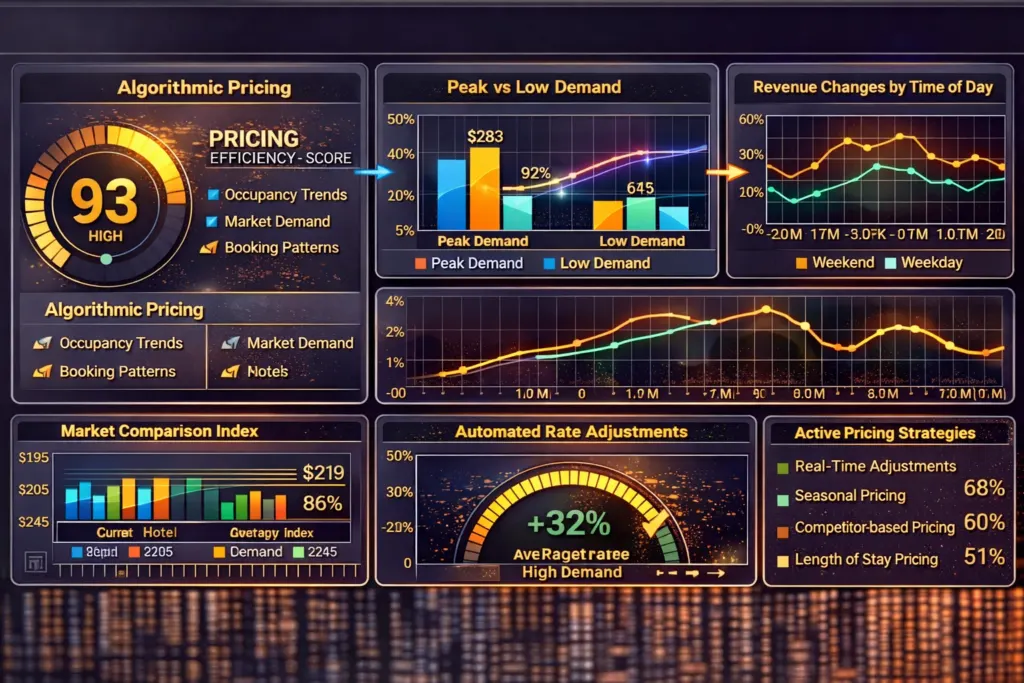
Dynamic pricing strategies used by top hotels adjust room rates for each date and room type as demand, competitor pricing and on-the-books occupancy change, instead of relying on static seasonal rate sheets. Modern revenue management systems combine booking pace, local events, competitor rates and historical patterns to recommend rates several times a day; the revenue team sets the guardrails, reviews the recommendations and approves the changes. Open pricing — setting each room type and rate plan independently rather than as fixed offsets — lets hotels lift ADR in peak windows and protect occupancy floors in quiet ones.
Table of Contents
- What Is Dynamic Pricing in Hotels?
- Demand-Based Pricing
- Time-Based and Booking-Window Pricing
- Competitor-Responsive Rate Strategy
- Length-of-Stay Dynamic Pricing
- Flash Pricing for Last-Minute Demand
- How AI Elevates Dynamic Pricing
- Propeter’s Rate Engine
- Frequently Asked Questions
Dynamic pricing is not a new concept in hospitality — airlines pioneered the practice in the 1980s, and hotel chains began adopting yield management systems in the 1990s. What has changed dramatically in recent years is the accessibility, speed, and intelligence of dynamic pricing tools. What once required a team of revenue analysts and expensive enterprise software is now available to independent properties through AI-powered platforms that automate the entire pricing cycle.
Understanding what dynamic pricing strategies top-performing hotels actually use — not just the concept in the abstract — provides a practical roadmap for any property looking to move beyond static rate cards and into truly optimised revenue management.
What Is Dynamic Pricing in Hotels?
Dynamic pricing is the practice of continuously adjusting room rates in response to current and forward-looking signals about demand, supply, competitive positioning, and booking behaviour. Unlike static pricing — where a hotel sets a seasonal rate card and adjusts it infrequently — dynamic pricing treats every date in the booking window as an independent pricing problem with its own supply/demand dynamics.
A dynamically priced hotel might charge $120 for a standard room on a quiet Tuesday in February, $180 for the same room on a Friday in peak season, $280 during a local event weekend, and $95 in the final 48 hours before arrival if occupancy is lagging on a Monday night. Each of these prices is independently optimised for that specific combination of date, day of week, booking window, and demand conditions — maximising total revenue across the entire portfolio of dates and room types.
Dynamic Pricing vs. Seasonal Pricing
Seasonal pricing uses broad time-based categories — peak, shoulder, and off-peak — to set rates. It captures obvious demand patterns like summer holidays and Christmas but misses date-specific demand drivers like local events, competitor moves, and booking pace anomalies. Dynamic pricing operates at a much finer resolution, adjusting rates at the individual date level in response to signals that seasonal buckets cannot capture.
Demand-Based Pricing
Demand-based pricing is the core principle underlying all dynamic pricing systems. Rates rise when demand is high and fall when demand is soft — the economic principle of supply and demand applied to perishable hotel inventory. The sophistication of modern demand-based pricing lies in how accurately and how quickly demand is measured and forecast.
Indicators of high demand include: above-average booking pace for a future date (more bookings being made than expected at this distance from arrival), declining availability across the compset, low remaining inventory in your own property, known events or holidays on the date in question, and search volume data showing elevated interest from booking channels. When multiple demand signals align, the case for rate elevation is strong.
Booking Pace Analysis
Booking pace — the rate at which reservations are accumulating for a future date relative to historical patterns — is one of the most powerful demand signals available. A date that is booking three times faster than the same date last year at this lead time is almost certainly experiencing demand growth, whether from an event, a trend, or a competitor’s closure. Responding to booking pace anomalies with rate adjustments is one of the highest-ROI applications of dynamic pricing logic.
The Pickup Signal
Propeter’s demand forecast analyses booking-pace patterns against the property’s own history. When pickup for a future date runs ahead of the predicted norm by a configurable margin, the date is flagged for rate review — often earlier than the pattern would show up in a daily pick-up report.
Time-Based and Booking-Window Pricing
Time-based pricing strategies adjust rates based on how far in advance a booking is made — the booking window. The fundamental insight is that different customer segments book at different lead times with different price sensitivities. Leisure travellers planning holidays often book months in advance and are moderately price-sensitive but willing to pay a premium for certainty. Business travellers book within 7–14 days of travel and are less price-sensitive but need availability. Last-minute bookers (0–3 days) are mixed: distressed leisure demand is price-driven, while urgent business and event travellers have few alternatives and are often less price-sensitive — so last-minute pricing should follow the segment and the occupancy position, not a blanket discount rule.
A booking-window pricing strategy typically structures rates to capture maximum value from each segment: slightly elevated rates for far-out advance bookings that capture committed early birds, optimised rates for the core booking window, and specific last-minute rate structures (either elevated due to scarcity or discounted via flash deal if inventory remains) in the final days before arrival.
Non-Refundable vs. Flexible Rate Tiers
Booking-window pricing is often paired with cancellation policy tiers. Non-refundable rates — lower priced, committed — are targeted at price-sensitive advance bookers who are certain of their plans. Flexible rates — higher priced, cancellable — capture revenue from guests who value the option to cancel. The rate differential between flexible and non-refundable should reflect the actual demand risk, not just a fixed percentage: in high-demand periods, the premium on flexible rates should be larger.
Competitor-Responsive Rate Strategy
No hotel prices in a vacuum. A guest on Booking.com sees your rate and your competitors’ rates side by side. Competitor-responsive pricing ensures that your rates are calibrated to the competitive market context — not blindly matching every competitor move, but maintaining an informed, intentional position relative to the compset on every date.
The most sophisticated competitor-responsive strategies distinguish between different types of competitive signals. A competitor raising rates is a positive market signal — demand in the market is strong enough for them to push higher, and you may be able to follow. A competitor dramatically cutting rates is a more complex signal — it might indicate genuine demand weakness in the market, or it might simply be a tactical error by an undisciplined competitor. Responding with an identical cut to a competitor’s panic pricing perpetuates market-wide revenue destruction.
Rate Positioning Strategy
Hotels with genuine product advantages — higher guest review scores, superior location, better amenities — should price at a persistent premium to the compset average, defending that premium rather than matching competitor discounts. Properties that are broadly comparable to the compset should aim for competitive parity on rate with differentiation on value-adds. Properties with product disadvantages should price modestly below the compset average while investing in product improvement.
Length-of-Stay Dynamic Pricing
Length-of-stay (LOS) pricing adds a multi-dimensional layer to dynamic pricing, adjusting rates not just by date but by the combination of check-in date and length of stay. A 1-night stay on a peak Friday night might be priced higher per night than a 3-night stay starting the same Friday, because the 3-night stay fills a shoulder Sunday night that would otherwise be difficult to sell at a premium rate.
LOS-aware pricing enables hotels to fill gaps in the weekly occupancy pattern by incentivising multi-night stays that bridge peak and shoulder nights. This increases overall weekly RevPAR even when the per-night rate on peak nights appears lower for multi-night guests, because the total revenue from the combination of nights exceeds what could be achieved by pricing each night independently.
Flash Pricing for Last-Minute Demand
Flash pricing — deeply discounted rates with very short validity windows, targeted at last-minute demand — is the emergency tool in the dynamic pricing toolkit. Used correctly, flash deals fill inventory that would otherwise go unsold in the final days before arrival without permanently damaging rate integrity. Used incorrectly — applied too early, too broadly, or too deeply — they train guests to wait for discounts and erode long-term revenue performance.
The key principles of effective flash pricing are: activate only within a defined last-minute window (typically 7–14 days from arrival), limit distribution to channels that reach genuinely last-minute bookers (mobile apps, push notifications, last-minute OTA segments), set the discount level against the variable cost floor rather than the standard rate, and ensure the offer expires genuinely — guests who see a flash deal still available two weeks later lose trust in the urgency signal.
How AI Elevates Dynamic Pricing
Manual dynamic pricing — a revenue manager checking rates daily and making adjustments based on their reading of the market — is better than static pricing but limited by human bandwidth. A person can actively manage perhaps 90 days of future inventory in meaningful detail. An AI system evaluates every date in the forward booking window at once and refreshes its analysis several times a day as booking data, competitor rates and demand signals change.
AI also eliminates the cognitive biases that affect human pricing decisions. Revenue managers who anchor too strongly on last year’s rates, who are reluctant to raise rates aggressively for fear of appearing opportunistic, or who respond emotionally to slow pickup by discounting prematurely — all common human tendencies — are replaced by a model that optimises systematically against a defined revenue objective without emotional interference.
Propeter uses two complementary machine-learning approaches for demand forecasting: gradient boosting (effective at capturing non-linear relationships between features and demand) and recurrent neural networks (well suited to time-series forecasting that captures temporal patterns in booking behaviour). Together they tend to produce more robust demand predictions than either model alone.
Propeter’s Rate Engine
Propeter’s rate engine applies the hotel’s commercial rules to each recommendation in sequence — base rate, inventory position, rate plans and derived rates, promotions, loyalty discounts and vouchers, stacking rules, guardrails, upsell and finally taxes and fees — so that the recommended rate your team reviews already reflects your full commercial structure.
The dynamic pricing logic lives primarily in the first two steps. The base rate is set from the forecast — a demand-calibrated rate that reflects projected occupancy and competitive positioning for the date. The inventory step then applies occupancy-based adjustments: as a date fills, inventory-based multipliers raise the recommended rate so the hotel captures value as scarcity increases.
The Rate Plan stage routes the booking to the appropriate rate structure — public rate, negotiated corporate rate, OTA rate, direct rate — based on the booking channel and any applicable access controls. Derived Rates stage generates room-type variants and length-of-stay derivatives from the base price. From stage five onward, promotion and discount logic layers — Promotion, Loyalty Discount, Voucher, Referral, Flash Deal — apply any eligible adjustments in sequence.
The Stacking Resolver is a critical safeguard: it enforces the hotel’s configured rules for which promotions can be combined and which are mutually exclusive, preventing unintended compounding of discounts that could generate rates below the hotel’s floor. The Guardrails stage provides the final check — enforcing absolute minimum and maximum rate boundaries regardless of what the preceding stages have calculated. This ensures that no automated pricing decision can push rates to levels outside the hotel’s defined acceptable range.
Every Date, Every Room Type, Refreshed Through the Day
Propeter recalculates recommendations across the forward booking window several times a day for every room type and rate plan, so a market change in the morning shows up as a revised recommendation the same day. Your team reviews and approves the changes — individually or in bulk — and approved rates are published through your connected PMS.
Frequently asked questions
What is Open Pricing in hotel revenue management, and how does it differ from traditional dynamic pricing?
Open Pricing is an advanced revenue management strategy that allows hotels to price every room type, distribution channel, and stay date independently instead of following fixed BAR relationships. Unlike traditional dynamic pricing, Open Pricing gives AI the flexibility to optimise each product individually, helping hotels maximise revenue across different guest segments and demand conditions.
How do high-frequency dynamic pricing updates affect Google Hotel Ads and metasearch accuracy?
Frequent rate updates can create temporary price mismatches because metasearch platforms and OTA APIs cache pricing for short periods. Hotels minimise this by synchronising pricing through their PMS, CRS, and channel manager, while AI systems balance update frequency with distribution latency to maintain pricing consistency across channels.
How do hotels prevent dynamic pricing adjustments from causing cart abandonment during checkout?
Hotels reduce checkout abandonment by applying booking-session price locks. Once a guest begins the reservation process, the selected room rate is temporarily reserved—typically for 15 to 20 minutes—ensuring prices remain consistent throughout checkout even if the revenue management system updates rates in the background.
What is dynamic pricing in hotels?
Dynamic pricing is the practice of adjusting hotel room rates based on current demand, occupancy, booking pace, competitor pricing, seasonality, and market conditions. The objective is to maximise RevPAR by selling each room at the optimal price throughout the booking window.
How is hotel dynamic pricing different from airline dynamic pricing?
Hotel dynamic pricing must optimise multiple room categories, distribution channels, loyalty programmes, promotions, and length-of-stay rules simultaneously. Airline pricing focuses primarily on seat inventory, whereas hotel pricing requires balancing occupancy, ADR, RevPAR, and guest segmentation across different room types and booking channels.
Does dynamic pricing hurt guest satisfaction or brand loyalty?
Not when implemented correctly. Guests increasingly expect prices to change with demand. Hotels maintain trust by using transparent pricing, reasonable rate changes, loyalty member benefits, and pricing guardrails that prevent excessive fluctuations or inconsistent booking experiences.
How does Propeter’s rate engine implement dynamic pricing?
Propeter’s rate engine combines demand forecasting, price-elasticity modelling, occupancy thresholds, competitor intelligence, promotions and loyalty rules to recommend a rate for each room type and date. Recommendations are refreshed through the day; your team reviews and approves them, and approved rates are published through your connected PMS and distribution systems.
Price Smarter, Not Harder
Propeter recommends a rate for every room type and date across your booking window, explains the reasoning, and lets your team approve changes individually or in bulk.
Related Articles
Practical ways revenue management solution scan boost your hotel’s RevPAR
Revenue management solutions boost hotel RevPAR by replacing slow manual repricing with an…

Low Season Hotel Strategy: Maximize Occupancy & Revenue (2026)
Maximising hotel occupancy and revenue in low season is not about discounting your…
Pricing Parity Strategies for Hotels: Managing Rate Consistency Across Channels
A hotel pricing parity strategy is a legal and commercial commitment to maintain…
Test a pricing scenario
See how demand-based rate changes affect occupancy and revenue.
Open the dynamic pricing simulator