
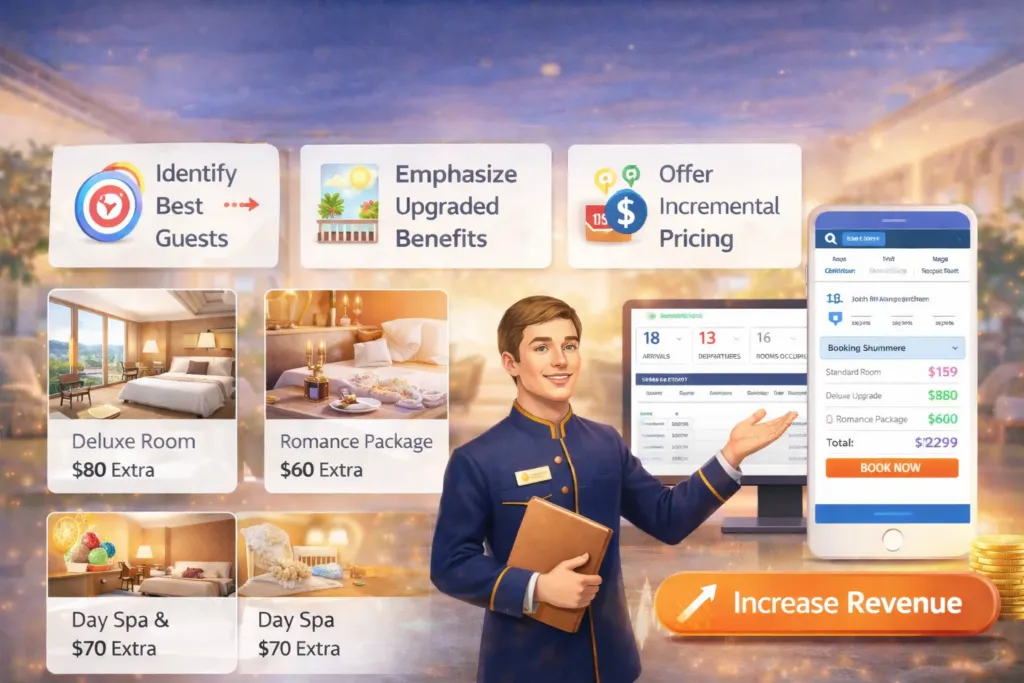
Hotel upselling is a data-driven revenue management strategy that maximizes the financial value of existing reservations by encouraging guests to purchase premium room upgrades, extended stay windows, or ancillary services throughout their travel journey. Rather than relying on manual front-desk pitches, modern hotels utilize automated, pre-arrival software integrated with their Property Management System (PMS) to deliver hyper-targeted, algorithmic offers 48 to 72 hours before check-in. When executed via unbundled, attribute-based pricing models, an optimized upselling framework can increase a hotel’s Total Revenue Per Available Room (TRevPAR) by 5% to 12% without increasing baseline customer acquisition costs.
Table of Contents
- Why Upselling Is the Highest-Margin Revenue Strategy
- Room Upgrade Strategy: Turning Available Inventory Into Revenue
- Package Bundling: The Art of the Compelling Offer
- Pre-Arrival Upsell Emails and Offers
- AI-Powered Upsell Personalisation
- How Propeter Prices Upsell Offers
- Loyalty Integration and Upsell Synergies
- Frequently Asked Questions
For most hotels, the acquisition cost of a new guest — paid in OTA commissions, marketing spend, and distribution fees — is the single largest variable cost in the revenue model. Upselling to guests who have already committed to booking bypasses this cost entirely. The incremental revenue from a room upgrade or ancillary package carries margins that new bookings cannot match, making upselling one of the highest-return strategies available to hotel revenue managers.
Despite this, most hotels under-work their upsell opportunity. Generic upgrade emails sent to the whole guest database convert poorly; offers matched to the guest, the stay and the moment convert far better. The gap between the two is a function of strategy and tooling, not of the guests.
$25–$80
Typical incremental revenue per booking from effective upsell programmes
Why Upselling Is the Highest-Margin Revenue Strategy
When a guest upgrades from a standard room to a superior room for an additional $40 per night, the incremental revenue cost to the hotel is marginal — the room exists, the housekeeping cost is nearly identical, and the only meaningful variable is the marginal difference in operational cost between room categories. The $40 upgrade revenue flows almost entirely to margin.
Compare this to the economics of acquiring a new guest. An OTA booking at $200 might deliver $160–170 in net revenue after commission. A $200 room booked direct might cost $20–30 in marketing support. The upgrade from the already-booked guest costs nothing to acquire — the guest is already in your system, already committed, and the incremental offer is delivered through channels (email, SMS, check-in flow) that carry negligible marginal cost.
The Full Upsell Opportunity Beyond Room Upgrades
While room upgrades are the most visible upsell category, the full ancillary revenue opportunity extends significantly further:
- Food and beverage packages: Breakfast additions, dinner reservations, welcome champagne
- Spa and wellness: Treatment bookings, access upgrades, couples packages
- Experience packages: Local tours, activity bookings, transportation
- Early check-in / late check-out: Operational convenience converted into revenue
- Parking and transfers: Airport pickups, valet parking upgrades
- In-room amenities: Occasion setups, pillow menus, premium minibar
Room Upgrade Strategy: Turning Available Inventory Into Revenue
Room upgrades represent a natural intersection between upsell revenue and inventory management. Superior rooms, suites and premium categories often run lower occupancy than standard rooms because their price points are harder to fill at full rate. An upgrade strategy converts this unsold premium inventory into revenue by offering it to booked guests at an incremental price that is lower than the published category rate but still contributes meaningful margin. Run a displacement check first: on dates where the premium category is forecast to sell at full rate, a discounted upgrade displaces revenue rather than adding it, so upgrade offers should be throttled or withdrawn for those dates.
Complimentary vs. Paid Upgrades
Complimentary upgrades — assigning a guest to a better room at no charge — are a powerful loyalty and satisfaction tool but generate no direct revenue. Paid upgrade programmes replace or supplement complimentary upgrades with a systematic commercial offer: a guest booked into a standard room receives an offer to upgrade to a superior room for $30/night before arrival. The hotel captures revenue from inventory that might have otherwise been given away for free or gone unsold.
The optimal strategy combines both: offer paid upgrades to all eligible guests, then use complimentary upgrades as a loyalty tool for returning guests who declined or did not receive a paid offer, or to manage check-in inventory situations. This approach ensures that every upgrade action is either generating revenue or building loyalty — never wasted.
Upgrade Pricing Principles
The ideal upgrade price sits in a psychological sweet spot: low enough to feel like a genuine deal compared to booking the superior room directly, but high enough to generate meaningful incremental revenue. Research suggests 30–50% of the rate differential between categories is the conversion-optimising price point for pre-arrival upgrade offers.
Package Bundling: The Art of the Compelling Offer
Package bundling combines room accommodation with one or more ancillary products or services into a single purchasable offer. When done well, packages create a perception of added value that exceeds the sum of the component prices — guests feel they are getting more for their money even when the hotel is generating higher total revenue per booking than it would from room-only sales.
The most effective packages are occasion-specific: romance packages for couples celebrating anniversaries, family packages for school holiday periods, business packages for corporate travellers. Occasion-based bundles have higher perceived relevance and convert better than generic packages because they address the specific emotional context of the guest’s trip.
Package Design Principles
- Lead with experience, not components: “The Romance Escape” converts better than “Room + Breakfast + Champagne” even if the contents are identical.
- Include at least one tangible physical element: Welcome amenities, in-room extras, or arrival surprises make packages feel more premium than service-only bundles.
- Price packages below the sum of components: The perceived discount drives conversion; the bundled revenue still exceeds room-only RevPAR.
- Limit the number of package options: Three to five well-designed packages outperform a menu of twelve options where the choice itself becomes a barrier to purchase.
Pre-Arrival Upsell Emails and Offers
The pre-arrival communication window — typically 3–7 days before check-in — is the single highest-converting moment for upsell offers. Guests who have booked accommodation are in active trip-planning mode: reviewing itineraries, checking local attractions, mentally preparing for the experience. An upsell offer that arrives at this moment lands in a psychologically receptive context.
Pre-arrival upsell emails sent through Propeter’s guest communication tools can be personalised using booking data: the room category booked, the stay occasion inferred from the loyalty profile or booking details, the length of stay and the guest’s loyalty tier. A returning member celebrating a birthday receives a different email — with different offers — from a first-time guest on a weeknight business trip.
Elements of a High-Converting Pre-Arrival Upsell Email
- Personalised subject line that references the upcoming stay
- Specific upgrade offer with clear pricing and a direct booking link
- Visual imagery that communicates the experience of the upgrade
- Social proof element (e.g., “Our guests love this room”)
- Clear deadline or limited availability signal to create urgency
- Simple one-click accept mechanism — friction kills conversion
AI-Powered Upsell Personalisation
The performance gap between generic and personalised upsell programmes is large enough to justify significant investment in personalisation technology. AI-powered personalisation analyses guest booking history, demographic signals, stay patterns, past upgrade acceptance rates, and stated preferences to determine which offers are most likely to convert for each individual guest — and delivers those offers through the channels most likely to reach that guest at the right moment.
Machine learning models trained on historical upsell acceptance data can identify patterns that human marketers would never discover manually. For example: guests who book corner rooms show higher upgrade acceptance rates for suite offers. Guests who book more than 30 days in advance are more responsive to breakfast package bundles than to room upgrade offers. Guests in loyalty tier 2 who have declined upgrades twice respond better to F&B add-ons than room upgrades.
These micro-segmented insights, applied at scale across thousands of bookings, transform upsell from a broadcast exercise into a precision targeting operation — generating meaningfully higher revenue while delivering a more relevant guest experience.
How Propeter Prices Upsell Offers
Propeter’s rate engine applies the hotel’s commercial rules in sequence — base rate, inventory position, rate plans and derived rates, promotions, loyalty discounts and vouchers, stacking rules, guardrails, then upsell, then taxes and fees. Upsell is deliberately placed late in that sequence.
By executing after all discount, promotion, and guardrail logic has been resolved, the Upsell stage operates on the final committed room rate. This positioning ensures that upsell offer pricing is calculated correctly relative to what the guest has actually paid, not an intermediate rate that might be further adjusted downstream. The engine calculates the upgrade differential between the guest’s booked category and available superior categories, applies the configured upsell pricing model (fixed differential, percentage-of-differential, or AI-optimised price), and generates the personalised offer.
Upsell offers are then delivered through the guest communication channels you have configured in Propeter, such as pre-arrival email campaigns to your guest database, without the revenue manager having to manage separate campaign tools. Which channels are available for your property is confirmed during implementation.
Loyalty Integration and Upsell Synergies
Loyalty programme members are both more responsive to upsell offers and more valuable upsell targets. A loyal guest who has stayed at your property multiple times has established preferences you can act on. They have demonstrated willingness to return — a strong signal of satisfaction that correlates with willingness to spend more during the stay. And they have a relationship with the brand that makes personalised offers feel natural rather than intrusive.
Propeter’s loyalty integration enables upsell offers to be segmented by loyalty tier, points balance, and redemption history. A guest approaching a tier threshold can be offered an upgrade that simultaneously advances their tier status — a compelling dual-incentive that drives both upsell revenue and loyalty programme engagement. Guests with large points balances can be offered the option to pay for upgrades using points, driving redemption and keeping the programme feeling active and rewarding.
Upsell as a Loyalty Tool
Paid upgrades that are framed as exclusive loyalty member benefits — “Available to Gold members first” — generate higher conversion than identical offers framed purely as commercial transactions. The loyalty framing increases perceived value and reinforces the member’s decision to participate in the programme, creating a virtuous cycle between upsell revenue and loyalty retention.
Frequently asked questions
How do hotels implement attribute-based pricing to maximize upselling revenue?
Hotels implement Attribute-Based Pricing (ABP) by unbundling traditional room types into standalone features—such as a specific floor, a balcony, or an in-room espresso machine—allowing guests to build custom rooms during direct booking. This requires configuration at the Property Management System (PMS) and Central Reservation System (CRS) level to inventory individual attributes rather than broad room codes, so that attribute-level upsells can be offered and priced; measure the RevPAR effect on your own property rather than assuming a benchmark.
How can hotel management prevent front desk bottlenecks when executing upselling strategies?
To prevent front desk bottlenecks, hotels must automate the upselling journey by shifting high-margin offers—like room upgrades, early check-ins, and spa packages—to digital pre-arrival touchpoints 48 to 72 hours before arrival. This leaves front desk teams to manage real-time, high-context inventory upgrades via synchronized upselling software, backed by a clear employee commission program that incentivizes seamless, value-based guest check-in conversations.
What is the most effective upselling technique to increase a hotel’s TRevPAR?
The most effective technique to increase Total Revenue Per Available Room (TRevPAR) is bundling non-room ancillary services into high-perceived-value experiential packages—such as combining an early check-in, local wine flight, and late check-out into a single “Romance” or “Business Productivity” bundle. By shifting focus from isolated room upgrades to automated cross-selling of underutilized food, beverage, wellness, and local partner services throughout the guest stay cycle, hotels unlock uncapped margin per occupied room.
What is the difference between upselling and cross-selling in hotels?
Upselling involves encouraging a guest to purchase a higher-value version of what they have already booked — for example, upgrading from a standard room to a deluxe room or suite. Cross-selling involves selling additional, complementary products or services alongside the original booking — for example, adding a spa package, airport transfer, or restaurant reservation. Both strategies increase total revenue per guest and are most effective when personalised to guest preferences and context.
When is the best time to present upsell offers to hotel guests?
The highest-converting upsell window is the pre-arrival period — typically 3–7 days before check-in. At this point, guests are in active trip-planning mode, excited about their stay, and psychologically open to enhancements. A well-timed pre-arrival email with a personalised room upgrade offer typically converts far better than a generic one; measure your own rate by offer type. Check-in is the second-best moment, when front desk staff or digital check-in flows can present upgrade options in real time.
How does AI improve hotel upsell conversion rates?
AI improves upsell conversion by personalising offers based on guest data — booking history, stated preferences, loyalty tier, stay occasion, and room type booked. A guest celebrating an anniversary receives a romance package offer; a returning business traveller receives an executive floor upgrade. This personalisation means guests receive offers that are genuinely relevant to them, dramatically improving acceptance rates compared to generic broadcast upsell campaigns.
How does Propeter price and deliver upsell offers?
Propeter prices upsell offers after all discount and promotion logic has been resolved but before taxes and fees are added. It identifies eligible room-type upgrades and ancillary add-ons for the guest’s booking, calculates upgrade pricing from the differential between the booked and target room categories, and delivers the offer through the guest communication channels configured for your property.
Unlock the Full Revenue Potential of Every Booking
Propeter prices upgrade and add-on offers from your own rate structure and delivers them to guests before arrival — adding ancillary revenue without separate campaign tools.
Related Articles
Practical ways revenue management solution scan boost your hotel’s RevPAR
Revenue management solutions boost hotel RevPAR by replacing slow manual repricing with an…
Low Season Hotel Strategy: Maximize Occupancy & Revenue (2026)
Maximising hotel occupancy and revenue in low season is not about discounting your…
Pricing Parity Strategies for Hotels: Managing Rate Consistency Across Channels
A hotel pricing parity strategy is a legal and commercial commitment to maintain…
Model the opportunity
Estimate what better pricing could be worth using your own assumptions.