
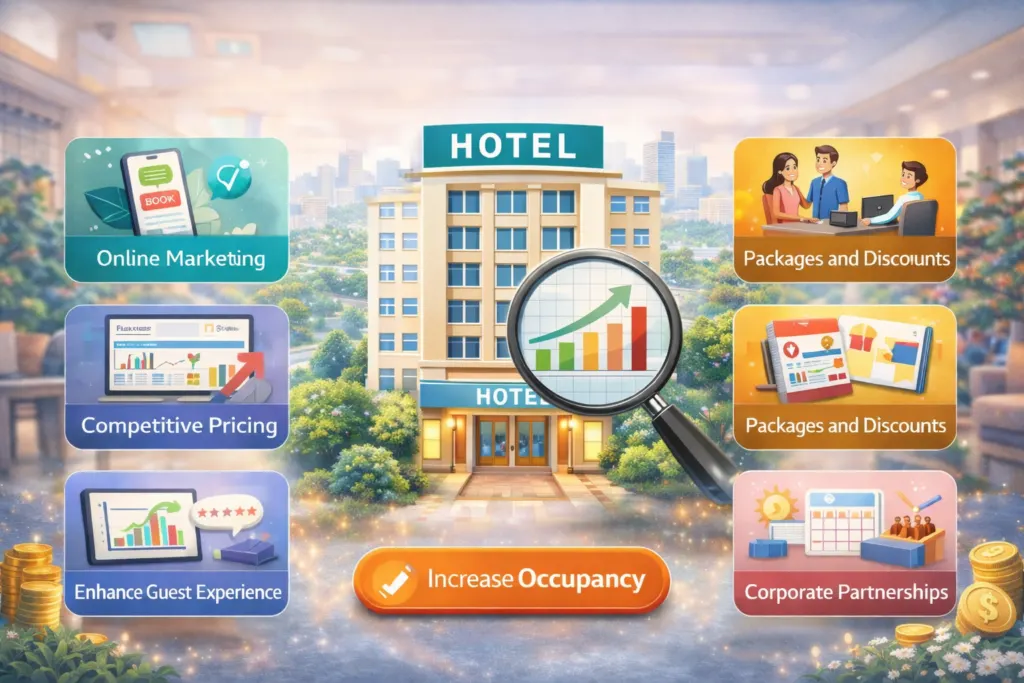
To improve hotel occupancy without lowering public room rates, hoteliers must execute targeted distribution and segmentation strategies that target niche demand pools. This is achieved by shifting distressed inventory to private, closed-user distribution groups (such as loyalty programs or corporate portals), configuring automated pre-arrival upselling to maximize standard room availability, and setting up precise risk-based overbooking formulas to account for cancellation wash-factors. These techniques fill unsold physical inventory during off-peak periods while completely preserving public rate floors and brand positioning.
Table of Contents
- Why Occupancy Matters — and When Rate Matters More
- Dynamic Pricing to Drive Occupancy
- Direct Booking Promotion Strategies
- Loyalty Programmes and Repeat Guest Retention
- Flash Deals and Last-Minute Inventory Management
- Corporate Accounts and Negotiated Rates
- Length-of-Stay Pricing Strategies
- How Propeter Handles Flash Deals
- Frequently Asked Questions
In hotel revenue management, the pursuit of higher occupancy is a constant tension between filling rooms and protecting rate integrity. Push rates too low to fill the hotel and you erode RevPAR, devalue your brand, and attract price-sensitive guests who are unlikely to return. Maintain rates stubbornly while rooms sit empty and you lose out on revenue that evaporates the moment the night passes.
The most successful hotel operators navigate this tension with a set of complementary strategies — dynamic pricing that adjusts automatically to demand signals, direct booking incentives that grow the most profitable channel, loyalty programmes that build a floor of repeat demand, and precision tools like flash deals that fill the final gap without painting the entire hotel with discount.
15–25%
OTA commission saved on every direct booking — reinvestable in guest incentives
Why Occupancy Matters — and When Rate Matters More
Hotel occupancy measures how many of your available rooms are sold as a percentage of total capacity. A hotel with 100 rooms that sells 75 on a given night has 75% occupancy. But raw occupancy is only part of the revenue picture. A hotel running at 90% occupancy at $80 average daily rate (ADR) generates $72 RevPAR — identical to a hotel running at 72% occupancy at $100 ADR. The second scenario, however, leaves the hotel better positioned for margin and brand perception.
The goal is not to maximise occupancy in isolation — it is to maximise RevPAR, which accounts for both how many rooms you sell and what you sell them for. In high-demand periods, holding rates and accepting lower occupancy may be the right strategy. In soft periods, strategically deploying occupancy-boosting tools — even at a temporary rate concession — captures revenue that would otherwise be permanently lost.
Dynamic Pricing to Drive Occupancy
Dynamic pricing is the most powerful occupancy management tool available to modern hotels. By continuously adjusting rates in response to demand signals — booking pace, competitive rates, market conditions, days to arrival — dynamic pricing ensures that rates are calibrated to attract the right volume of bookings at any given time.
When demand is weak and occupancy is tracking below target for a future date, dynamic pricing systems lower rates incrementally to stimulate demand. When demand is strong and occupancy is tracking above target, rates are pushed upward to maximise revenue from the remaining inventory. This continuous calibration is far more effective than static rate cards that set rates once and hope for the best.
Occupancy Thresholds and Rate Triggers
Advanced dynamic pricing implementations set occupancy thresholds that trigger specific rate adjustments. For example: if occupancy for a date 30 days out reaches 70%, rates step up by 10%. If it reaches 85%, rates step up another 15%. Conversely, if occupancy at 14 days out is only 40%, a pre-defined rate reduction strategy activates. These threshold-based triggers create a systematic response to demand signals without requiring manual intervention for every adjustment.
Dynamic Pricing Is Not Discounting
The goal of dynamic pricing is to find the revenue-maximising rate at every occupancy level — not to discount as a default. In many cases, dynamic pricing pushes rates upward as occupancy builds. The discipline is in the downward adjustments: knowing when, by how much, and for which room types to reduce rates to stimulate the specific demand needed to fill the hotel.
Direct Booking Promotion Strategies
Every booking made through an OTA costs your hotel a commission of 15–25% of the booking value. A $200 room night booked through Booking.com generates perhaps $160–170 in net revenue after commission. The same booking made directly through your website generates $200 — a meaningful difference that compounds over thousands of bookings per year.
Direct booking promotion strategies reduce OTA dependency, improve net RevPAR, and build a guest database that enables direct marketing and repeat visit management. Effective direct booking strategies typically combine a clear best-rate promise for guests who book direct (within the limits of your OTA agreements), value-add incentives that justify booking direct without requiring explicit rate discounts, and a guest experience on the direct booking engine that rivals the convenience of OTAs.
Value-Add Incentives That Work
- Complimentary breakfast: Adds perceived value without reducing the displayed room rate.
- Early check-in / late check-out: Low cost to the hotel, high perceived value to guests.
- Room category upgrades: Fills higher room categories that might otherwise go unsold while rewarding direct bookers.
- F&B credits: Drives additional on-property spend while incentivising direct booking.
- Flexible cancellation: Reduces booking friction for guests who value flexibility, without requiring a rate concession.
Loyalty Programmes and Repeat Guest Retention
Loyal guests are the highest-value guests in your database. They book more frequently, spend more per stay, cost less to acquire, and cancel less often. A well-designed loyalty programme builds a floor of repeat demand that insulates occupancy during soft periods when leisure and transient demand is unpredictable.
Loyalty programmes do not need to be complex to be effective. The core requirement is recognising and rewarding repeat guests in ways they genuinely value — points that translate into meaningful benefits, exclusive rate access, and personalised communication that makes members feel seen rather than processed.
Loyalty Rate Mechanics
Loyalty discounts in Propeter’s rate engine are applied as a distinct step in the pricing sequence — after base rate, inventory adjustment, rate-plan selection and promotions, but before final guardrails and fee calculations. This sequencing ensures that loyalty benefits are applied consistently across all room types and rate plans, and that the loyalty discount interacts correctly with other active promotions without unintended stacking.
Flash Deals and Last-Minute Inventory Management
Flash deals are time-limited, deeply discounted rate offers designed to convert last-minute demand that would not otherwise book your property at standard rates. They are the final tool in the occupancy management toolkit — deployed when a date is approaching with material unsold inventory that standard pricing has failed to convert.
The economics of flash deals are straightforward: an unsold room generates zero revenue. A room sold at a 30% discount generates 70% of the potential revenue. As long as the discounted rate covers variable costs (housekeeping, utilities, amenities), filling the room through a flash deal generates more total revenue than leaving it empty — even at a significant rate concession.
Flash Deal Targeting
Flash deals are most effective when targeted at specific demand segments rather than broadly published. Push notifications through a hotel’s mobile app, email campaigns to the loyalty database, and targeted offers through last-minute booking channels reach guests who are ready to book quickly — without the brand damage of publicly advertising deep discounts that undermine perceived value for future standard-rate bookers.
Corporate Accounts and Negotiated Rates
Corporate accounts provide a dependable base of weekday demand from business travellers who book regularly, stay frequently, and tend to be less price-sensitive than leisure guests. A well-managed corporate account programme builds consistent midweek occupancy that reduces dependence on leisure demand and creates revenue predictability that simplifies financial planning.
Negotiated corporate rates — agreed annually with companies that commit to a volume of room nights — trade rate flexibility for booking certainty. The key is calibrating the negotiated rate appropriately: low enough to win the business, but not so low that the corporate block displaces higher-value transient demand during peak periods. GDS channel management and rate fencing ensure that corporate rates are only accessible to qualifying travellers, preventing rate leakage into leisure segments.
Length-of-Stay Pricing Strategies
Length-of-stay (LOS) pricing strategies influence how long guests stay — and therefore how efficiently the hotel fills its inventory across multi-day periods. LOS discounts offer rate incentives for longer stays, encouraging guests who might book one night to extend to two or three nights, which improves weekly occupancy patterns and reduces the operational cost of frequent room turnovers.
The most common LOS strategy is a sliding discount structure: 0% for 1 night, 5% for 2 nights, 10% for 3+ nights, 15% for 5+ nights. The discounts should be calibrated against the incremental revenue value of each additional night versus the cost of the concession — a calculation that varies significantly by day of week, season, and occupancy position.
How Propeter Handles Flash Deals
Propeter’s rate engine includes a flash-deal step, applied after promotions and before stacking rules are resolved. When the demand forecast identifies dates where projected occupancy falls below a threshold you configure within a defined booking window (often 7–14 days from arrival), Propeter proposes a flash deal for those dates.
Once your team approves it, the flash deal applies a configurable discount to eligible rate plans, generates a unique deal code for targeted distribution, and can be promoted through the guest communication channels you have configured, such as email to your guest database and your direct booking engine.
The Stacking Resolver stage immediately downstream ensures that Flash Deal discounts cannot be combined with other active promotions beyond pre-configured stacking rules — preventing the unintentional double-discounting that can occur when multiple promotional mechanisms are live simultaneously. The Guardrails stage that follows enforces the hotel’s minimum rate floors, ensuring that even an active flash deal cannot push rates below the defined price floor that protects brand value and covers minimum operational costs.
Automated Occupancy Management
Propeter supports occupancy management across the whole pricing sequence — from demand forecasting that flags occupancy gaps before they materialise, through base-rate recommendations, to flash-deal proposals as the arrival date approaches. The aim is a hotel that fills at the highest achievable rate for every date, with your team approving the changes rather than re-keying them.
Frequently asked questions
What are opaque booking channels, and how do they increase hotel occupancy safely?
Opaque booking channels allow hotels to sell distressed, unsold room inventory at steep discounts without revealing the property’s name until after payment is complete. By utilizing platforms like Hotwire or Priceline Express Deals, a hotel can rapidly clear excess room availability during extreme low-demand periods to increase occupancy, while keeping public retail prices intact and protecting core market positioning.
Does real-time room availability affect a hotel’s ranking on Google Maps?
Not directly in any documented way. Google has not published live availability as a ranking factor for Maps or local results. What is clear is that accurate, connected availability and rates (through your booking engine and the hotel pricing feeds Google supports) determine whether your property can appear with a bookable price in Google’s hotel results at all, and stale or missing availability data costs you those impressions. Treat connected, accurate inventory as a visibility prerequisite rather than a ranking lever.
How do hotels use closed-user groups (CUG) to fill inventory during shoulder seasons?
Closed-user groups (CUG) are private distribution channels that require user authentication, such as corporate member portals, geofenced mobile apps, or free loyalty club sign-ups. Because these platforms sit behind a secure login barrier, hotels can legally bypass OTA public rate parity clauses and offer deep, targeted discounts to stimulate shoulder-season occupancy without triggering automated market-rate undercutting.
What is a good hotel occupancy rate?
A good hotel occupancy rate depends on market type and segment, but most full-service hotels target 70–80% annual occupancy as a healthy baseline. More important than the raw occupancy figure is RevPAR — revenue per available room — which accounts for both occupancy and rate. High occupancy at low rates often generates less RevPAR than moderate occupancy at premium rates.
How do flash deals help improve hotel occupancy?
Flash deals are time-limited, deeply discounted rate offers targeted at last-minute demand segments. They are most effective for filling unsold inventory within a 7–14 day window, where the revenue cost of an empty room exceeds the margin impact of the discount. Propeter proposes flash deals when projected occupancy for a date falls below a threshold you define within that window; your team approves them before they go live.
How do length-of-stay strategies improve occupancy?
Length-of-stay (LOS) pricing strategies offer rate incentives for longer stays — for example, a 10% discount for 3+ nights — to encourage guests to extend their stay and fill shoulder nights. This improves overall occupancy across the week while generating more total revenue per booking than a single-night stay at the same nightly rate.
Can direct booking strategies improve occupancy without hurting rate?
Yes. Direct booking strategies that offer value-adds rather than rate discounts (such as complimentary breakfast, early check-in, or room upgrades) can grow direct channel occupancy without eroding ADR. Since direct bookings carry no OTA commission (typically 15–25%), even a modest incentive can be offered while generating more net revenue per room than an OTA booking at the same gross rate.
Fill More Rooms at Better Rates
Propeter flags occupancy gaps before they hurt revenue and recommends how to fill them — from rate adjustments to flash deals — with your team approving every change.
Related Articles
Practical ways revenue management solution scan boost your hotel’s RevPAR
Revenue management solutions boost hotel RevPAR by replacing slow manual repricing with an…

Low Season Hotel Strategy: Maximize Occupancy & Revenue (2026)
Maximising hotel occupancy and revenue in low season is not about discounting your…
Pricing Parity Strategies for Hotels: Managing Rate Consistency Across Channels
A hotel pricing parity strategy is a legal and commercial commitment to maintain…
Model the opportunity
Estimate what better pricing could be worth using your own assumptions.