
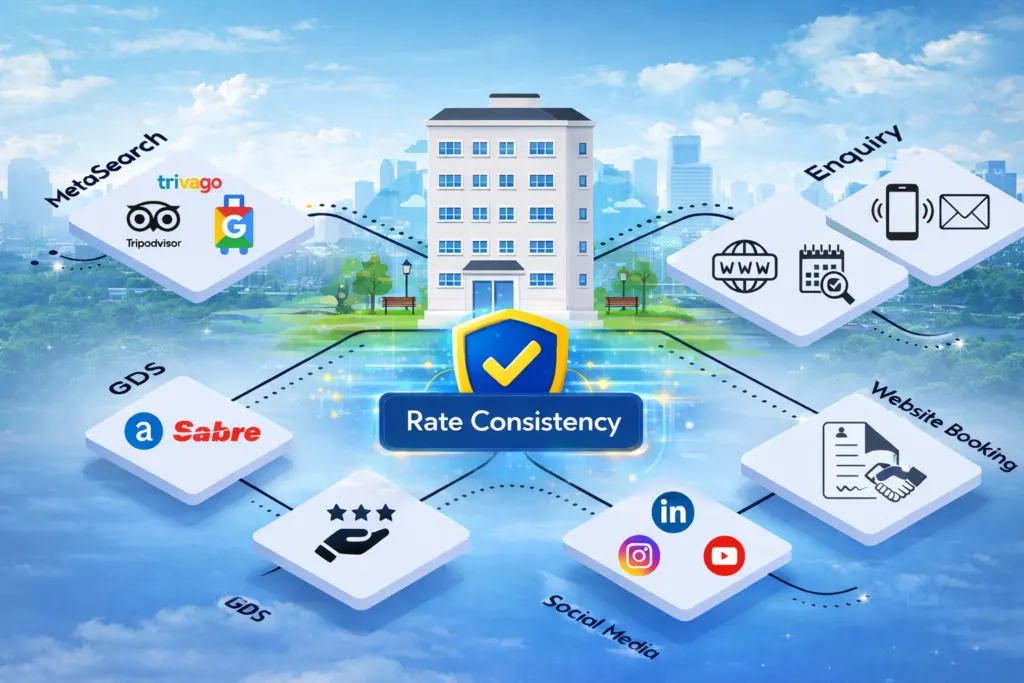
A hotel pricing parity strategy is how a hotel manages the rates and conditions it shows publicly across distribution channels — OTAs, GDS, metasearch and its own website — so that its contractual parity obligations are met and the direct channel still offers guests a good reason to book. Parity terms vary by OTA contract and by country: wide parity requires the OTA to get rates at least as good as every other channel, while narrow parity only stops the hotel publishing a lower rate on its own website than on that OTA. In the EU, Booking.com may no longer impose parity clauses on hotels under the Digital Markets Act, so check your own agreements before you plan rates.
Table of Contents
- What Is Rate Parity and Why Does It Exist?
- Understanding OTA Parity Clauses
- Wide Parity vs Narrow Parity
- Smart Parity: Beyond Simple Rate Matching
- Direct Booking Advantages Within Parity
- Channel-Specific Value Adds and Member Rates
- Monitoring and Maintaining Parity
- Propeter’s Approach to Rate Consistency
- Frequently Asked Questions
Rate parity is one of the most discussed — and most misunderstood — topics in hotel distribution. Some revenue managers treat it as an inflexible constraint that prevents them from favouring their direct channel. Others dismiss it as a regulatory relic that no longer applies. The reality is more nuanced: parity rules have changed significantly and now differ by country and by contract, but the strategic challenge of presenting consistent value across channels remains.
This guide explains what the different forms of rate parity mean, how the rules have changed, the practical strategies hotels use to build a competitive direct booking proposition, and how to monitor rates across channels. It is general guidance, not legal advice: your obligations depend on the contracts you have signed and the law where your hotel operates.
What Is Rate Parity and Why Does It Exist?
Rate parity is the contractual or operational commitment to show the same publicly available rate, for the same room type, date and conditions, across distribution channels. When a guest sees your property on Booking.com at £150 per night and then visits your own website, parity means they find the same £150 public rate — not a lower one that undercuts the OTA, and not a higher one that penalises guests who book direct. Parity is about the price and conditions the guest sees (the gross, public rate), not the net amount the hotel receives after commission, which naturally differs by channel.
From the OTA’s perspective, parity clauses protect its investment in customer acquisition. OTAs spend heavily on marketing to drive consumers to their platforms; if hotels systematically offered lower public rates on their own websites, guests could use OTAs for discovery and then book direct — the OTA would incur the acquisition cost but capture none of the transaction.
From the hotel’s perspective, the original case for accepting parity was access to a global demand-generation infrastructure that smaller hotels could never build alone. The cost was less freedom to price their own channels.
Understanding OTA Parity Clauses
OTA parity clauses vary by platform, by country and by contract, and they have changed repeatedly following competition investigations and legislation. Several European countries prohibit parity clauses, including narrow parity, through national law or competition decisions, and at EU level the Digital Markets Act now applies to Booking.com.
The EU position under the Digital Markets Act. The European Commission designated Booking Holdings as a gatekeeper under the Digital Markets Act on 13 May 2024. From 14 November 2024, Booking must allow hotels and other providers to offer better prices and conditions on other online channels, including their own websites, than on Booking.com (European Commission, Digital Markets Act). That obligation applies to Booking.com’s service in the EU; it does not by itself change other OTAs’ contracts or the rules in other countries.
Outside the EU, and for other OTAs, terms differ by market and contract vintage. Hotels should audit their current contracts rather than assuming they know what applies.
Check Your Contracts
Rate parity requirements differ between OTAs, between markets, and between programmes within the same OTA. A hotel in a preferred or visibility programme may have different obligations from one on the standard terms. Always review the specific provisions in your current contracts — and take legal advice if in doubt — rather than working from general industry knowledge.
Wide Parity vs Narrow Parity
The distinction between wide and narrow parity has been the central battleground in hotel distribution regulation over the past decade.
Wide Parity (Now Largely Prohibited in Europe)
Wide parity requires the hotel to give the OTA rates and conditions at least as good as those it offers on every other channel — its own website, other OTAs, and offline channels such as phone, email or walk-in. Under wide parity, a hotel cannot offer a lower rate anywhere else, even on a competing OTA. Wide parity was common in OTA contracts until competition authorities in Europe moved against it from the mid-2010s.
Narrow Parity (Where It Still Applies)
Narrow parity is a lighter restriction: the hotel may not publish a lower rate on its own website than the rate it offers on the OTA, but it remains free to offer lower rates on other OTAs and through offline channels such as phone, email or walk-in bookings. Many narrow parity clauses also exclude closed user groups, such as loyalty members who must sign in to see a rate, but this depends on the contract wording.
Understanding this distinction is commercially significant. Where narrow parity applies, the hotel’s own public website rate is the main thing it must keep in line; differentiation usually comes through other OTAs, offline channels, closed user groups (where permitted) and value-adds. Where parity clauses are prohibited — for example for Booking.com in the EU under the Digital Markets Act — the hotel has more freedom to price its own website below that OTA.
Smart Parity: Beyond Simple Rate Matching
Smart parity is the strategic approach of managing rate presentation across channels to maximise direct booking conversion while maintaining the OTA relationships that generate incremental demand. It goes beyond the compliance question of “what rates am I required to match?” to the commercial question of “how do I present value most effectively across each channel?”
Smart parity strategies typically involve:
- Keeping headline public rates consistent where your contracts require it, while differentiating through bundled inclusions on the direct channel
- Offering member rates to signed-in guests (closed user groups), where your OTA agreements permit
- Using flexible cancellation terms as a direct-channel differentiator — OTA bookings may be non-refundable while direct bookings offer free cancellation
- Structuring promotions as member-only or subscriber-only offers, after checking how your contracts treat them
Direct Booking Advantages Within Parity
The most robust channel differentiation strategies compete on total value rather than headline price, because they work under most parity regimes. A guest comparing the same £150 room rate on Booking.com and on the hotel’s own website should find that the direct booking offers better value — not because the rate is lower, but because it includes elements not available through the OTA.
Bundled Inclusions
Complimentary breakfast adds tangible value to direct bookings without reducing the room rate. A hotel with a £20 breakfast product can offer “room + breakfast for £150” through its direct channel while listing the same room at £150 room-only on Booking.com. The headline rates match; the total guest value does not. Check how your contracts treat packages, as some parity clauses also cover conditions and inclusions.
Flexible Cancellation
Many OTA bookings are non-refundable or carry early cancellation fees. Offering free cancellation as a direct-channel benefit — particularly valued by business travellers and guests with uncertain plans — creates a genuine advantage that influences channel choice.
Room Upgrade Priority
Committing to upgrade direct bookers to the next available room category when possible costs little when that inventory would otherwise go unsold, and creates real perceived value for the guest. Check first that the higher category is not likely to sell at full rate.
Channel-Specific Value Adds and Member Rates
Member rates are one of the most effective tools for channel differentiation. A loyalty member rate shown only to signed-in guests is commonly treated as a closed-user-group rate and falls outside many narrow parity clauses — but not all, so check the wording of each OTA agreement and the rules in your country before relying on it.
The barrier to member rates has historically been the investment required to build and maintain a loyalty programme. Modern booking engines with integrated CRM make this more accessible to independent hotels — a simple sign-up with a member rate can capture direct bookings without the overhead of a full points programme.
Monitoring and Maintaining Parity
Rate parity is not a set-and-forget configuration. Channel managers, promotional activations, third-party wholesalers and OTA-funded discounts can all create unintended disparities that damage OTA relationships or confuse guests. Systematic monitoring is essential.
Parity issues typically fall into several categories:
- Wholesale leakage: Rates contracted with wholesalers at a net rate appear on OTA and metasearch platforms below the public rate
- Promotional misconfiguration: A promotion intended for the direct channel only is published to OTA channels through the channel manager
- Currency conversion discrepancies: Rates set in one currency appear cheaper when displayed in another after conversion
- Caching artefacts: Rate changes take different amounts of time to reach different channels, creating temporary disparities visible to rate-shopping tools
- OTA-funded discounts: Some OTAs may discount from their own margin, making your rate look higher on your website than on the OTA
Rate-shopping tools that monitor your own rates across channels — not just competitor rates — help you identify and resolve these issues quickly.
Propeter’s Approach to Rate Consistency
Propeter is a revenue management and pricing system that works with your PMS. It helps with rate consistency in three practical ways. First, its rate engine applies discount-stacking rules (which offers are exclusive and which can combine) and a maximum-discount cap, so promotions, loyalty rates, vouchers and flash deals do not stack into an unintended rate on the direct booking engine. Second, rate floors and ceilings act as guardrails, and recommendations without them are blocked from publishing. Third, if you subscribe to Lighthouse, Propeter can ingest that feed: Lighthouse parity data refreshes every 6 hours and appears as parity alerts in the dashboard.
Propeter’s member-only rates are shown to signed-in guests in its direct booking engine. Parity terms vary by OTA contract — check your agreements. Propeter does not give legal advice on your contracts.
Frequently asked questions
How do hotels fix rate parity violations caused by wholesalers?
Start by documenting the problem: use a rate-shopping tool to capture the date, time, channel and rate where the wholesale rate appears. Then identify the source, for example through a test booking that shows which wholesaler supplied the room. Finally, enforce the non-distribution terms in your wholesale contract — most restrict the public display of net rates — and, if the leak continues, reduce or stop that wholesaler’s allocation.
Does rate parity affect a hotel’s visibility on Google Hotels?
Google does not publish a “parity score” ranking factor. What matters in practice is that Google Hotels shows prices from your official website and from OTAs side by side, so if your official site is more expensive than the OTAs, it tends to lose the click. Keeping your direct price competitive — and connecting your booking engine to Google’s free booking links where available — gives your official site a better chance of winning the booking.
Can a hotel legally offer lower rates on its direct website than on OTAs?
It depends on your contracts and where your hotel operates. Under narrow parity, a hotel may not publish a lower public rate on its own website than on that OTA, although it can usually offer lower rates on other OTAs, offline and, in many contracts, to closed user groups such as signed-in members. Where parity clauses are prohibited — for example for Booking.com in the EU under the Digital Markets Act, and under national rules in several European countries — the hotel is free to price its own website lower. Check your agreements and take legal advice if you are unsure.
What is rate parity in hotels?
Rate parity is the practice of showing the same public room rate and conditions across distribution channels — OTAs such as Booking.com and Expedia, the hotel’s own website and other booking platforms. OTA contracts have historically required it as a condition of listing, but regulation has narrowed or removed parity clauses in many markets, and the rules now vary by country and contract.
What is the difference between wide parity and narrow parity?
Wide parity requires the hotel to give the OTA rates at least as good as every other channel, including its own website, other OTAs and offline channels. Narrow parity only stops the hotel from publishing a lower rate on its own website than on that OTA; the hotel can still offer lower rates on other OTAs and offline. In the EU, Booking.com may not impose parity clauses at all under the Digital Markets Act, and several European countries prohibit narrow parity under national law.
How can hotels offer better value through direct channels without breaking parity?
Hotels can differentiate the direct booking proposition with value-adds that are not part of the OTA offer: complimentary breakfast, room upgrade priority, flexible cancellation, early check-in or late check-out, or loyalty points. These make the direct channel more attractive at the same headline rate. Check how your contracts treat packages and conditions, since some parity clauses cover more than price.
How does Propeter help hotels manage rate parity?
Propeter’s rate engine applies discount-stacking rules and a maximum-discount cap so combined offers do not produce unintended direct rates, and rate floors and ceilings act as guardrails. If you subscribe to Lighthouse, Propeter can ingest its parity data, which refreshes every 6 hours and appears as parity alerts in the dashboard. Propeter does not interpret your contracts; parity terms vary by OTA agreement.
Manage Rate Parity with Confidence
See how Propeter’s rate engine, guardrails and member rates help keep your channels consistent while strengthening your direct booking offer.
Related Articles

Practical ways revenue management solution scan boost your hotel’s RevPAR
Revenue management solutions boost hotel RevPAR by replacing slow manual repricing with an…

Low Season Hotel Strategy: Maximize Occupancy & Revenue (2026)
Maximising hotel occupancy and revenue in low season is not about discounting your…

Price Elasticity Modeling for Hotels: Optimizing Pricing Without Losing Demand
Price elasticity modeling for hotels is a data-driven forecasting technique that quantifies how…
Watch your market
How Propeter brings competitor rates into your pricing recommendations.