
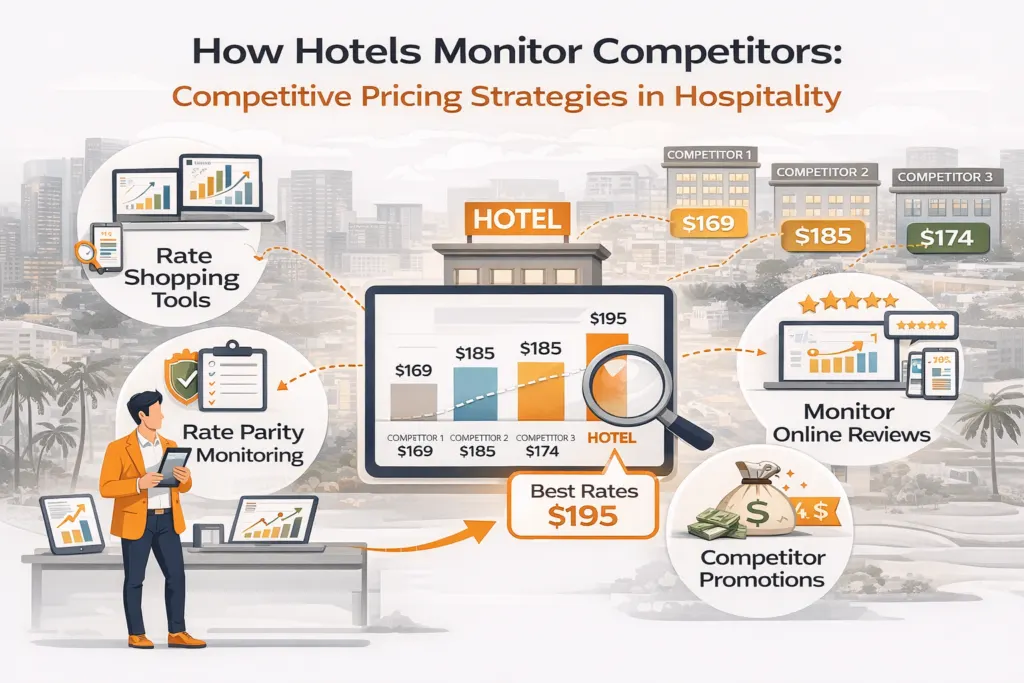
Hotels monitor competitor pricing strategies by deploying automated rate shopper software that continuously extracts room rates, minimum length-of-stay restrictions, and promotional terms across Online Travel Agencies (OTAs), brand websites, and metasearch engines. This regularly refreshed intelligence is mapped to a hotel’s competitive set (compset) inside a revenue management system (RMS). By analyzing these external signals alongside internal occupancy pacing, hoteliers can accurately adjust their dynamic pricing architecture to capture demand without losing market position or sparking a reactive price war.
Table of Contents
- Why Competitive Rate Monitoring Matters
- Manual Rate Shopping: The Old Way
- OTA Monitoring Tools and Rate Parity
- Lighthouse (OTA Insight) and Similar Platforms
- Collecting Public Rates Beyond the Major OTAs
- How to Build the Right Compset
- Competitive Response Strategies
- How Propeter Uses Competitor Rates
- Frequently Asked Questions
In a market where a guest can compare prices across a dozen hotels in under ten seconds, competitive pricing intelligence is not optional — it is a survival requirement. Hotels that price in a vacuum, relying on last year’s rate cards or gut instinct about the market, consistently leave revenue on the table and lose bookings to properties that price with precision.
The good news is that the tools and techniques available to hotels today — from sophisticated OTA monitoring platforms to AI-driven market intelligence agents — make competitive pricing intelligence more accessible and actionable than ever before. Understanding how these tools work, and how to build a strategy around them, is what separates high-performing revenue managers from the rest.
Why Competitive Rate Monitoring Matters
Rate shopping — the practice of checking what competitors are charging for the same dates — has been part of hotel revenue management since the earliest days of the industry. But the stakes have never been higher. OTAs like Booking.com and Expedia display competitor properties side by side, sorted by price. A guest who sees your property listed at $180 while a comparable hotel shows at $155 will simply click through to the cheaper option, often without reading another word of your listing.
The impact is not just on individual bookings. Consistent mispricing relative to your competitive set distorts your market positioning over time. Chronic underpricing trains guests to expect bargain rates, erodes perceived quality, and squeezes margins. Chronic overpricing collapses occupancy and signals to OTA algorithms that your property is less popular — reducing your search ranking and creating a self-reinforcing cycle of underperformance.
Manual Rate Shopping: The Old Way
Before sophisticated rate shopping tools existed, revenue managers would manually visit OTA websites, punch in future dates, and record competitor rates in spreadsheets. Many small and independent hotels still rely on this approach today. A revenue manager might spend an hour each morning checking rates on Booking.com and Expedia for the next 30 days, noting what the Holiday Inn down the road and the boutique hotel across the street are charging.
This approach has significant limitations. It is time-consuming, capturing only a snapshot in time rather than continuous data. It is prone to human error and inconsistency — different staff members may check different dates or record data in different formats. Most critically, it provides no historical trend data, making it impossible to understand whether a competitor’s rate today is unusually high, unusually low, or business as usual.
The Manual Monitoring Problem
A revenue manager checking rates manually at 8 AM captures one data point per day. A competitor might change rates three or four times on the same day in response to demand signals. Manual monitoring misses these intraday movements entirely — and those are often the most important signals.
Why Manual Methods Fail in Dynamic Markets
Modern hotel markets are highly dynamic. Demand signals shift throughout the day as search volumes change, new bookings are made, and events are announced. A competitor hotel using a dynamic pricing system may update rates multiple times between your morning rate check and checkout time. If your response to competitive signals is delayed by 12–24 hours because you are relying on manual monitoring, you are always reacting to yesterday’s market rather than today’s.
OTA Monitoring Tools and Rate Parity
OTA monitoring tools solve the core problem of manual rate shopping by automatically and continuously collecting rate data from major booking platforms. These tools collect published rates from Booking.com, Expedia, Hotels.com and other OTAs at regular intervals, storing historical rate data and presenting it in dashboards that allow revenue managers to see competitive positioning at a glance.
Beyond simple rate comparison, OTA monitoring tools track rate parity — ensuring that a hotel’s rates across different distribution channels are consistent. Rate parity violations, where a hotel’s rate on one OTA is materially lower than on another or lower than on the hotel’s direct booking engine, can damage brand trust, violate contractual OTA agreements, and suppress direct booking conversion rates.
Key Metrics from OTA Monitoring
- Rate index: Your average daily rate expressed as a percentage of the compset average — a score above 100 means you are pricing above market, below 100 means you are below.
- Rate position: Where your rate ranks within your compset on any given date (1st cheapest, 2nd cheapest, etc.).
- Availability gaps: Dates where competitors are sold out or restricting availability — a signal that demand is strong and rates can be pushed higher.
- Rate change frequency: How often competitors are updating rates — a proxy for how dynamically they are managing pricing.
Lighthouse (OTA Insight) and Similar Platforms
Lighthouse, formerly known as OTA Insight, is a widely used rate-intelligence platform. It aggregates rate data from major OTAs and other channels, with historical trend data and a forward view of competitor pricing.
If you subscribe to Lighthouse, Propeter can ingest that feed — including the competitor sets defined in your Lighthouse account — so the data flows into rate recommendations without your team logging into a separate dashboard.
What a Rate-Intelligence Platform Typically Provides
- Regularly refreshed competitor rate data across major OTAs
- Historical rate trends for each compset property, going back months
- Rate calendar view showing competitive positioning for future dates
- Parity monitoring for your own rates across channels
- Market demand indicators derived from search and booking data
Propeter + Lighthouse
Rather than simply displaying competitor data in a dashboard, Propeter uses it as one input to each rate recommendation, alongside your demand forecast and price elasticity, and shows the competitor snapshot behind each suggested rate. If you subscribe to Lighthouse, its parity data (refreshed every 6 hours) also appears as parity alerts in Propeter’s dashboard.
Collecting Public Rates Beyond the Major OTAs
OTA monitoring covers the rates that competitors publish through the major booking platforms. But not all relevant competitive information flows through OTAs. Direct booking websites, metasearch engines, lesser-known booking platforms, and even property-specific promotional pages can carry rates and deals that OTA tools miss.
Some hotels supplement OTA data with manual checks of competitors’ own websites and promotions, or with data providers that collect public listings. Whatever the method, use only data sources and collection methods permitted by each site’s terms. For reference, Propeter collects rates from public Booking.com listings through a third-party data provider, alongside your Lighthouse feed if you have one.
Web Scraping vs. OTA Tool Coverage
Structured OTA data gives you the trend context needed to tell whether a rate is a temporary anomaly or a genuine market signal; checks of direct and promotional rates show you the offers that do not surface on OTAs. Neither source alone gives the full picture.
How to Build the Right Compset
The quality of your competitive monitoring is only as good as the quality of your compset. If you are tracking the wrong competitors — hotels that do not actually compete for the same guests on the same dates — your competitive data will mislead rather than inform your pricing decisions.
Compset Selection Criteria
- Geographic proximity: Properties within walking distance or a short drive that a guest would genuinely consider as alternatives.
- Star rating and service level: Hotels within one star category of your own — guests comparing a 4-star property against a 2-star are unlikely to cross over regardless of price.
- Room count: Properties of broadly similar scale — a 20-room boutique has different demand dynamics than a 400-room convention hotel.
- Target segment: Properties competing for the same mix of leisure, corporate, and group business that you serve.
- Average rate position: Properties with similar ADR ranges — tracking a luxury resort as a competitor when you are a mid-market property produces meaningless data.
A well-constructed compset typically contains 4–8 properties. Too few and your market picture is incomplete; too many and the signal-to-noise ratio drops as dissimilar properties dilute the relevant intelligence.
Competitive Response Strategies
Competitive monitoring is only valuable if it drives action. Hotels that collect competitive data but do not build systematic responses to it are wasting their investment. The most effective competitive response strategies are proportionate, timely, and context-sensitive.
Rate Matching vs. Rate Leadership
Not every competitive rate move warrants an immediate response. If a single competitor drops rates sharply for a future date, the appropriate response depends on context. Is your own pickup for that date strong? Are other compset properties holding their rates? Is the competitor responding to a private rate request or a genuine market softening? Blind rate matching — automatically lowering your rate whenever a competitor does — is a race to the bottom that destroys market-wide revenue.
Rate leadership is the more profitable strategy for properties with a genuine quality differential. If your hotel consistently receives higher guest review scores and offers tangible product advantages, maintaining a modest rate premium above the compset average and defending that premium rather than matching every downward move will generate more total revenue over time.
Demand-Context Response
The right response to a competitor’s rate move is always demand-context dependent. A competitor selling out two weeks from now is a signal that demand is stronger than expected — the correct response may be to raise your own rates, not to match theirs. A competitor dropping rates for a shoulder period where your own pickup is lagging may warrant a defensive response. A system that shows demand, pace and competitor rates side by side helps revenue managers make these context-sensitive judgements consistently.
How Propeter Uses Competitor Rates
Propeter is a revenue management and pricing system that works with your PMS. Propeter brings competitor rates into its pricing recommendations — from your Lighthouse subscription, if you have one, and from public listings collected through a third-party data provider. Competitor rates refresh hourly for the next 14 nights and progressively less often for dates further out.
Competitor rates are one input to each recommendation, alongside your occupancy and pickup pace, booking window, seasonality, scored local events and price elasticity. Competitor rate position also feeds the demand forecast, so the model can separate genuine demand growth from market share shifting between properties.
Where Competitor Data Fits in the Pipeline
Forecasting, price-elasticity and RevPAR pipelines feed a pricing engine with a policy gate, and the pipeline runs hourly by default. Guardrails apply to every recommendation, and each one shows its calculation inputs — including the competitor snapshot — before your team approves it.
Frequent Intelligence, Not Daily Snapshots
Because competitor rates for the next 14 nights refresh hourly, a competitor closing availability for a high-demand date this week shows up in Propeter’s next pricing run, and the updated recommendation is ready for your team to review the same day — rather than at next week’s pricing meeting.
Frequently asked questions
How do hotels prevent automated price-war loops when monitoring competitors?
Hotels prevent automated price-war loops by setting strict algorithmic “rate floors” and response rules within their revenue management systems. If your software detects a competitor dropping rates, instead of triggering an automatic matching reduction that forces them to drop prices further, the system evaluates internal booking velocity and holds the rate floor to protect brand equity and yield margins.
Should hotels include short-term vacation rentals in their competitive pricing audits?
Yes, hotels experiencing heavy leisure demand should include professional short-term vacation rentals and multi-unit Airbnb properties in their competitive pricing audits. Modern rate shoppers allow revenue managers to map local alternative accommodations alongside traditional hotels, providing a truer reflection of market inventory supply and consumer price elasticity.
How does competitor pricing intelligence impact Google Hotel Ads performance?
Competitor pricing intelligence directly dictates the conversion efficiency of Google Hotel Ads and metasearch campaigns. When an automated rate shopper reveals that a direct competitor is undercutting your public rate for a specific date, you should programmatically lower your metasearch ad bids for that window, preventing waste on clicks that are unlikely to convert due to the unfavorable price discrepancy.
How often should hotels check competitor rates?
At least daily, and more often for the nearest dates. Automated tools refresh much more frequently than a manual check: Propeter, for example, refreshes competitor rates hourly for the next 14 nights and progressively less often for dates further out. During high-demand periods or major local events, frequent monitoring matters most.
What is a hotel competitive set (compset)?
A hotel’s competitive set (compset) is the group of 4–8 comparable properties that compete directly for the same guest segments in the same market. Compset selection should be based on location proximity, star rating, room count, service level, and target customer profile — not just brand name or proximity alone.
What tools do hotels use to monitor competitor pricing?
Hotels use a combination of OTA rate shopping tools (such as Lighthouse, formerly OTA Insight), manual checks of competitors’ direct websites, GDS monitoring, and revenue management systems that bring rate data into pricing decisions. Propeter uses your Lighthouse feed (if you subscribe) and public listings collected through a third-party data provider.
How does Propeter use competitor rates?
Propeter brings competitor rates — from your Lighthouse subscription, if you have one, and from public listings via a third-party data provider — into its rate recommendations alongside your demand forecast and price elasticity. Rates refresh hourly for the next 14 nights and less often further out. Each recommendation shows the competitor snapshot behind it, and your team approves rates before they are published.
See Propeter's Competitive Intelligence in Action
See how Propeter brings competitor rates into the rate recommendations your team approves.
Related Articles
Practical ways revenue management solution scan boost your hotel’s RevPAR
Revenue management solutions boost hotel RevPAR by replacing slow manual repricing with an…

Low Season Hotel Strategy: Maximize Occupancy & Revenue (2026)
Maximising hotel occupancy and revenue in low season is not about discounting your…
Pricing Parity Strategies for Hotels: Managing Rate Consistency Across Channels
A hotel pricing parity strategy is a legal and commercial commitment to maintain…
Watch your market
How Propeter brings competitor rates into your pricing recommendations.