
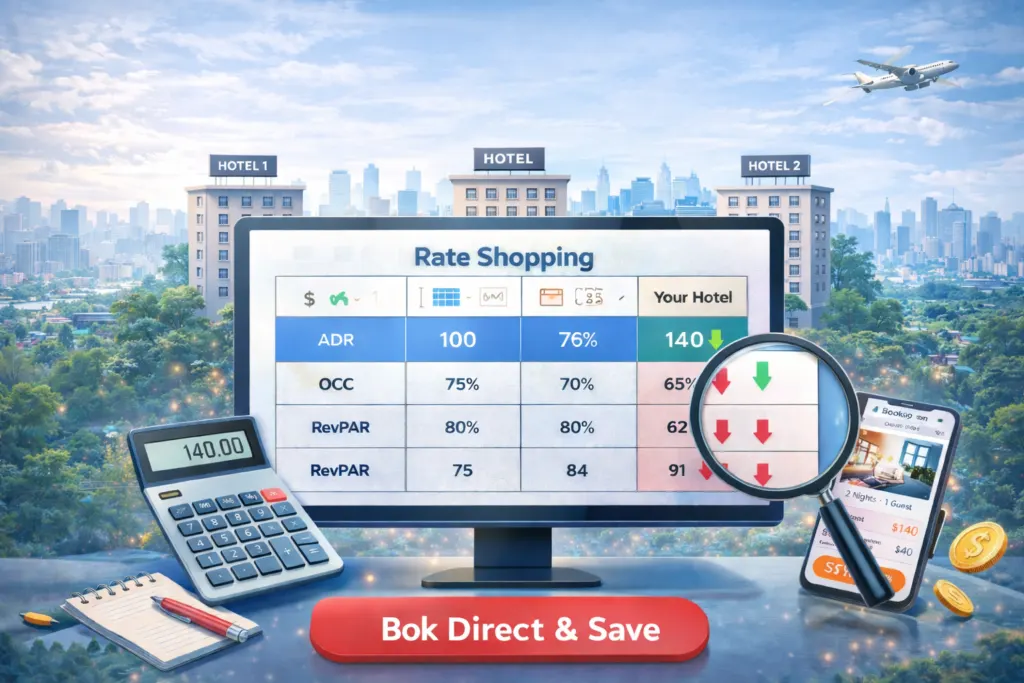
Rate shopping in the hotel industry is the automated process of monitoring, aggregating, and analyzing competitor room rates and distribution policies across online travel agencies (OTAs), metasearch engines, and brand websites in real time. Hoteliers leverage dedicated rate intelligence software to instantly track pricing fluctuations across multi-property competitor sets (compsets) and receive automated alerts when their own rates are undercut. This systematic tracking eliminates manual oversight, protects channel rate parity, and informs predictive dynamic pricing strategies.
Table of Contents
- What Is Rate Shopping?
- Manual vs. Automated Rate Shopping
- OTA Monitoring and Channel Coverage
- Lighthouse Data and Other Rate Sources
- Rate Shop Data Interpretation
- Competitive Response Workflows
- Propeter’s Competitive Intelligence
- Frequently Asked Questions
In hotel revenue management, you cannot set your rates in a vacuum. Every rate decision your property makes exists in a competitive context — guests browsing OTAs compare your rate to five or ten alternatives simultaneously, making their booking decision in a matter of seconds based on perceived value relative to price. Understanding what your competitors charge for the same dates is not optional intelligence; it is the baseline requirement for any serious revenue strategy.
Rate shopping — the systematic monitoring of competitor pricing across channels — is how hotels gather that intelligence. Done well, it fuels faster, better-calibrated pricing decisions. Done poorly (or not at all), it leaves hotels perpetually reactive, responding to competitive moves after the bookings have already shifted. The most useful set-ups feed rate shopping data straight into rate recommendations, so intelligence turns into a pricing decision the same day.
What Is Rate Shopping?
Rate shopping is the practice of systematically monitoring competitor hotels’ published rates across OTA channels and direct booking websites. The output is a rate grid — a view of what your compset charges for the same room types on the same future dates as your hotel — which allows direct comparison of your positioning relative to the market.
A typical rate shop output answers questions like:
- Is your hotel priced above, at, or below the compset median for next Saturday night?
- Which competitor is currently the lowest-priced in your compset — and by how much?
- Have any competitors significantly increased or decreased their rates for an upcoming high-demand date?
- Are any compset properties showing as sold out for specific future dates?
- Is your hotel maintaining rate parity across OTA channels (your Booking.com rate matches your Expedia rate)?
Rate shopping is not just a data collection activity. The value lies in interpreting the data and responding appropriately — which is where most manual rate shopping processes break down.
Manual vs. Automated Rate Shopping
Before specialised tools existed, revenue managers would manually open OTA websites, search for their compset properties, record the rates in spreadsheets, and attempt to identify patterns. This approach is still used by some smaller independent hotels — and it has fundamental limitations that make it increasingly inadequate in competitive markets.
Limitations of Manual Rate Shopping
- Frequency: A revenue manager can realistically check rates once or twice daily. Competitor rates can move multiple times per hour in high-demand periods
- Coverage: Manually checking 5–8 competitors across 4–5 OTA channels for 30+ future dates is practically impossible without dedicated tools
- Consistency: Manual checks introduce human error and inconsistency in search parameters (same occupancy, same room type, same cancellation policy)
- Speed to action: Even if a manual check identifies a competitor pricing move, translating that insight into a rate change requires additional time and approval steps
Automated Rate Shopping
Automated rate shopping tools solve all of these limitations. They collect published rates on a schedule from data sources and channels they are permitted to use, using consistent search parameters, and present the data in a structured format that allows fast pattern recognition and decision-making. The best automated systems move beyond data collection to provide alerts when significant competitive moves occur and to recommend (or automatically execute) rate responses.
From Data to Action
The critical evolution in rate shopping is the move from passive data collection to active rate response. In Propeter, competitor rates feed directly into rate recommendations alongside your demand forecast, so a significant competitive move shows up as a recommended rate change — with the competitor snapshot behind it — that your team can review and approve.
OTA Monitoring and Channel Coverage
Effective rate shopping requires comprehensive OTA coverage. Guest booking behaviour is distributed across multiple platforms, and competitor strategies often vary by channel. The key channels to monitor include:
- Booking.com: The largest OTA in most European and Asian markets; the default starting point for most leisure travellers
- Expedia / Hotels.com: Dominant in North American markets and important globally for corporate travel
- Google Hotels: Increasingly significant as a metasearch and direct discovery channel
- Airbnb: Relevant for properties competing with serviced apartments and vacation rentals
- Agoda: Dominant in Southeast Asian markets
- Direct hotel websites: Monitoring competitor direct booking rates to identify whether they offer member discounts or exclusive direct rates
Rate parity monitoring — checking that your own hotel’s rates are consistent across all channels — is a closely related exercise. OTA contracts typically require rate parity (or best available rate conditions), and parity violations can result in reduced OTA visibility. If you subscribe to Lighthouse, Propeter can also show Lighthouse parity data for your own rates, refreshed every 6 hours, as parity alerts in its dashboard.
Lighthouse Data and Other Rate Sources
Propeter’s competitor rate data comes from two sources: Lighthouse (formerly OTA Insight), a widely used rate-intelligence platform, if you subscribe to it; and public listings collected through a third-party data provider.
Lighthouse (OTA Insight) Data
Lighthouse provides structured rate data from major OTAs with broad hotel coverage. If you subscribe to Lighthouse, Propeter can ingest that feed — including the competitor sets defined in your Lighthouse account — so the data flows into rate recommendations without your team logging into a separate platform.
Public Listings via a Third-Party Data Provider
Propeter also collects rates from public Booking.com listings through a third-party data provider. Competitor rates refresh hourly for the next 14 nights and progressively less often for dates further out, which focuses collection where pricing decisions are most time-sensitive.
Rate Shop Data Interpretation
Raw rate shop data — a grid of competitor rates by date — requires skilled interpretation to generate actionable insights. The key interpretive frameworks are:
Competitive Position Analysis
Where does your hotel rank in your compset by price on each future date? If you are consistently the second-highest priced for weekdays but the lowest-priced for weekends, this suggests a pricing strategy misalignment — weekend demand may justify a higher rate relative to the compset.
Rate Movement Patterns
Tracking how competitor rates change over time — particularly as arrival dates approach — reveals their pricing strategies. A competitor that prices low 60 days out and increases rates as dates approach is using availability-based dynamic pricing. A competitor whose rates remain flat is likely on a static or semi-static pricing strategy. Understanding competitor pricing patterns helps predict their future moves.
Sellout Detection
When a competitor’s OTA listing shows as unavailable or sold out for a future date, it signals high demand and represents an opportunity for your hotel to increase rates. Treat a competitor sellout as a prompt to review your own rate for that date, alongside your booking pace.
Competitive Response Workflows
The goal of rate shopping is not to match every competitor move — that approach leads to rate wars that damage all properties in the market. The goal is informed competitive positioning: knowing what competitors charge, evaluating whether your rate relative to theirs is appropriate given your product quality and demand position, and adjusting when the evidence is clear.
When to Match a Competitor Rate Cut
A competitor’s rate cut warrants a response only if: (a) your hotel is positioned above them in a way that current demand does not justify, (b) the rate cut is causing visible demand shift to their property, and (c) the demand conditions for the dates in question are insufficient to support your current rate. Matching a competitor rate cut simply because they cut is a reactive response that typically erodes margins without improving occupancy.
When to Ignore a Competitor Rate Cut
If your booking pace is strong and your demand forecast projects healthy occupancy at current rates, competitor discounting is largely irrelevant — they may be filling their rooms cheaply, but you are filling yours at a premium. Seeing demand, pace and competitive rates in one place makes this judgment call much quicker.
Propeter’s Competitive Intelligence
Propeter is a revenue management and pricing system that works with your PMS, not a standalone rate shopping tool. Propeter brings competitor rates into its pricing recommendations — from your Lighthouse subscription, if you have one, and from public listings collected through a third-party data provider. Competitor rates refresh hourly for the next 14 nights and progressively less often for dates further out.
Competitor rates are one input to each recommendation, alongside your demand forecast, booking pace and price elasticity. When the market moves — a competitor sellout, a broad compset rate increase or an unexpected rate drop — the recommended rate reflects it, guardrails apply, and the recommendation shows the competitor snapshot behind it. Your team reviews and approves recommendations individually or in bulk before they are published through your connected PMS and distribution systems.
This means competitive rate intelligence turns into pricing decisions rather than sitting in a dashboard waiting for someone to act on it.
Frequently asked questions
Why do hotel rate shopping tools sometimes display stale or incorrect competitor prices?
Hotel rate shopping tools display incorrect prices when they read cached metasearch data instead of making live API requests to the distribution channel. To minimize network bandwidth and prevent bot blocking, some third-party platforms scrape historical data pools that can be hours old, causing hoteliers to mismatch rates by reacting to promotional pricing structures that the competitor has already updated or closed out.
How can a hotel track competitor rates that are hidden inside mobile apps or private login walls?
Rate shoppers generally cannot see closed-user-group rates, such as app-only promotions or rates shown only to signed-in loyalty members, and you should not try to get around the access controls that protect them. Use legitimate methods instead: join competitors’ loyalty programmes or download their apps as an ordinary customer and check rates periodically, review what competitors publicly advertise about member benefits, and watch for signs of closed-user-group discounting in your own conversion and pace data.
How does Attribute-Based Pricing (ABP) disrupt traditional hotel rate shopper metrics?
Attribute-Based Pricing (ABP) disrupts rate shoppers by unbundling room features, allowing guests to pick individual elements (like a balcony or high floor) rather than booking a fixed, standard category. When a competitor shifts to ABP, a traditional rate shopper tool struggles to find a baseline “standard room” rate to compare, often skewing compset indexes and causing automated dynamic pricing algorithms to miscalculate market positioning.
What is rate shopping in hotels?
Rate shopping is the practice of monitoring competitor hotel rates across OTA channels (Booking.com, Expedia, Hotels.com, etc.) and direct channels to understand your competitive pricing position. It allows revenue managers to see how their rates compare to compset properties for the same dates, and to adjust pricing accordingly.
How often should hotels shop competitor rates?
In active markets and high-demand periods, competitor rates can change multiple times per day. Manual rate shopping once daily is insufficient for strategic rate management. Automated rate shopping keeps the data current: in Propeter, competitor rates refresh hourly for the next 14 nights and less often for dates further out, from your Lighthouse subscription (if you have one) and public listings via a third-party data provider.
What is the difference between rate shopping and rate parity monitoring?
Rate shopping focuses on competitor pricing — what other hotels charge for similar rooms on the same dates. Rate parity monitoring focuses on your own hotel’s rates across different channels — ensuring that your Booking.com rate is not lower than your direct rate, for example. Both are essential components of a complete competitive intelligence strategy.
How does Propeter’s competitive intelligence differ from a standard rate shopping tool?
Standard rate shopping tools present data — they show you competitor rates and leave interpretation and action to the revenue manager. Propeter uses competitor rates as one input to rate recommendations, alongside your demand forecast, booking pace and positioning strategy, and shows the competitor snapshot behind each recommendation. Your team approves the rates before they are published.
Turn competitive intelligence into revenue
See how Propeter brings competitor rates into rate recommendations your team approves — or read our guide to how hotels monitor competitors.
Explore Competitive Intelligence
Related Articles
How to Increase RevPAR Without Lowering Rates
To increase RevPAR without lowering hotel room rates, hoteliers must focus on optimizing…
Watch your market
How Propeter brings competitor rates into your pricing recommendations.