
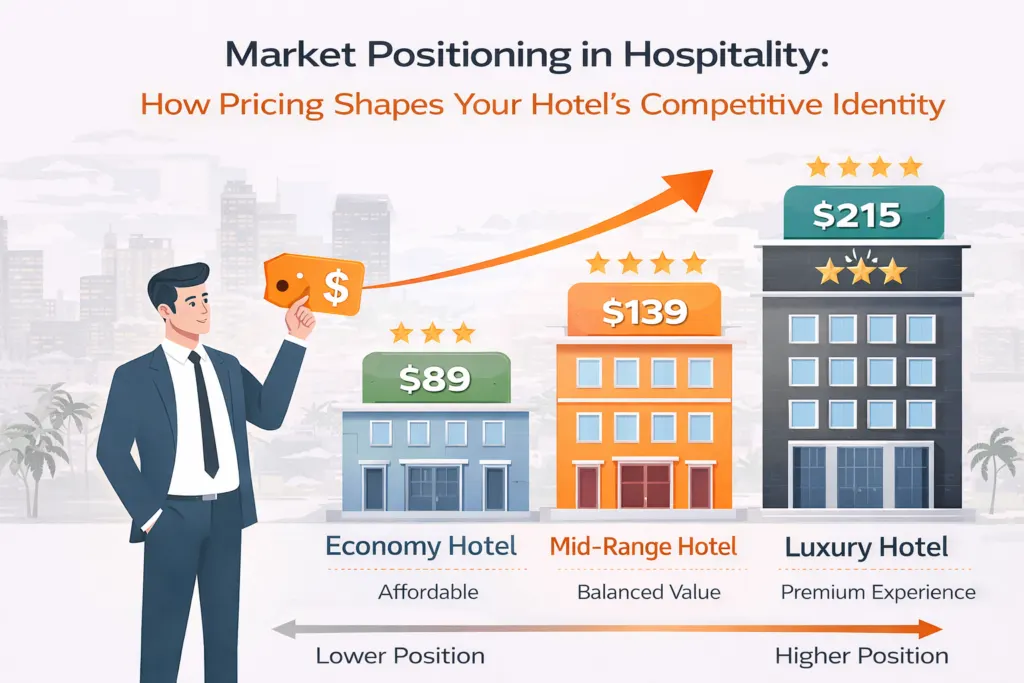
Market positioning in hospitality is the deliberate strategic process of establishing a hotel’s unique brand value and competitive identity relative to substitute properties within its market. It relies heavily on pricing as an immediate quality proxy, utilizing index metrics like Average Rate Index (ARI) and strict rate guardrails to project luxury, midscale, or value status. When executed accurately, consistent positioning anchors consumer perception, shields a hotel from reactive price wars, and sustainably optimizes long-term Revenue Generation Index (RGI) performance.
Table of Contents
- What Is Market Positioning in Hospitality?
- Price as a Competitive Positioning Signal
- Luxury vs. Value Positioning Strategies
- Compset Positioning Analysis
- Rate Index Benchmarking
- Propeter’s Market Intelligence Features
- Frequently Asked Questions
In a crowded OTA search results page, a guest sees your hotel’s name, a photo, a star rating, and a price. In under three seconds, they form a judgment about where your property sits in the market. That judgment — value, mid-scale, upscale, luxury — is your market position. And the single most influential input to that snap judgment is your price relative to the alternatives on screen.
Market positioning is not just a marketing concept. In hospitality, it is a revenue management discipline. Hotels that price with strategic intent — maintaining consistent rate relationships with their compset, protecting their positioning during low-demand periods, and capturing premium when demand justifies it — outperform those that price reactively.
What Is Market Positioning in Hospitality?
Market positioning describes the distinctive place a hotel occupies in the minds of its target guests relative to competitor properties. It is the answer to the question: “Why should a guest choose your hotel over the alternatives at similar or higher prices?”
Positioning is built from multiple dimensions: physical product (room size, design, amenities), service level (staffing ratios, personalisation), location (proximity to demand generators), brand (awareness, loyalty programme), and reputation (review scores, awards). But all of these elements are communicated to potential guests through a single, immediately visible signal: the rate.
A boutique hotel that invests heavily in design and guest experience but prices itself at the compset median is not claiming its position — it is subsidising competitors who have done less. Conversely, a property that prices at a premium without the product to justify it will face consistently poor conversion and damaging reviews. Sustainable market positioning requires alignment between product reality and pricing signal.
Price as a Competitive Positioning Signal
Economic research has long shown that price functions as a quality signal in markets where quality is difficult to assess before purchase — which describes hospitality perfectly. Guests cannot fully evaluate a hotel room until they are staying in it. In the absence of direct experience, they use price, reviews, brand, and photos as proxies for quality. Price is the most immediately visible of these proxies.
The Price-Perception Relationship
Hotels that price at a consistent premium to their compset over time are perceived as higher quality, even when objective product differences are marginal. This “price halo” effect means that rate discipline is not just a revenue decision — it is a brand decision. Every discount that drops a hotel significantly below its compset median slightly degrades the brand signal it sends to the market.
This is why the most sophisticated revenue management strategies include explicit minimum rate floors below which the hotel will not price, regardless of demand conditions. These floors protect brand positioning even during weak periods. In Propeter, these are configured as guardrails: rate floors, ceilings and maximum discount caps that recommendations cannot breach, so data-driven optimisation does not undermine the hotel’s positioning through overcorrection.
Positioning vs. Profitability
There is a common assumption that premium positioning sacrifices occupancy. It does not have to: hotels with consistent premium positioning often attract guests who are less price-sensitive, convert more direct bookings and show higher loyalty. Whether the net effect on RevPAR is positive depends on whether the product genuinely justifies the premium — which is exactly what your RGI trend will tell you.
Luxury vs. Value Positioning Strategies
Different hotels have different natural positioning targets, and there is no universally “correct” position in the market. What matters is internal consistency and intentional strategy. Here is how positioning manifests across the hotel tier spectrum:
Luxury Positioning
Luxury hotels maintain rates significantly above the market average. Their pricing strategy is less focused on optimising occupancy and more focused on optimising ADR and guest quality. They use strict minimum rate floors, limit deep discounting to truly extraordinary circumstances, and invest in direct booking programmes and loyalty schemes that attract high-value repeat guests. A well-run loyalty programme is particularly valuable here, turning premium guests into repeat direct bookers.
Upper-Midscale and Upscale Positioning
Properties in the upper-midscale and upscale segments face the most complex positioning challenge: they need to justify a premium over midscale competitors while remaining accessible to guests who are evaluating the luxury tier. Dynamic pricing is central to this segment — rates should rise aggressively in high-demand periods (to capture premium) and hold firm relative to the compset in weak periods (to protect positioning).
Value and Budget Positioning
Value-positioned hotels compete on price accessibility, but even here, positioning discipline matters. Consistently pricing below the compset median reinforces the value positioning signal. Deep discount promotions — beyond the normal rate tier — can actually hurt value hotels by attracting low-quality guests and generating poor reviews that undermine the product’s genuine appeal.
Compset Positioning Analysis
Effective market positioning requires a clearly defined competitive set — the group of hotels against which your property’s rates and performance are measured. Compset selection is a strategic decision, not just an operational one. It defines the market in which you are competing.
Common compset construction errors include:
- Including properties that are too different in product quality (comparing yourself to hotels that are genuinely not in your competitive consideration set)
- Making compsets too narrow (only 2–3 properties), creating misleading averages
- Failing to update the compset as the market evolves (new openings, rebrands, closures)
- Using geographic proximity as the sole criterion rather than guest overlap
Once defined, compset analysis tracks your property’s rate relative to the compset median or average across the full booking window. The goal is not to match competitors exactly but to maintain your intended rate premium or discount relative to the market consistently over time.
Propeter’s Competitive Intelligence Layer
Propeter brings competitor rates into its pricing recommendations — from your Lighthouse subscription, if you have one, and from public listings collected through a third-party data provider. Competitor rates refresh hourly for the next 14 nights and progressively less often for dates further out. Recommendations show the competitor snapshot behind each suggested rate, so your team can see positioning drift before approving changes.
Rate Index Benchmarking
The hospitality industry uses several standard indices to benchmark positioning performance. The two most important are the Average Rate Index (ARI) and the Revenue Generation Index (RGI).
Average Rate Index (ARI)
ARI compares your hotel’s ADR to the compset average ADR. An ARI of 1.10 means your hotel’s ADR is 10% above the compset — indicating a successful premium positioning strategy. An ARI below 1.0 means you are pricing below market, which is appropriate for value-positioned properties but potentially a positioning failure for upscale and luxury hotels.
Revenue Generation Index (RGI)
RGI compares your hotel’s RevPAR to the compset average RevPAR. Because RevPAR incorporates both occupancy and rate, it is a more complete measure of revenue positioning. An RGI above 1.0 means you are outperforming your compset on a revenue-per-available-room basis.
Monitoring Index Trends
Single-period indices can be misleading. What matters most is the trend over time: is your ARI rising, falling, or stable? A rising ARI combined with stable or rising occupancy is evidence of successful premium positioning. A falling ARI combined with flat occupancy suggests rate erosion without demand benefit — a positioning problem that needs correction.
Propeter’s Market Intelligence Features
Maintaining consistent market positioning manually requires daily monitoring and analysis: compset rates, index trends, demand forecasts and rate adjustments. Propeter is a revenue management and pricing system that supports this workflow with recommendations your team approves.
Propeter brings competitor rates into its pricing recommendations — from your Lighthouse subscription, if you have one, and from public listings collected through a third-party data provider. Competitor rates refresh hourly for the next 14 nights and progressively less often for dates further out. Your pricing strategy (for example, a target premium over the compset median) is configured by your team, and recommendations aim to hold it — whether that means holding firm while competitors discount or moving up when they raise rates. Guardrails then apply, and each recommendation shows its calculation inputs before you approve it.
Propeter’s direct booking engine and loyalty module help build the direct guest relationships that make premium positioning sustainable. Member-only rates are shown to signed-in guests; parity terms vary by OTA contract, so check your agreements.
Market positioning is ultimately a long game. The hotels that win it are those that commit to a clear positioning strategy, maintain rate discipline through market cycles, and use intelligence tools to ensure their positioning signal never drifts without strategic intent. In a market where competitors reprice daily, that discipline matters more than ever.
Frequently asked questions
How does a faulty competitor set (Compset) ruin a hotel’s market positioning?
A faulty compset corrupts a hotel’s market positioning by skewing its Average Rate Index (ARI) calculations. If an upscale boutique hotel accidentally benchmarks its rates against un-renovated budget motels or properties outside its immediate sub-market, its pricing data will signal artificial premium positioning, resulting in over-priced rooms, lower occupancy, and a distorted Revenue Generation Index (RGI).
Can a change in guest review scores alter a hotel’s pricing identity?
Guest review scores act as a critical value multiplier for pricing identity. Even if an upscale hotel keeps an inelastic, high rate to maintain a luxury market position, a sudden drop in its online reputation score lowers a consumer’s willingness to pay, converting an intended “quality signal” into an uncompetitive price barrier that drives traffic to highly rated alternatives.
Do geo-targeted discounts hurt a hotel’s core market positioning?
Geo-targeted discounts can compromise a hotel’s core positioning if they leak into general search environments. While offering lower, localized rates to specific international source markets helps fill empty rooms off-season, poor channel configuration can allow regional users to access these discounted rates via virtual private networks (VPNs), diluting the property’s public brand equity and perceived quality.
What is market positioning in hospitality?
Market positioning in hospitality refers to how a hotel is perceived relative to its competitors in the minds of potential guests. It is shaped by product quality, service level, location, brand, and — critically — pricing. A hotel’s rate relative to its compset is one of the most visible and immediate positioning signals available to guests browsing OTAs.
How does pricing affect a hotel’s brand positioning?
Price is a proxy for perceived quality. Hotels that consistently price at a premium to their compset signal quality and exclusivity. Hotels that price below market signal value or accessibility. Inconsistent pricing — high one week, deeply discounted the next — confuses the market and erodes brand positioning over time. Sustainable positioning requires rate discipline alongside genuine product differentiation.
What is a Rate Index (RGI) and why does it matter for positioning?
The Revenue Generation Index (RGI) compares a hotel’s RevPAR to the average RevPAR of its competitive set. An RGI above 1.0 means the hotel is outperforming its compset; below 1.0 means underperforming. Tracking RGI over time reveals whether a hotel’s positioning strategy is gaining or losing commercial ground relative to the competition.
How does Propeter help hotels maintain their intended market position?
Propeter brings competitor rates (from your Lighthouse subscription, if you have one, and from public listings via a third-party data provider) into its rate recommendations. Your team configures the positioning target — for example, a 10% premium over the compset median — and recommendations aim to hold it. Guardrails stop recommendations falling below the minimums you set, and your team approves rates before they are published.
Position your hotel to win the market
Check what your rate index is worth in revenue terms with the RevPAR calculator, or see how Propeter brings competitor rates and your positioning strategy into the rates you approve.
Related Articles
Market Demand Index in Hospitality: Understanding the Signals That Drive Hotel Demand
The Market Demand Index (MDI) in hospitality is a critical metric that measures…

Channel Mix Optimization: Balancing OTA and Direct Bookings for Maximum Hotel Revenue
Hotels optimize their channel mix by prioritizing net revenue yield over gross booking…
Calculate your RevPAR
Apply the formulas in this guide to your own occupancy and ADR.