
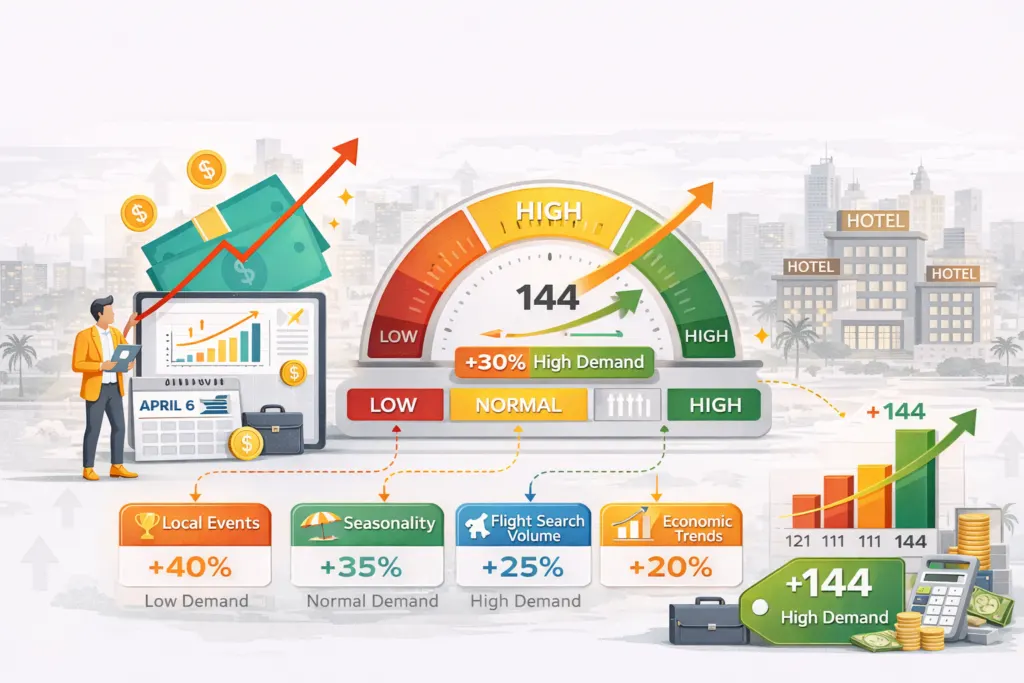
“Market demand index” is a loose term in hospitality. The standard benchmark for a hotel’s share of market demand is the Market Penetration Index (MPI), also called the occupancy index: your occupancy divided by your competitive set’s occupancy, × 100. An MPI above 100 means you captured more than your fair share of demand. Because MPI is backward-looking, hotels read it alongside ARI and RGI and combine it with forward signals — booking pace, events and competitor rates — to price ahead of demand.
Table of Contents
- What Is a Market Demand Index — and Why the Standard Is MPI
- STR Data and How MPI Is Calculated
- Types of Demand Signals
- Interpreting Your MPI
- Above and Below Index: Implications
- AI Demand Monitoring and Propeter’s Demand Forecasting
- Frequently Asked Questions
Demand is not uniform. On any given night, some hotels in a market fill up quickly and at premium rates, while others struggle to convert lookers into bookers even at deep discounts. Understanding why — and predicting when demand will favour your property — is the core challenge of hotel revenue management.
Hoteliers often talk about a “market demand index”, but the industry-standard benchmark for demand capture is the Market Penetration Index (MPI). MPI is a lagging indicator: it tells you where you have been. The forward-looking signals that drive future demand — booking pace, search volume, event calendars, competitor rates and wider economic conditions — are where the real competitive advantage lies.
What Is a Market Demand Index — and Why the Standard Is MPI
The term “market demand index” is not a standard benchmarking metric, and you may see it used for different things — from an occupancy index to a vendor’s own composite demand score. The standard benchmark for demand capture is the Market Penetration Index (MPI), one of three performance indices tracked by hotels using competitive benchmarking data such as STR. It is calculated as:
MPI = (Hotel Occupancy % / Compset Average Occupancy %) × 100
An MPI of 100 means the hotel is capturing exactly its fair share of market demand. An MPI of 115 means the hotel’s occupancy was 15% higher than the compset average. An MPI of 88 means its occupancy was 12% below the compset average.
MPI is part of a trio of standard indices alongside the Average Rate Index (ARI) and Revenue Generation Index (RGI, also called the RevPAR index). Together, they provide a complete picture of competitive performance: MPI shows demand capture, ARI shows rate positioning, and RGI shows overall revenue performance. A hotel with a high MPI but low ARI is filling rooms cheaply — capturing demand but at a rate discount. A hotel with high ARI and moderate MPI may be pricing itself out of some demand while maximising rate on the bookings it does capture. The optimal balance between these indices defines the hotel’s revenue strategy.
STR Data and How MPI Is Calculated
The MPI calculation requires competitive set data — specifically, the occupancy performance of the hotels against which you benchmark. In most markets, this data is sourced from STR (now CoStar), which aggregates and anonymises performance submissions from participating hotels.
How STR Benchmarking Works
Hotels submit their daily performance data (rooms sold, rooms available, revenue) to STR, which aggregates it across predefined competitive sets and returns each hotel’s performance relative to its compset. Because the data is anonymised, individual competitor performance cannot be identified — but the compset averages provide a statistically robust benchmark.
STR reports are commonly reviewed monthly, and more frequent reporting is available from the benchmarking provider, enabling closer MPI tracking and faster response to demand shifts.
Compset Selection for MPI Accuracy
The accuracy and relevance of your MPI depends entirely on the quality of your competitive set definition. If your compset includes hotels that are not genuine competitors (different market tier, different location, different demand generators), the MPI will be misleading. Review compset composition regularly so your benchmarks reflect true competitive dynamics.
Types of Demand Signals
The MPI tells you about past demand capture. Forward-looking demand signals tell you about future demand. There are several categories of signals that hotel revenue managers should monitor:
Transient Booking Pace
The rate at which individual (non-group) reservations are accumulating for future dates, compared to the same point in the booking window in prior periods. Accelerating pace signals strengthening demand; decelerating pace signals weakness. This is the highest-frequency, most operationally actionable demand signal available.
Group Booking Pace
For hotels with significant group segments (conference, events, weddings), group bookings often arrive many months in advance. Monitoring group pace against historical norms provides early warning of periods where the base occupancy from group business is stronger or weaker than expected, informing transient rate strategy for those periods.
Search Volume and Intent Signals
Increases in OTA search queries for your destination, or in Google Hotels visibility data, are leading indicators of future booking demand. These signals can lead actual bookings, giving revenue managers an advance window to adjust rates before pace confirms the change.
Event and Calendar Demand Drivers
Major events — conferences, festivals, sports, graduations — create predictable demand spikes. Monitoring event calendars 90–180 days in advance allows hotels to price these periods appropriately before demand becomes visible in booking pace. Local events up to 365 days ahead (via PredictHQ, where enabled) are scored and fed into demand forecasts. Where enabled, a daily email lists high-impact events for the next 7 days.
Macroeconomic and External Signals
Consumer confidence, corporate travel policy changes, airline capacity decisions, and exchange rate movements all affect hotel demand at a macro level. While these signals are harder to incorporate in day-to-day rate decisions, they are essential context for medium and long-term demand forecasting.
XGBoost + LSTM Neural Networks
Propeter’s demand forecasting blends XGBoost gradient boosting and LSTM neural network forecasts per horizon once enough booking history exists. XGBoost captures non-linear relationships between structured demand signals; LSTM handles temporal patterns in booking pace data. Inputs include your occupancy and pickup pace, booking window, length of stay, competitor rates, seasonality and scored local events.
Interpreting Your MPI
Raw MPI numbers become meaningful when tracked over time and segmented by date type. A hotel might have an overall MPI of 102 (marginally above index) but find significant variation when looking at weekdays versus weekends, shoulder season versus peak, or event periods versus standard periods.
Trend Analysis
A declining MPI trend — even if still above 100 — is a warning signal. It means the hotel is gradually losing demand share to its compset. This can result from rate increases that have exceeded the market’s willingness to pay, declining distribution visibility on key OTA channels, product deterioration relative to improved competitors, or loyalty programme weakness. Identifying the cause requires correlating the MPI decline with changes in rate positioning (ARI), review scores, and channel mix data.
Segment-Level MPI
Some hotels track separate demand indices by segment — transient MPI, group MPI, and corporate MPI. This granularity reveals whether demand underperformance is market-wide or concentrated in a specific segment, enabling more targeted responses. For example, a hotel with strong overall MPI but weak corporate MPI may need to review its corporate rate programme rather than adjusting BAR rates.
Above and Below Index: Implications and Responses
Being above MPI index is generally positive, but context matters. A hotel that is significantly above index (MPI of 120+) may be selling out too early at rates that are too low — capturing more than its fair share of demand by underpricing relative to the market. In this scenario, the right response is to raise rates, not to celebrate the high MPI.
Being below MPI index (under 90) indicates demand underperformance. The appropriate response depends on diagnosis:
- Pricing too high relative to product: Rates need to be more competitive with compset peers offering similar value
- Distribution gap: The hotel may not be visible on key OTA channels or may have rate parity issues suppressing OTA visibility
- Product or reputation issues: Low review scores reduce conversion from lookers to bookers regardless of rate
- Loyalty programme weakness: Competitors with stronger loyalty programmes are winning repeat business that bypasses the hotel
AI Demand Monitoring and Propeter’s Demand Forecasting
Propeter is a revenue management and pricing system that works with your PMS. Its forecasts use your occupancy and pickup pace, booking window, length of stay, competitor rates, seasonality and scored local events, at horizons out to 90 days. Forecasting, price-elasticity and RevPAR pipelines feed a pricing engine with a policy gate, and the pipeline runs hourly by default.
When the forecast for a date moves above or below expectations, the recommended rate moves with it. Guardrails apply, each recommendation shows its calculation inputs, and your team reviews and approves rates before they are published.
For revenue managers, this means MPI becomes a retrospective check on decisions made from forward signals, rather than the primary planning tool. Note that MPI is relative: not every hotel in a compset can be above 100 at the same time, so the goal is to capture your fair share at the right rate, not to chase occupancy.
From Reactive to Predictive
Moving from reactive, index-based management to forward-looking demand management is one of the most valuable changes a revenue team can make — not through rate cuts, but through better timing of rate decisions across the booking curve.
Frequently asked questions
How do air search signals help predict demand before it shows up in MPI?
Air search and capacity data can act as an early indicator of destination demand. Rising flight searches or added route capacity into a destination weeks before travel can signal demand that will later show up in booking pace — and, after the fact, in MPI. Hotels with access to this kind of data can use it as context for rate decisions ahead of their historical booking curve.
What causes “ghost demand” to distort local hotel market index calculations?
Ghost demand happens when automated bots, competitors, or third-party metasearch scrapers run continuous automated searches on a hotel’s booking engine. This creates an artificial spike in localized search interest without any actual booking conversions, which can trick un-optimized forecasting models into raising room rates for dates where real organic demand is low.
How should hotels read MPI during overlapping local events?
Compare event dates with comparable non-event dates rather than with the month as a whole, because events distort averages. Separate general seasonality from event-specific booking pace, and use observable signals — competitor availability closures and rate moves — to judge how much of the market the event is absorbing. That keeps you from reading a high MPI on an event night as success when you may simply have sold out too cheaply.
What is the market demand index in hospitality, and how does it relate to MPI?
“Market demand index” is a loose term; the standard index is the Market Penetration Index (MPI), also called the occupancy index. It compares a hotel’s occupancy percentage to the average occupancy of its competitive set. An MPI above 100 means the hotel is capturing more than its fair share of market demand; below 100 means underperformance relative to the compset.
What are the main types of demand signals hotels should monitor?
Hotels should monitor transient booking pace, group booking pace, search volume trends on OTAs and Google Hotels, event calendars, flight search data, competitor rate and availability signals (competitor occupancy itself is not observable), and historical seasonal patterns. Propeter’s forecasts use your pickup pace, booking window, length of stay, competitor rates, seasonality and scored local events.
How is STR data used to calculate demand indices?
STR (now CoStar) aggregates anonymised performance data from hotels in a competitive set and calculates market averages for occupancy, ADR, and RevPAR. A hotel’s MPI is calculated by dividing its own occupancy by the compset average occupancy and multiplying by 100. An MPI of 110 means the hotel achieved 10% higher occupancy than the compset average.
What does it mean when a hotel’s MPI is below 100?
An MPI below 100 means the hotel is underperforming its compset on occupancy — it is not capturing its fair share of available demand. This can result from pricing that is too high relative to the product, poor OTA visibility, weak distribution strategy, or product issues.
Stay ahead of market demand with AI
See what your index position is worth in revenue with the RevPAR calculator, or book a demo to see how Propeter turns forward demand signals into rate recommendations your team approves.
Learn About AI Revenue Management
Related Articles

Market Positioning in Hospitality: How Pricing Shapes Your Hotel’s Competitive Identity
Market positioning in hospitality is the deliberate strategic process of establishing a hotel’s…

Channel Mix Optimization: Balancing OTA and Direct Bookings for Maximum Hotel Revenue
Hotels optimize their channel mix by prioritizing net revenue yield over gross booking…
Calculate your RevPAR
Apply the formulas in this guide to your own occupancy and ADR.