
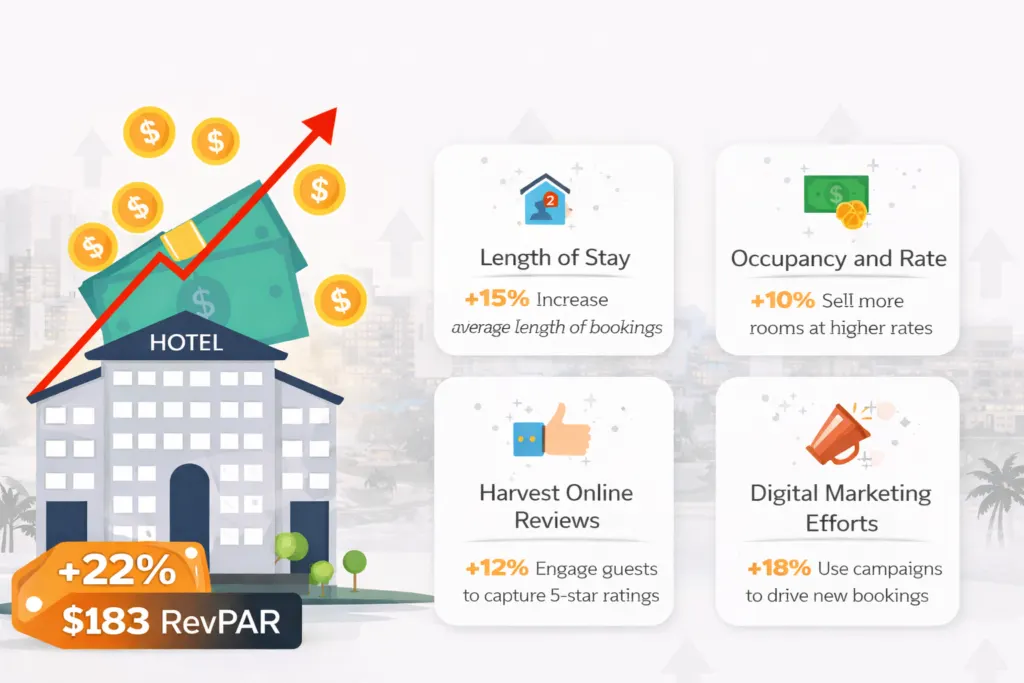
To increase RevPAR without lowering hotel room rates, hoteliers must focus on optimizing occupancy and Average Daily Rate (ADR) simultaneously through non-disruptive value creation. This is achieved by implementing strict length-of-stay (LOS) controls to protect shoulder nights, utilizing automated upselling software for room upgrades and early check-ins, and leveraging direct-booking perks like free amenities to shift business away from high-commission OTAs. These tactics drive ancillary revenue and net room yield without triggering destructive market-wide price wars.
Table of Contents
- Why Rate Cuts Hurt RevPAR Long-Term
- Occupancy Optimisation Strategies
- Upselling and Ancillary Revenue
- Direct Booking Conversion
- Loyalty Programme ROI
- Length of Stay Optimisation
- AI RevPAR Optimisation with Propeter
- Frequently Asked Questions
When RevPAR underperforms expectations, the first instinct in many hotels is to look at the rate and ask: “Are we too expensive?” Sometimes the answer is yes — but far more often, the rate is not the problem. Occupancy shortfalls, distribution inefficiencies, missed upsell opportunities, loyalty programme weaknesses, and suboptimal length-of-stay management account for a larger share of RevPAR underperformance than rate levels do.
Cutting rates to solve a RevPAR problem is like taking painkillers for a broken bone: it might temporarily relieve a symptom without addressing the underlying issue, and it creates new problems (rate anchor erosion, margin compression) that are harder to fix. The better route is to improve occupancy, upsell capture, direct booking conversion and the timing of rate decisions across the forward booking window.
15–25%
Typical OTA commission range — saved on every booking shifted to direct
Why Rate Cuts Hurt RevPAR Long-Term
A rate cut is appealing because it appears to offer an immediate, mechanical solution: lower the price, sell more rooms, RevPAR recovers. In practice, the relationship between rate and occupancy is more complex — and the long-term consequences of rate cutting are almost always negative.
Rate Anchor Erosion
Markets have memory. Guests who booked your hotel at a discounted rate return expecting that rate again. Online Travel Agencies track price history. When a hotel consistently discounts to fill rooms, it gradually lowers the market’s expectation of what that hotel should cost. Recovering rate after a period of sustained discounting requires either a genuine product improvement or a painful period of lower occupancy while the market recalibrates — both costly outcomes.
Guest Quality Dilution
Rate cuts attract more price-sensitive guests — travellers whose primary selection criterion is cost rather than quality. Deal-driven guests can be less likely to use ancillary services (lower TRevPAR) and less likely to return (lower lifetime value), because they chose the hotel for the price rather than the product. The guests that premium pricing attracts are the guests that make a hotel’s revenue base sustainable.
The RevPAR Formula Reminder
RevPAR = ADR × Occupancy %. Rate cuts improve the occupancy component but reduce the ADR component. Whether RevPAR net improves depends on price elasticity — and on many dates demand is not elastic enough for a rate cut to raise RevPAR. Where demand is genuinely elastic — soft periods with plenty of alternatives — a targeted rate move can be the right call, which is why elasticity should be estimated rather than assumed. The strategies below improve occupancy and/or reduce distribution costs without touching ADR.
Occupancy Optimisation Strategies
Improving occupancy without reducing rates requires attracting more guests at current price points. Several proven approaches achieve this:
Distribution Channel Optimisation
Many hotels underperform on occupancy not because their rates are wrong but because they are not visible enough on the channels where their target guests shop. Auditing OTA visibility — ensuring listing content (photos, descriptions, amenities) is optimised, reviewing scores are strong, and listing rank is maximised — often improves occupancy without any rate change.
Segment Mix Optimisation
Different guest segments fill different dates. Corporate guests travel Monday to Thursday; leisure guests fill weekends; conference groups block specific dates months in advance. Hotels that actively manage their segment mix — proactively pursuing corporate accounts for weak mid-week periods, activating group contracting for historically low-demand dates — can improve overall occupancy without changing BAR rates.
Booking Window Extension
Incentivising guests to book further in advance (through early bird rate plans, non-refundable rate packages, or loyalty programme perks) extends the booking window and smooths occupancy across the forward calendar. This is particularly valuable for dates where last-minute demand is structurally weak — it fills the calendar early rather than scrambling at low rates close to arrival.
Upselling and Ancillary Revenue
One of the most reliably profitable RevPAR improvement strategies is growing revenue per guest rather than growing guest volume. Upselling — room upgrades, premium room types, extended stays — and ancillary cross-selling (spa, dining, parking, activities) increases TRevPAR without any rate cut or occupancy increase.
Room Upgrade Upselling
Systematic room upgrade offers at booking and at check-in convert a significant percentage of standard room bookings to premium room types. The incremental rate premium for an upgrade is typically small relative to its impact on TRevPAR — a guest who books a standard room at £150 and upgrades to a deluxe room for £30 more has improved ADR by 20% on that booking with minimal friction.
Propeter’s direct booking engine includes a dedicated upsell stage in its rate engine: rule-based upgrade and add-on offers that you configure by room type and price, applied within the same guardrails as the room rate. Before offering a discounted upgrade, check that the premium room is unlikely to sell at full rate.
Ancillary Revenue Packages
Rate packages that bundle room with food and beverage, spa access, or experiences encourage higher guest spend within the property. The key is pricing packages at a modest perceived discount relative to individual components (making them feel valuable to the guest) while ensuring the total revenue exceeds what a room-only booking would generate in ancillary spend. Well-designed packages increase both occupancy conversion and TRevPAR simultaneously.
Direct Booking Conversion
This strategy does not increase the number of bookings or the rate — it changes where bookings originate. Shifting a booking from Booking.com (often 15–20% commission) to a direct channel (a much lower acquisition cost) improves NRevPAR (Net Revenue Per Available Room) by exactly the commission saved, without any rate change or occupancy increase required.
For a hotel with £150 ADR and 75% occupancy (RevPAR £112.50), converting 20% of OTA bookings to direct at an average 17.5% commission saving improves net RevPAR by about £3.94 per available room per night (assuming all bookings currently come through OTAs: £112.50 × 20% × 17.5%) — purely from distribution cost reduction, before any direct-channel costs. At scale, this is a material, sustainable RevPAR improvement.
Propeter’s Direct Booking Engine is designed to convert OTA lookers into direct bookers through a straightforward booking experience, clear direct-booking benefits and member-only rates for signed-in loyalty members (parity terms vary by OTA contract — check your agreements), that make direct booking genuinely attractive to guests without discounting the BAR rate.
The Direct Booking Multiplier
Every direct booking does double revenue management duty: it saves the OTA commission (improving NRevPAR immediately) and builds a guest relationship that makes the next booking more likely to be direct as well. A loyalty programme turns this multiplier into a compounding advantage over time, growing the hotel’s direct booking base.
Loyalty Programme ROI
A well-run loyalty programme is one of the highest-ROI RevPAR improvement investments available to a hotel. Its benefits compound across multiple RevPAR drivers simultaneously:
- Direct booking shift: Loyalty members book direct to earn points, reducing OTA commission costs
- Repeat frequency increase: Members stay more often, improving average occupancy
- ADR resilience: Loyal guests are less price-sensitive and more resistant to competitor discounts
- Ancillary spend increase: Members who feel ownership of their loyalty relationship spend more on F&B, spa, and extras
- Review quality improvement: Engaged loyalty members generate more positive reviews, improving OTA visibility and conversion
Propeter’s loyalty module builds these benefits through points, tier progression, achievement badges and member rewards — creating an engaging loyalty experience that goes beyond standard point programmes. The gamification layer makes participation intrinsically motivating, not just transactionally valuable.
Length of Stay Optimisation
Length of stay (LOS) restrictions — minimum stay requirements applied to specific dates — are one of the most underused RevPAR tools in the hotel industry. When applied intelligently, they can significantly improve occupancy on shoulder dates adjacent to high-demand peaks without any rate discount.
How LOS Restrictions Work
Consider a hotel that is strongly booked on a peak Saturday night (85% occupancy at £220) but has weak occupancy on the surrounding Friday (45%) and Sunday (40%) nights. The goal is to make guests who want Saturday also take a shoulder night. Two controls do this correctly. A minimum stay-through rule — any stay that includes Saturday must be at least 2 or 3 nights — means Saturday guests have to add Friday and/or Sunday. A closed-to-arrival (CTA) restriction on Saturday means guests who want Saturday night must arrive on Friday, which fills Friday specifically. (A minimum stay applied only to Saturday arrivals would not help Friday at all: it would push those guests into Sunday and Monday instead.) Watch for displacement: if Saturday would sell out anyway to one-night guests, the restriction should be light enough not to turn that demand away.
The RevPAR impact on the shoulder dates is direct and measurable. Illustrative example: a Friday night that moves from 45% to 70% occupancy through these controls (at an unchanged rate of £160) improves Friday RevPAR from £72 to £112 — a 56% improvement with no rate change.
In Propeter, min/max length-of-stay rules are configured on rate plans and enforced when the direct booking engine quotes; your team decides when to apply them, using the demand forecast as a guide.
AI RevPAR Optimisation with Propeter
Each of the strategies described above can be applied manually with enough time, data, and analytical capacity. But in practice, manual implementation is limited by human bandwidth — a revenue manager cannot simultaneously monitor occupancy trajectories for every future date, evaluate upsell pricing, manage loyalty programme offers, track competitor rates, and optimise LOS restrictions. Something gets deprioritised.
Propeter is a revenue management and pricing system that works with your PMS. Propeter forecasts demand, monitors your market and competitor rates, and recommends a rate for each room type and date, showing the reasons behind it. Your team reviews and approves recommendations individually or in bulk, and approved rates are published through your connected PMS and distribution systems. Forecasting, price-elasticity and RevPAR pipelines feed a pricing engine with a policy gate, and the pipeline runs hourly by default. Propeter brings competitor rates into its pricing recommendations — from your Lighthouse subscription, if you have one, and from public listings collected through a third-party data provider. Competitor rates refresh hourly for the next 14 nights and progressively less often for dates further out.
Set rate floors, ceilings and maximum discount caps; recommendations without them are blocked from publishing, and direct booking quotes are clamped to them. Its direct booking engine, loyalty module and rule-based upsells sit on the same rate engine, so direct offers stay consistent with the rates you approve.
The result is that the levers in this guide are applied every day rather than when someone has time — not through rate cuts, but through better intelligence, better timing and better use of every revenue lever available to the hotel. Model what that could be worth with the RevPAR calculator or the ROI calculator.
Frequently asked questions
How do you fix mid-week RevPAR slumps without dropping weekend rates?
Use length-of-stay controls around the strong nights so that guests who want them also book adjacent weak nights. For example, if Saturday is strong and Friday is weak, close Saturday to arrival (so Saturday guests must arrive on Friday) or apply a minimum stay-through on any stay including Saturday. If midweek is weak because business demand is soft, complement this with corporate account outreach and midweek packages rather than lowering weekend rates.
What is the role of automated upselling in protecting hotel ADR and RevPAR?
Automated upselling platforms protect hotel ADR and RevPAR by dynamically targeting pre-arrival guests with targeted add-ons, room upgrades, and early check-in offers based on real-time inventory availability. Because these upgrades monetize unbooked premium rooms after the initial reservation is made, they increase total revenue per guest without diluting the public base room rate.
How does predicting cancellation wash-factors increase RevPAR safely?
Predicting cancellation wash factors allows hotels to estimate how many confirmed bookings will end up as no-shows or late cancellations. By overbooking standard room types by a conservative share of that estimate during peak demand windows, a hotel can maximize its actual physical occupancy on check-in day, boosting RevPAR without discounting inventory.
Why does cutting rates hurt RevPAR long-term?
Rate cuts cause two long-term problems: rate anchor erosion and guest quality dilution. When a hotel repeatedly discounts, it trains the market to expect lower rates, making it harder to recover ADR. It also attracts more price-sensitive guests who spend less on ancillaries, leave poorer reviews, and are less likely to return — gradually degrading the hotel’s revenue base.
What is length of stay (LOS) optimisation and how does it increase RevPAR?
LOS optimisation uses length-of-stay controls during high-demand periods so that peak-night demand also fills the shoulder nights. For example, a minimum stay-through on any stay including a peak Saturday means Saturday guests must add Friday or Sunday, and closing Saturday to arrival pushes them to arrive on Friday. In Propeter, min/max LOS rules are configured on rate plans and enforced at quote time.
How much RevPAR improvement is achievable with AI revenue management?
There is no reliable universal figure: it depends on how the hotel prices today, its market and how consistently the team uses the system. Improvements come from better rate timing, occupancy optimisation, upsell capture, direct booking growth and lower distribution cost. Measure against a clear baseline, and model the value of each point of RevPAR with the RevPAR calculator.
How does a loyalty programme increase RevPAR without lowering rates?
Loyalty programmes increase RevPAR by shifting bookings from OTA channels (which charge 15–25% commission) to direct channels (much lower acquisition cost), increasing repeat booking frequency, and improving guest lifetime value. Propeter’s loyalty module builds these direct relationships through points, tier progression and member offers — all without requiring rate discounts that would erode ADR.
Grow your RevPAR without cutting rates
Start with your own numbers in the RevPAR calculator, or book a demo to see how Propeter’s rate recommendations, guardrails, booking engine and loyalty module work together.
Related Articles

Rate Shopping Explained: How Hotels Monitor Competitor Pricing
Rate shopping in the hotel industry is the automated process of monitoring, aggregating,…
Calculate your RevPAR
Apply the formulas in this guide to your own occupancy and ADR.