

AI revenue management differs from traditional hotel revenue management in three ways: speed (forecasts and rate recommendations are recalculated many times a day instead of once or twice), data volume (models weigh dozens of demand signals at once, where a person can realistically track a handful), and consistency (a model does not panic-discount on a quiet Tuesday or anchor on last year’s rate). The gain comes from pricing each date closer to what demand will bear, not from simply charging more. The revenue manager’s judgement still matters: the strongest set-ups use AI to recommend and people to approve.
Table of Contents
- How Traditional Revenue Management Works
- The Limitations of Rule-Based Pricing
- How AI Revenue Management Works
- Head-to-Head Comparison
- Where AI Pricing Creates Value
- Making the Transition to AI Pricing
- Frequently Asked Questions
The hotel industry has always been a game of supply and demand. For most of the 20th century, revenue management meant a skilled human studying historical booking patterns, setting seasonal rate bands, and hoping the competition didn’t undercut them. It worked — sort of.
Then came the OTA era. Booking.com and Expedia gave consumers instant price transparency across hundreds of properties. The competitive landscape became brutal. A rate decision made on Monday could be obsolete by Tuesday morning.
Today, we’re in a third era: AI-assisted revenue management. AI is changing how pricing decisions are prepared, but the revenue manager’s judgement still decides which ones go live.
How Traditional Revenue Management Works
Traditional hotel revenue management is built on a foundation of historical data and human judgment. A revenue manager typically:
- Reviews last year’s booking pace and occupancy for the same period
- Manually checks competitor rates once or twice per day via rate shopping tools
- Sets rate fences (minimum stays, cancellation policies) based on experience
- Adjusts rates in weekly or bi-weekly strategy meetings
- Relies on PMS reports and Excel spreadsheets for analysis
This approach worked when competition was local and data was scarce. Revenue managers built genuine expertise through years of market experience. Their intuition about when to open or close rate categories had real value.
The Limitations of Rule-Based Pricing
Traditional revenue management has structural limitations that become more apparent as markets grow more complex:
Speed — Humans Can’t React in Real Time
Markets move fast. Demand signals shift hourly. A concert announcement, a flight sale from a feeder city, or a competitor’s flash promotion can create — or destroy — a revenue opportunity within hours. Humans checking rates twice a day simply can’t capture these moments.
Data Volume — Too Many Variables to Track Manually
A comprehensive pricing decision requires synthesising booking pace, competitor rates across 10+ channels, weather, local events, airline search trends, social media sentiment, and cancellation patterns — simultaneously. No human can process this volume reliably.
Consistency — Cognitive Biases Creep In
Revenue managers are human. They develop biases — anchoring on last year’s rates, being loss-averse during quiet periods, or overconfident during high seasons. These biases compound over time into systematic revenue leakage.
Scale — One Manager, Many Decisions
A 200-room hotel might have 15+ room categories, 8+ rate plans, and dynamic promotions across 6 channels. That’s hundreds of pricing decisions every day. Rule-based systems struggle to maintain optimal pricing across this matrix.
How AI Revenue Management Works
AI revenue management replaces rule-based pricing with predictive, self-learning systems. Rather than asking “what rate did we use last year?”, AI asks “what rate will maximise RevPAR given current and predicted demand?”
Most AI revenue management systems work through the same sequence of steps, whatever the vendor calls them:
1. Data ingestion
Pulls data on a schedule from the PMS (reservations, pickup, occupancy), competitor rate feeds, event calendars and other market sources, then cleans and normalises it.
2. Market intelligence
Processes competitor pricing from rate-shopping data, identifies positioning gaps and flags when competitors move away from their usual patterns.
3. Demand forecasting
Uses machine-learning models (for example gradient-boosted trees such as XGBoost, or LSTM neural networks) to predict demand for the dates ahead, accounting for seasonality, trend, events and anomalies.
4. Price elasticity
Models how demand responds to price changes for each room category, day of week, and lead time. Prevents the common mistake of raising rates so aggressively during peak periods that booking velocity collapses.
5. RevPAR optimisation
Balances occupancy and average daily rate to maximise total revenue, not just ADR or occupancy in isolation. This is the key insight that separates sophisticated revenue management from simple rate matching.
6. Recommendation and approval
Turns the analysis into a recommended rate per room type and date, applies guardrails (floors, ceilings, maximum daily change) and explains the reasoning. In Propeter, your team reviews and approves recommendations individually or in bulk, and approved rates are published through your connected PMS and distribution systems.
Head-to-Head Comparison
| Dimension | Traditional Revenue Management | AI-Assisted Revenue Management |
|---|---|---|
| Rate update frequency | Daily or weekly | Recalculated many times a day; published after review or within configured rules |
| Data sources processed | A handful (PMS, comp set, OTA reports) | Many (PMS pickup, competitor rates, events, seasonality, booking window) |
| Forecast horizon | 30–90 days typical | Rolling forward horizon, refreshed frequently |
| Room type granularity | Category level | Room-type + lead-time + channel level |
| Competitor monitoring | Manual spot checks, 1–2x daily | Scheduled automated rate-shopping feeds |
| Seasonality handling | Historical rates + manual adjustments | ML model trained on patterns + real-time demand signals |
| Staff time required | Much of the day spent gathering data | Time shifts to reviewing recommendations and exceptions |
Where AI Pricing Creates Value
The value of AI pricing depends on where a hotel starts. The patterns below describe where the opportunity usually sits; they are not measured results.
Boutique Hotels (30–80 rooms)
Independent properties without dedicated revenue management staff usually have the most room to improve. With no previous systematic approach, AI introduces consistent rate discipline for the first time.
Mid-Scale Group Hotels (80–250 rooms)
Properties with existing revenue managers use AI to augment rather than replace their work. Revenue managers shift from daily rate maintenance to strategic oversight and upsell programme management.
Serviced Apartments and Extended-Stay Properties
Complex pricing matrices (nightly + weekly + monthly rates, corporate accounts, length-of-stay discounts) are where systematic pricing helps most. Manual management of these structures is error-prone; a model handles them consistently.
Illustrative example — not a customer result. A 100-room hotel at £150 ADR and 72% occupancy earns about £3.94M in room revenue a year (100 × 365 × 0.72 × £150). Each 1% change in RevPAR is worth roughly £39,400 a year. The uplift any hotel achieves is the uncertain input, so model it with your own assumptions in the ROI calculator.
Making the Transition to AI Pricing
Moving from traditional to AI revenue management doesn’t mean starting over. The transition is usually structured in three phases. How long each takes depends on PMS connectivity, historical data and configuration, and is agreed during onboarding.
Phase 1: Connection and configuration
Connect your PMS, configure your competitive set, and establish rate guardrails (minimum and maximum rates per room type). The models start learning your property’s demand patterns from its booking history.
Phase 2: Shadow mode and calibration
The system runs alongside your existing pricing process, generating recommendations without applying them. Your team compares suggested rates with actual decisions, builds confidence in the recommendations and calibrates edge cases.
Phase 3: Go-live with approval
Once the team trusts the recommendations, they go live. In Propeter, your team reviews and approves recommendations individually or in bulk before they are published, and spends its time on the exceptions the system flags rather than on building every rate by hand.
The result is a revenue management function that keeps pace with the market every day, while people keep control of strategy and of what gets published.
Frequently asked questions
What is the main difference between AI and traditional hotel revenue management?
Traditional hotel revenue management relies on a revenue manager manually reviewing historical data, checking competitor rates once or twice daily, and adjusting prices in weekly strategy meetings. AI revenue management adds a model that recalculates forecasts and rate recommendations many times a day from booking pace, competitor rates, local events and seasonality. The practical difference is speed and data volume: a person can realistically track a handful of signals and update rates daily, while a model can weigh many signals for every date and room type. That helps catch opportunities such as a demand spike on a Tuesday afternoon or a competitor selling out for Friday, which a weekly process tends to miss.
How much revenue does staying on traditional pricing actually cost a hotel?
There is no reliable single percentage, and the cost is invisible because it shows up as revenue never earned rather than a line-item loss. It comes from three sources: under-pricing high-demand dates identified too late (the hotel fills at £150 when the market would have paid £220), over-discounting quiet periods out of occupancy anxiety (cutting rates 30% when a modest promotion would have filled the gap), and rate dilution across channels from infrequent updates. To size it for your hotel, work in sensitivities: for a 100-room hotel at £150 ADR and 72% occupancy (about £3.94M room revenue a year), every 1% of RevPAR is worth about £39,400 a year. The ROI calculator lets you test your own assumptions.
How do you switch from traditional to AI revenue management without disrupting revenue mid-season?
The safest transition runs in three phases. First, connect your PMS and configure rate guardrails (minimum and maximum rates per room type) so recommendations cannot fall outside your acceptable range. Second, run the system in shadow mode alongside your existing pricing: it generates recommendations but does not apply them, and your team compares them with actual decisions to find calibration gaps. Third, go live with an approval workflow, where your team reviews and approves recommendations (individually or in bulk) before they are published. The timing of each phase depends on your PMS connectivity and data, and is agreed during onboarding. Guardrails plus approval keep the downside bounded from the first day.
What does a revenue manager’s job actually look like after switching to AI?
After switching to AI revenue management, the revenue manager’s daily role changes from rate maintenance to strategic oversight. Time previously spent on manual rate analysis, competitor spot checks and spreadsheet updates moves to reviewing recommendations and exceptions: flagged anomalies, override decisions and campaign approvals. The time freed is redirected toward market repositioning decisions (should we move upmarket for the summer season?), corporate account strategy (which accounts are worth holding rate for?), group displacement analysis (does this group block cost more in transient revenue than it earns?), channel mix and loyalty programme performance.
How does AI revenue management handle cognitive biases built into previous manual pricing?
A model learns from booking behaviour rather than from the previous revenue manager’s rate decisions, which reduces common manual biases: anchoring (setting this year’s rates from last year’s levels regardless of demand), loss aversion (discounting aggressively in quiet periods) and overconfidence (holding rates too high in peak periods until last-minute drops are forced). It does not remove bias entirely. If the hotel’s history reflects years of underpriced rates, the demand curve the model learns from that history can underestimate what guests would pay. That is corrected gradually as the model observes how bookings respond to higher recommended rates, and it is one reason human review of recommendations remains important.
Does switching to AI revenue management increase the hotel’s asset value?
It can, because hotels are typically valued by applying a cap rate to Net Operating Income (NOI), and room revenue is a high-margin revenue stream. As a sensitivity, not a forecast: Illustrative example — not a customer result. If better pricing added £100,000 of annual room revenue and 65% flowed through to NOI, NOI would rise by £65,000; at a 7% cap rate that is roughly £930,000 of value. Every input here is an assumption (the uplift, the flow-through and the cap rate), so asset managers should run the numbers on their own property rather than rely on headline percentages.
Is there a situation where traditional revenue management is still the right choice over AI?
Yes — three scenarios where traditional revenue management may still be appropriate. First, hotels with fewer than 10 rooms where rate complexity is genuinely minimal and the platform cost exceeds the revenue upside. Second, properties with extremely stable, contracted demand — for example, a hotel with 90%+ of revenue from long-term corporate contracts at fixed rates — where dynamic pricing has limited application. Third, markets with very low booking velocity where demand signals are insufficient for AI models to outperform simple seasonal rate plans. Outside these scenarios, most hotels benefit from at least some systematic, data-driven pricing support, because the number of dates, room types and channels to price has outgrown what a weekly manual process can handle well.
How does AI revenue management handle last-minute demand differently from traditional approaches?
Last-minute demand (bookings within 0–7 days of arrival) is where the gap between AI-assisted and traditional revenue management is often widest. Traditional approaches typically set last-minute rates in a weekly strategy meeting and rarely adjust them unless occupancy falls critically low. An AI system watches last-minute booking pace continuously: as same-week bookings accelerate beyond forecast, it recommends higher rates; as pace falls behind, it can suggest targeted promotions. In compression markets, where demand spikes sharply in the final days before arrival, reacting the same day rather than at next week’s meeting is the difference between selling out at the market rate and selling out at a rate set days earlier.
What is the 3-generation evolution of hotel revenue management?
Hotel revenue management has evolved through three distinct generations. Generation 1 (pre-2000s): fixed rate cards with seasonal adjustments — summer rate, winter rate, weekend rate — set annually and rarely changed. Generation 2 (2000s–2020s): rule-based RMS systems that automated basic occupancy-threshold pricing — “raise rate by 10% when occupancy exceeds 75%” — but still required human configuration of every rule and could not adapt to signals outside the predefined logic. Generation 3 (2020s–present): AI-powered systems using machine learning models (XGBoost, LSTM neural networks) that continuously learn from booking behaviour, weigh many demand signals at once, and generate pricing recommendations without every rule being configured by hand. Hotels still pricing from spreadsheets or basic rules are competing against properties that reprice from current demand every day.
How quickly does AI revenue management outperform an experienced traditional revenue manager?
There is no reliable universal timeframe. A model improves as it accumulates property-specific history, so the early weeks are a calibration period. Its advantage over an experienced revenue manager is not intelligence but stamina and coverage: it does not sleep, does not anchor on last year’s rates and weighs signals for every date and room type. Experienced revenue managers remain better at judgement calls the data cannot see, such as an unexpected event, a new competitor opening or a strategic repositioning. That is why the most effective set-up pairs model recommendations with human review rather than choosing one or the other.
See AI Revenue Management in Action
See how Propeter forecasts demand, monitors your market and recommends a rate for each room type and date with the reasons shown, while your team approves what gets published. Or start by modelling the opportunity on your own numbers.
Calculate your revenue opportunity
Related Articles
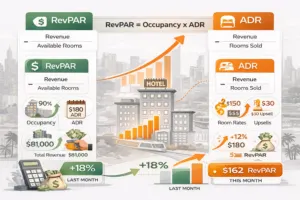
RevPAR vs ADR Explained: Understanding the Most Important Hotel Revenue Metrics
The core difference between RevPAR (Revenue Per Available Room) and ADR (Average Daily…

Channel Mix Optimization: Balancing OTA and Direct Bookings for Maximum Hotel Revenue
Hotels optimize their channel mix by prioritizing net revenue yield over gross booking…
Model the opportunity
Estimate what better pricing could be worth using your own assumptions.