
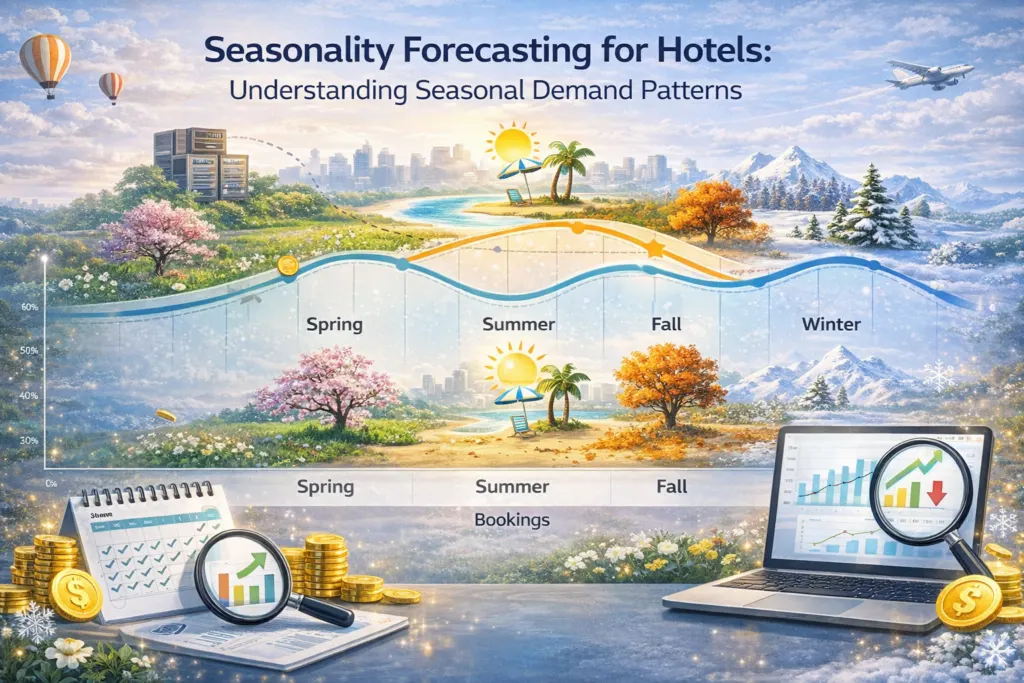
Seasonality forecasting for hotels is a predictive revenue management practice that uses historical occupancy data, time-series analysis, and machine learning to identify recurring demand fluctuations tied to calendar periods. By decomposing calendar data into predictable annual, seasonal, and day-of-week trends, hoteliers can anticipate recurring seasonal peaks and troughs well ahead — often a year or more for the broad pattern — and refine the outlook with booking pace as dates approach. This structural visibility allows properties to maximize Average Daily Rate (ADR) during high-demand surges and deploy targeted packaging strategies to shield profit margins during off-season valleys.
Table of Contents
- Types of Hotel Seasonality
- Decomposing Seasonal Demand
- Forecasting Methods for Each Season
- Peak Season Revenue Strategy
- Shoulder Season Optimisation
- Low Season Management
- How AI Improves Seasonal Forecasting
- Frequently Asked Questions
Seasonality is the backbone of hotel revenue management. A coastal resort in Queensland has a completely different seasonal pattern than a business hotel in Sydney CBD. A mountain ski lodge faces the opposite cycle to a beach property. Understanding, forecasting, and strategically responding to your property’s seasonal demand rhythm is one of the highest-leverage skills in hospitality revenue management.
The challenge is that seasonality is never perfectly predictable. Holiday dates shift, weather events disrupt normal patterns, new demand generators emerge, and economic cycles overlay seasonal trends. This is where rigorous forecasting — and increasingly, AI — makes the difference between properties that consistently hit peak revenue and those that leave money on the table.
Types of Hotel Seasonality
Hotel demand seasonality operates across multiple dimensions simultaneously:
Annual Seasonality
The primary seasonal cycle — driven by school holidays, climate, cultural events, and economic patterns. A coastal leisure hotel peaks in December–January (Australian summer); a business hotel peaks in February–June and September–November (outside school holiday periods).
Weekly Seasonality
Day-of-week patterns are often as pronounced as annual patterns. Business hotels peak Tuesday–Thursday and trough Friday–Sunday. Leisure properties peak Friday–Sunday and trough Monday–Wednesday. Understanding and pricing to weekly seasonality is a fundamental revenue management discipline.
Intra-Day Patterns
For hotels with significant walk-in traffic or same-day bookings, booking velocity has intra-day patterns — morning booking spikes, lunchtime lulls, evening peaks on travel websites. Understanding these patterns enables targeted flash promotions at the right moment.
Key Insight
Most hotels manage annual seasonality reasonably well. The biggest revenue opportunities often lie in weekly seasonality optimisation — specifically, capturing revenue on shoulder days (Sunday nights for business hotels; Monday nights for leisure) that would otherwise remain unfilled at low rates.
Decomposing Seasonal Demand
To forecast accurately, revenue managers must decompose observed demand into its underlying components:
- Trend: Long-term growth or decline in the market (new supply, population growth, tourism trends)
- Seasonality: Repeating cyclical patterns tied to calendar periods
- Calendar effects: Holiday positioning, school term dates, day-of-week patterns
- Event effects: Conferences, festivals, sporting events — not part of regular seasonality
- Residual/noise: Unexplained variation — true uncertainty in the forecast
Separating these components enables more accurate forecasting: trend models project the baseline; seasonal models apply predictable cycles; event models add specific demand spikes; residual uncertainty is quantified as a confidence interval.
Forecasting Methods for Each Season
Historical Decomposition (Classic Approach)
Calculate seasonal indices from 3–5 years of historical data: the ratio of each period’s average occupancy to the annual average. Apply these indices to a projected baseline to generate seasonal forecasts. Simple, interpretable, and surprisingly robust for stable markets.
Regression Models
Build regression models with seasonal dummy variables, event indicators, and macroeconomic predictors. Better at incorporating explanatory variables than pure historical decomposition, but requires careful variable selection.
ML-Based Forecasting (Propeter Approach)
XGBoost and LSTM models trained on full historical data plus external signals — capturing non-linear seasonal patterns that regression models miss. Updated as new booking data arrives, so the forecast is refined frequently rather than once a season.
Peak Season Revenue Strategy
Peak season is when revenue management decisions have the highest absolute impact. The goal: maximise RevPAR by capturing as much of peak demand at the highest sustainable rate.
Rate Ratchet Strategy
Rather than setting peak rates immediately, use a rate ratchet approach: start at moderate rates and increase as occupancy builds, ensuring you’re always slightly ahead of demand. This avoids the twin mistakes of pricing too high too early (losing early bookings to competitors) or too low too late (filling up before capturing peak rate).
Inventory Management
Peak season is when minimum stay requirements, close-to-arrival restrictions, and allocation management have the most impact. Block out low-rated contract and wholesale allocations early. Ensure direct booking and retail channels have sufficient inventory to capture premium-paying guests.
Group vs Transient Balance
Accept group business cautiously during peak periods. A large group at a discounted rate may displace individual transient bookings at higher rates. Before accepting, compare the group’s total value (rooms plus F&B and meeting space) with the transient revenue it is likely to displace on those dates.
Shoulder Season Optimisation
Shoulder season is underutilised in most hotels’ revenue strategies. It represents the largest opportunity for incremental revenue gain — demand is sufficient to support meaningful rate increases, but most hotels either hold peak rates too long or drop to low season rates too early.
Effective shoulder season tactics include length-of-stay promotions (stay 3 nights, get 4th at 50% off), package bundling (breakfast + parking + flexible checkout), targeted early-bird offers for advance bookings, and smart use of Flash Deals in the 7-day window to fill remaining inventory without compromising rate integrity on early bookings.
Low Season Management
Low season revenue management is about profitability optimisation, not just occupancy. With reduced demand, every cost-conscious decision matters:
- Close unsold room types to reduce housekeeping costs
- Use rooms strategically for maintenance and refurbishment
- Shift marketing spend to generate incremental demand (staycation, local market)
- Target value-seeking segments with genuine savings, not shallow discounts
- Lock in advance bookings with non-refundable rate plans at slightly lower BAR
How AI Improves Seasonal Forecasting
AI’s primary advantage in seasonal forecasting is the ability to capture complex, multi-dimensional seasonal patterns simultaneously. Traditional methods handle annual seasonality well but struggle with the interaction between weekly patterns, event effects, and long-term trend shifts.
LSTM networks are designed for temporal dependencies, which makes them a good fit for booking-curve and seasonal patterns, and gradient-boosted models such as XGBoost can incorporate external signals such as events and competitor rates. Propeter blends XGBoost and LSTM forecasts per horizon once enough booking history exists, using inputs including seasonality, pickup pace, booking window, competitor rates and scored local events, so forecasts reflect both the seasonal pattern and current market conditions. Long-range seasonal patterns still depend on having several years of clean history.
Frequently asked questions
How do hotels isolate micro-seasonality from macro annual demand patterns?
To isolate micro-seasonality, revenue management systems apply a multi-period seasonal decomposition algorithm (such as STL decomposition). This mathematical process separates high-level annual patterns (like summer travel spikes) from weekly localized variations (like midweek business traveler volume), allowing software to establish separate day-of-week pricing baselines within a larger overarching macro season.
How do you adjust a seasonal hotel forecast during extreme weather anomalies?
When extreme weather anomalies break historical seasonal baselines, hoteliers must shorten their forecast horizons and overlay real-time cancellation pace and short-term regional search intent. If a ski resort lacks snow during its typical peak winter window, historical seasonal multipliers must be overridden by localized pickup metrics to aggressively lower rate floors and stimulate alternative indoor or spa demand.
How do hotels prevent forecasting errors caused by shifting holiday calendars?
Hotels prevent forecasting errors from shifting holiday calendars by implementing a custom holiday event alignment mapping rule inside their Property Management System (PMS) or analytics stack. Instead of comparing year-over-year performance strictly by identical calendar dates, the software shifts the historical baseline reference to align with the actual day of the festival or holiday sequence (e.g., mapping Easter week to Easter week), preventing artificial pace alerts.
What are the main types of hotel seasonality?
Hotels typically experience three demand seasons: peak (highest demand, highest rates), shoulder (moderate demand with significant revenue opportunity if priced correctly), and low season (below-average demand requiring targeted promotions and cost management). These play out across annual, weekly, and sometimes intra-day cycles.
How do hotels forecast seasonal demand?
Hotels forecast seasonal demand using historical occupancy data, event calendars, forward-looking booking pace, search trend analysis, and competitive intelligence. AI platforms use machine learning to generate forecasts for the weeks and months ahead and update them frequently as bookings arrive.
How should hotels price shoulder seasons?
Shoulder seasons offer the best revenue management opportunity. Effective strategy includes targeted promotions for value-seeking segments, length-of-stay incentives bridging into peak periods, and early-bird rates to capture advance bookings without diluting peak rates.
Can AI improve seasonal demand forecasting accuracy?
Yes. AI improves seasonal forecasting by processing far more variables than traditional methods, identifying non-linear seasonal patterns, and updating forecasts continuously. Models such as LSTM networks are well suited to recurring temporal patterns, though multi-year seasonal effects still need several years of history to learn reliably.
Forecast Your Seasons With AI Precision
See how pickup, seasonality and events combine into a forward demand view with the forecast tool, or book a demo to see Propeter’s demand forecasts feed rate recommendations your team approves.
Related Articles

Event Demand Forecasting for Hotels: Predicting Demand from Major Events
Event demand forecasting for hotels is the process of tracking local events (concerts,…

Demand Forecasting Techniques for Hotels: Predicting Demand to Optimize Revenue
Hotels leverage a combination of quantitative, historical, and advanced machine learning models to…

AI Forecasting for Hotel Demand: How Predictive Analytics Improves Revenue Strategy
AI forecasting for hotel demand uses machine learning models — specifically XGBoost gradient…
Try a demand forecast
See how pickup, seasonality and events combine into a forward demand view.