
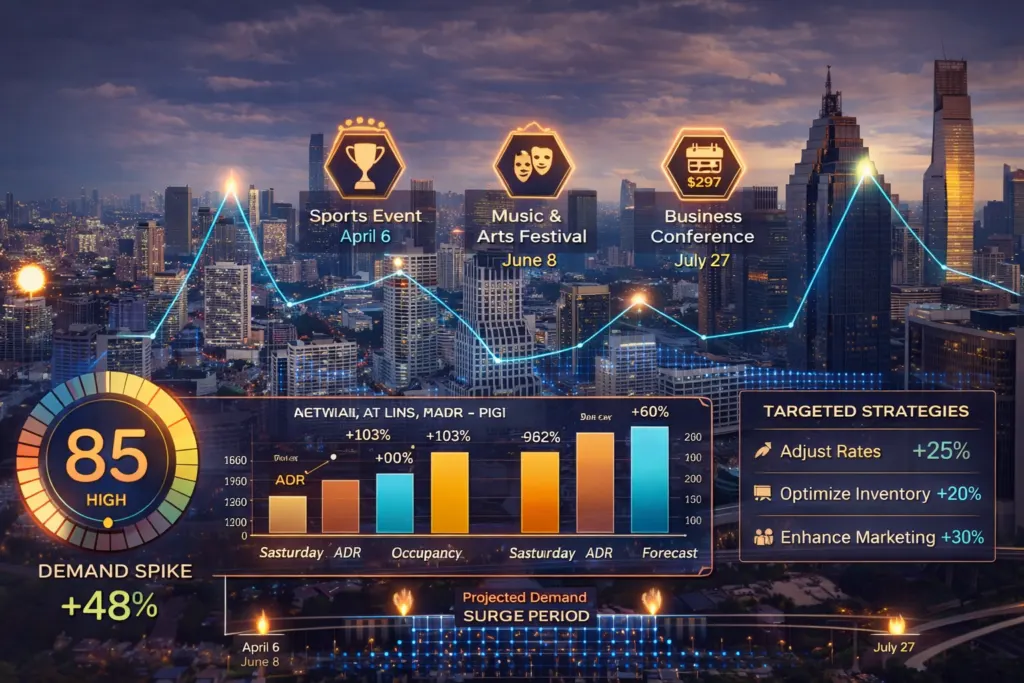
Event demand forecasting for hotels is the process of tracking local events (concerts, sports, conferences) and the demand signals around them so that room rates and restrictions are adjusted before booking pace spikes. Manual processes tend to notice an event only when rooms are already filling. Modern systems combine event calendars with booking-pace anomalies and compset closures, so independent and boutique hotels can lift rates for the affected dates weeks ahead of the market rather than after it has moved.
Table of Contents
- Why Event Forecasting Matters
- Types of Events and Their Demand Impact
- Detecting Event Demand Signals
- Pricing Strategy for Event Periods
- Minimum Stay and Restriction Strategy
- How AI Detects and Responds to Events
- Frequently Asked Questions
Consider an illustrative scenario: a stadium two kilometres from a boutique hotel announces a three-day, 50,000-attendee music festival. Hotels watching booking pace and event calendars see the surge building weeks ahead and raise rates progressively. Hotels relying on a weekly manual rate review notice when competitors are already full — and sell their last rooms at rates set for an ordinary weekend. (Illustrative example — not a customer result.)
Event demand forecasting is the discipline of identifying when major events will drive above-normal hotel demand, quantifying that demand uplift, and pricing accordingly — early enough to capture the maximum revenue opportunity.
Why Event Forecasting Matters
Events create demand compression — a surge in simultaneous accommodation demand across a destination that would otherwise be spread across time. This compression is a revenue manager’s best friend: it allows rates to increase far above seasonal norms because supply is constrained.
The problem is that events are by definition non-recurring in the historical data. A new concert, a first-time conference, or a rescheduled sporting fixture has no prior year comparator. Revenue managers must forecast demand using signals other than direct historical precedent.
Revenue Impact
Hotels in markets with major events consistently outperform those in non-event markets, but only if they price correctly. Under-pricing during events is one of the most common and costly errors in hotel revenue management — and the hardest to fix retrospectively.
Types of Events and Their Demand Impact
Large-Scale Entertainment Events
Major concerts (20,000+ attendees), music festivals, theatre runs, and touring exhibitions generate significant accommodation demand from visitors travelling specifically for the event. Booking windows are typically 4–12 weeks for domestic visitors; 8–24 weeks for international.
Sporting Events
Grand finals, international fixtures, and major tournaments create strong demand compression. Rugby World Cup matches, cricket test series, and marathon events fill city-wide accommodation. Advance booking windows are 3–6 months for marquee events.
Conferences and Trade Shows
Industry conferences generate predictable, repeating demand — same conference, different year. Historical data from prior years at the same venue is a reliable baseline. Book accommodation as soon as conference dates are announced.
Public Holidays and School Holidays
Not event-driven per se, but holiday periods create compression similar to events. The challenge is accurately modelling when Easter, Anzac Day, or Melbourne Cup create genuine compression versus normal seasonal demand.
Your Own Venue Events
Weddings, corporate events, and functions in your own ballroom or event space create known demand for the accommodation side. Revenue management and events teams must coordinate to ensure event business generates, not cannibalises, accommodation revenue.
Detecting Event Demand Signals
The most powerful early signal for event demand is booking pace acceleration on a specific future date. When a previously normal-paced date suddenly shows rapid booking uptake — especially with unusual lead time patterns — it typically indicates either an event announcement or competitor restriction spillover.
Booking Pace Monitoring
Daily pace tracking against STLY and multi-year averages will flag event-driven anomalies — often before you’ve independently confirmed the event. Unusual pickup in the 60–90 day window is a strong event signal for domestic travel markets.
Competitor Rate Monitoring
When multiple competitors simultaneously increase rates or close discount categories on a future date, it signals market-wide event intelligence — someone in the market has already identified and priced for the event. This is a second-order signal that should prompt investigation and response.
Event Calendar Integration
Structured event calendars from venue operators, tourism bodies, and event ticketing platforms provide forward visibility that booking pace can’t offer. Local events up to 365 days ahead (via PredictHQ, where enabled) are scored and fed into demand forecasts.
Social Media and Search Signals
Search volume spikes for accommodation in your city on specific future dates, combined with social media announcements of events, provide early detection before booking pace has accumulated to significant levels.
Pricing Strategy for Event Periods
Event pricing requires a different approach from routine seasonal management:
Early Rate Setting
Set event rates as soon as the event is confirmed — ideally at 150–200% of normal season rates for large-scale events. Advance bookers have high willingness-to-pay and few alternatives at early lead times. Holding standard rates during this window destroys recoverable revenue.
Progressive Rate Increases
Monitor booking pace relative to available inventory. As the rate-to-inventory ratio tightens, increase rates progressively. The goal: sell the last room at the highest rate the market will bear, not fill early at a rate you’d regret later.
Channel Prioritisation
During event periods, prioritise direct bookings (highest margin, no OTA commission) and retail channels over wholesale and contract allocations. Review any allocations given to tour operators or corporates that were set at normal rates — recall or renegotiate where contractually possible.
Minimum Stay and Restriction Strategy
Events spanning multiple nights (festivals, multi-day sporting tournaments) benefit from minimum length of stay requirements. A minimum 2 or 3-night stay on peak event nights:
- Prevents single-night compression bookings that displace multi-night guests willing to pay for the event period
- Increases total length-of-stay revenue per booking
- Reduces shoulder night vacancy if nights around the event are less in demand
Apply minimum stay restrictions through your channel manager or rate engine — ensure they apply across all channels consistently to avoid arbitrage.
How AI Detects and Responds to Events
Propeter detects event demand through continuous monitoring of booking-pace anomalies, combined with event calendar data and competitor rate signals. When a future date shows a statistically significant deviation from expected booking pace — accounting for seasonality, lead time and channel mix — the date is flagged in the forecast and in the rate recommendations.
Competitor rate context is cross-referenced with the anomaly: if several compset properties have already raised rates or closed availability, event-driven demand is the likely cause, and Propeter recommends rate adjustments for those dates with the supporting evidence shown — for your team to approve.
The value of automated detection is lead time: the earlier the signal is seen, the more of the event’s premium demand can be captured at rates set deliberately rather than reactively.
Frequently asked questions
How do hotels detect event demand spikes before bookings actually begin?
Event calendars alone are often too late, because by the time an event is widely listed the market has started to reprice. To stay ahead, hotels also track early-stage demand signals: regional search-interest trends, unusual pickup for specific future dates, and compset behaviour. Hotels cannot see competitors’ occupancy, but they can see rates and availability: when several compset hotels raise rates or close out for the same date 60 days ahead, it usually signals a newly ticketed or unannounced event, and your own rates for that date should be reviewed before your inventory is sold at an ordinary rate.
How do you separate high-volume local events from profitable overnight hotel demand?
A common forecasting failure is treating every major local event equally. A massive local music festival or sports rivalry might bring 50,000 people to a city but generate zero hotel demand if the attendees are local day-trippers. To avoid overpricing and suffering low occupancy, forecasting engines cross-reference historical ZIP code data from past guest folios with current ticket sales distribution data. True compression events are characterized by high out-of-state ticket purchases and multi-day lengths of stay.
How do machine learning models prevent major event anomalies from ruining next year’s forecast?
When a one-time event (like a massive political convention or a rotating stadium tour) brings historic demand to your city, it skews your historical PMS baseline. If an algorithm blindly looks at the prior year’s data, it will overprice those same dates the next year when no event is happening, leading to empty rooms. Advanced revenue systems resolve this by applying an event-cleansing filter to training data. The anomaly is isolated, and the baseline model is trained on a normalized, non-event historical average while keeping the event data flagged as a separate, conditional variable.
How do hotels detect and incorporate event demand into pricing?
Hotels detect event demand through booking pace monitoring, event calendar APIs, competitor rate monitoring, and social media signals. Systems like Propeter flag future dates where booking patterns diverge significantly from seasonal expectations, so the team can decide how to price them.
How far in advance should hotels adjust rates for major events?
Rate adjustments for major events should begin as soon as the event is confirmed — ideally 6–12 months in advance for large events. Rates should then be managed dynamically as the event date approaches, tracking booking pace and competitive positioning.
What types of events have the biggest impact on hotel demand?
The highest-impact events are large music concerts and festivals, major sporting fixtures, national conferences and trade shows, public holidays in compression periods, and large weddings or private events in your own venue.
How does Propeter detect event demand automatically?
Propeter monitors booking pace continuously. When a future date shows significantly higher booking velocity than seasonal norms, the date is flagged in the forecast. The system also uses event calendar data (via PredictHQ, where enabled) and competitor rate monitoring to cross-reference anomalies with known events, and recommends rates and restrictions for your team to approve.
Never Miss an Event Demand Opportunity
Propeter flags event-driven demand early and recommends the rates and restrictions to capture it — your team approves them before they are published.
Related Articles
Seasonality Forecasting for Hotels: Understanding Seasonal Demand Patterns
Seasonality forecasting for hotels is a predictive revenue management practice that uses historical…
Demand Forecasting Techniques for Hotels: Predicting Demand to Optimize Revenue
Hotels leverage a combination of quantitative, historical, and advanced machine learning models to…

AI Forecasting for Hotel Demand: How Predictive Analytics Improves Revenue Strategy
AI forecasting for hotel demand uses machine learning models — specifically XGBoost gradient…
Try a demand forecast
See how pickup, seasonality and events combine into a forward demand view.