

Hotels should increase prices when leading indicators show demand running ahead of supply for a date: booking pace ahead of the same lead time last year, compset hotels closing out or raising rates, a confirmed event in the market, on-the-books occupancy crossing a pre-set threshold, cancellations running low against strong pace, or destination search volume rising above seasonal norms. The increase should be bounded by guardrails (rate ceilings and maximum daily change) and layered with restrictions — advance-purchase fences early in the window, length-of-stay controls in compressed periods — rather than applied as a blanket rack-rate jump.
Table of Contents
- Booking Pace Acceleration
- Competitor Sellouts and Rate Surges
- Event Demand Indicators
- Occupancy Thresholds and Lead Time Patterns
- Cancellation Rate Drops and Search Volume Spikes
- Signal Detection with Propeter
- Frequently Asked Questions
Revenue management has always been about one deceptively simple question: what is the right price for this room, for this date, right now? The challenge is that the answer changes by the hour — and the signals that should drive that answer are spread across booking systems, competitor OTA listings, local event calendars, search trend data, and historical pickup curves.
Hotels that get this right consistently outperform their compset, because they raise rates while demand is still building rather than after the dates have filled. Software can watch these signals at scale, but every revenue manager needs to understand the human-readable signals that warrant a rate increase. This guide covers all of them.
1. Booking Pace Acceleration
Booking pace — the rate at which reservations accumulate for a specific future arrival date — is arguably the single most important signal available to a revenue manager. When pace is running ahead of last year’s comparable period, or ahead of your baseline pickup curve, demand is structurally higher than normal. That excess demand is exactly the condition that justifies a rate increase.
Consider a Saturday night three weeks from today. If last year you had 18 rooms sold at this point in the booking window, and today you already have 27 rooms sold for the same date, your pace index is running at 150% of prior year. That is a green light to move rates upward, because at that trajectory you will sell out well in advance — and selling out early at a low rate is one of the most costly errors in revenue management.
How to Read Pace Data Correctly
Raw pace numbers need context. A faster-than-usual pace in a market that has seen overall demand growth just means the tide is rising. What matters is pace relative to your own compset and relative to your historical baseline for that specific date type (weeknight, weekend, holiday, event period). Look for:
- Pace running 10% or more ahead of prior year at 30+ days out
- Pace acceleration (the rate of new bookings is speeding up, not just leading)
- Pace improvement across multiple future dates simultaneously (indicating a broad demand surge, not a single anomalous booking)
Propeter Insight
Propeter’s demand forecast projects final occupancy from current pace data and is refreshed through the day. When projected occupancy for a date exceeds the hotel’s target threshold, Propeter recommends a price increase for that date, shows the reasoning, and queues it for your team to approve.
2. Competitor Sellouts and Rate Surges
When competitors in your compset begin showing as sold out or unavailable on OTAs, your pricing power increases immediately. Demand that would have gone to those properties has to go somewhere — and if your hotel is positioned correctly in the market, it flows to you. The critical window is the period between a competitor selling out and your own sellout, where you have both high demand and available inventory.
Rate surges among competitors are an earlier indicator of the same phenomenon. When three or four of your compset members simultaneously raise rates by 20–30%, the market is signalling scarcity. Following competitors upward in that scenario is not reactive — it is rational pricing based on real supply-demand conditions.
Monitoring Competitors Effectively
Effective competitive rate monitoring requires both frequency and breadth. Checking OTA rates once a day is insufficient in high-demand periods when rates can move several times in an afternoon. Propeter brings competitor rates into its pricing recommendations — from your Lighthouse subscription, if you have one, and from public listings collected through a third-party data provider. Competitor rates refresh hourly for the next 14 nights and progressively less often for dates further out. Significant movements are flagged so your pricing can respond the same day.
3. Event Demand Indicators
Major local events create compressed, predictable demand spikes that are ideal for aggressive pricing. Conferences drawing thousands of delegates, music festivals, sporting finals, graduation ceremonies, trade shows — all of these generate guests who are less price-sensitive (their employer or enthusiasm is paying) and who book within a compressed window once event details are confirmed.
The revenue management advantage goes to hotels that identify these events early — before competitors have priced them in and before the OTA search volume spike makes the opportunity obvious. A hotel that sets premium rates 90 days before a major conference, when most competitors are still offering standard BAR, captures the highest-value early corporate bookers.
Event Signal Checklist
- Conference and convention centre calendars (published up to 24 months in advance)
- Ticketing platform announcements for concerts and sporting events
- Local authority event permits (accessible via public databases in many markets)
- Search volume increases for your destination + event term combinations
- Flight search data showing inbound volume increases for specific dates
Key Principle
Event-driven pricing should begin as soon as the event is confirmed, not when the booking spike begins. By the time search volume spikes, competitors have already repriced. The first-mover advantage in event pricing is significant — and automated event monitoring makes it far easier to capture consistently across event types and lead times.
4. Occupancy Thresholds and Lead Time Patterns
Occupancy-based pricing tiers are a foundational revenue management tool. The principle is straightforward: as the number of available rooms decreases, the marginal value of each remaining room increases. A hotel that is 40% booked six weeks out has different pricing power than one that is 70% booked at the same point.
Most revenue management frameworks define explicit occupancy triggers. For example:
- 50% occupancy at 45+ days: Confirm rate is at standard BAR; evaluate pace for early increase
- 65% occupancy at 21–45 days: Increase to mid-tier rate; restrict discounts and promotional rates
- 80% occupancy at 7–21 days: Move to high-demand rate; close OTA discounts, push direct booking premium
- 90%+ occupancy within 7 days: Maximum rate tier; restrict all discounts; consider minimum length of stay restrictions
Lead time patterns also matter. If your property historically converts most of its bookings in the 30–60 day window, and you are already well-sold at 75 days, that is abnormal early demand — a strong signal to increase rates immediately rather than waiting for the conventional trigger points.
5. Cancellation Rate Drops and Search Volume Spikes
Two often-overlooked signals deserve attention: cancellation rates and search volume.
Cancellation Rate Drops
Cancellations are a natural feature of hotel booking patterns, particularly for flexible-rate reservations. When cancellation rates for a specific future period drop materially below your baseline — meaning guests who book are choosing to keep their reservations — it signals firm, committed demand. This is particularly telling in the 14–30 day window, when travellers who book are usually sure of their plans.
Low cancellation rates combined with strong pace create a high-confidence signal for rate increases. Propeter tracks net pickup (new bookings minus cancellations) rather than gross pace, giving a more accurate picture of genuine demand accumulation.
Search Volume Spikes
Increases in destination search volume are a leading indicator of future booking demand. Public search-trend data and your own booking-engine traffic can act as an early-warning system for demand surges before they show up in booking pace. When search interest for your destination rises well above seasonal norms, a booking wave often follows within days.
6. Signal Detection with Propeter
The challenge for any revenue manager working manually is that these signals arrive simultaneously, require cross-referencing, and need to be evaluated against different baselines for different date types. A busy weekend warrior might be tracking 30+ future arrival dates, each with its own pace curve, competitive context, and event overlay.
Propeter forecasts demand, monitors your market and competitor rates, and recommends a rate for each room type and date, showing the reasons behind it. Your team reviews and approves recommendations individually or in bulk, and approved rates are published through your connected PMS and distribution systems.
Each recommendation passes through the hotel’s commercial rules in sequence — base rate, inventory position, rate plans and derived rates, promotions, loyalty discounts and vouchers, stacking rules, guardrails, upsell and finally taxes and fees — so that a demand signal translates into a precise, commercially appropriate rate rather than a mechanical adjustment that could erode rate integrity.
The Guardrails Stage
Set rate floors, ceilings and maximum discount caps; recommendations without them are blocked from publishing, and direct booking quotes are clamped to them. Recommended increases are therefore always bounded by parameters your team sets, and nothing is published until your team approves it.
Propeter’s dashboard surfaces the key indicators — pace, competitive position, demand forecast and the reasons behind each recommendation — in a single view for each future date, so pricing decisions are faster and better informed whether you approve recommendations one at a time or in bulk.
The bottom line: hotel revenue management is a signal-detection discipline. The properties that outperform their compset are not necessarily the ones with the best product — they are the ones that see demand signals earliest and act on them decisively. In today’s market, that means combining the structured logic of a professional revenue manager with the continuous, multi-signal monitoring capability that only AI can deliver.
Frequently asked questions
How can a hotel increase room rates dynamically without alienating loyal guests?
Hotels can raise rates dynamically without causing customer backlash by using private, fenced rate codes and closed-user-group (CUG) loyalty pricing. Keep public rack rates matched to market demand, but automatically offer locked, member-only discounts (typically 5% to 10% off the dynamic base rate) to your direct booking database. This rewards brand loyalty and shifts travelers away from price-sensitive OTAs while preserving your property’s dynamic yielding power.
How do hotels prevent dynamic pricing from violating OTA rate parity agreements?
To keep rates consistent across channels such as Booking.com and Expedia, hotels publish rate changes through their PMS or channel manager so that every channel receives the same update rather than being edited by hand in each extranet. Check your OTA agreements before offering lower rates on any channel; to differentiate direct bookings safely, package the direct rate with value-adds such as breakfast, early check-in or an upgrade.
What should a hotel do when an artificial or false demand signal triggers a price surge?
When a false demand signal occurs—such as a major local event cancellation or a temporary mass group booking hold that eventually drops—the system must have strict velocity caps and price floors in place. Revenue managers should establish manual or AI-driven rate guardrails that prevent prices from spiking more than 30% within a 4-hour window without human verification, protecting the property from being priced completely out of the market when the false demand dissipates.
How can a hotel optimize last-minute pricing when booking pace slows down unexpectedly?
When the booking pace stalls inside the 24-to-48-hour window, avoid a race to the bottom by dropping public rates drastically, which dilutes your brand value. Instead, use opaque distribution and flash deals targeted strictly to mobile-only users or geo-fenced local travelers. Alternatively, bundle the room with non-room revenue components (like spa credits or dining vouchers) to preserve your Average Daily Rate (ADR) while covertly clearing distressed inventory.
What is the most reliable signal that a hotel should increase its room rates?
Booking pace acceleration — where the rate of reservations arriving for a future date is running significantly ahead of the same point in time last year or compared to your baseline pickup curve — is consistently the most reliable single signal. When combined with rising competitor rates or competitor sellouts, the case for a rate increase becomes very strong.
How does occupancy threshold trigger a pricing decision?
Most revenue management frameworks define occupancy ‘triggers’ — for example, if a date reaches 70% occupancy with 21+ days to arrival, the rate should move to a higher tier. Propeter evaluates current occupancy against these thresholds continuously and recommends the corresponding rate step for your team to approve, so the trigger is never missed because nobody was watching.
Can a hotel increase prices too early and risk losing bookings?
Yes — raising rates too aggressively too far in advance can push price-sensitive bookers toward competitors. The key is to use demand signal confidence scores rather than reacting to isolated data points. Propeter weighs multiple signals together — pace, competitor rates, events and cancellation patterns — before recommending a rate increase, and shows the reasoning so you can judge it.
How do major local events affect hotel pricing decisions?
Major events — conferences, festivals, sporting tournaments, concerts — compress the booking window and create localised demand spikes. Hotels that detect these early (for example through Propeter’s event demand monitoring) can set higher rates before competitors do, capturing premium bookings from event attendees who are less price-sensitive.
Ready to automate your pricing signal detection?
See how Propeter watches these signals for every date, recommends the increase with its reasoning, and lets your team approve it in one step.
Related Articles
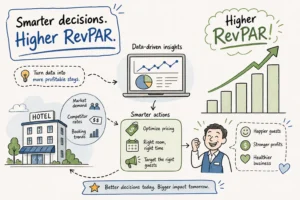
Practical ways revenue management solution scan boost your hotel’s RevPAR
Revenue management solutions boost hotel RevPAR by replacing slow manual repricing with an…

Low Season Hotel Strategy: Maximize Occupancy & Revenue (2026)
Maximising hotel occupancy and revenue in low season is not about discounting your…
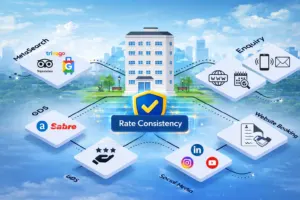
Pricing Parity Strategies for Hotels: Managing Rate Consistency Across Channels
A hotel pricing parity strategy is a legal and commercial commitment to maintain…
Test a pricing scenario
See how demand-based rate changes affect occupancy and revenue.
Open the dynamic pricing simulator