
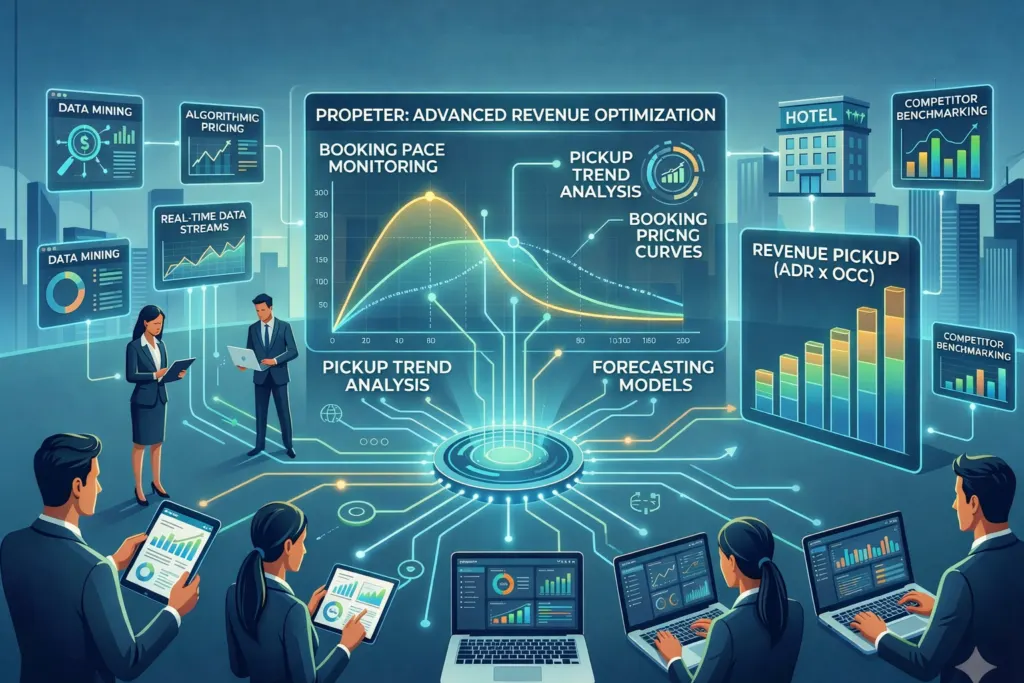
Hotels optimize pricing by tracking the pickup rate—the velocity at which new room bookings accumulate for a specific future date—relative to historical benchmarks. When booking pace tracks ahead of the historical average at identical lead times (e.g., 30 days out), it signals strong market demand, allowing revenue systems to systematically raise Average Daily Rate (ADR) and protect yield. Conversely, running behind pace signals overpricing or a market slowdown, triggering targeted baseline pricing adjustments or promotional channel distribution to stimulate volume before the cancellation window closes.
Table of Contents
- What Is Booking Pace?
- Measuring Pickup Trends
- Pace vs Prior Year Analysis
- Interpreting Pace Signals
- Pricing Responses to Pace Signals
- How AI Automates Pace Analysis
- Frequently Asked Questions
If demand forecasting is the map, booking pace is the live GPS. It tells you not just where demand should go, but where it’s actually going — right now. Revenue managers who master booking pace analysis make better pricing decisions faster. Those who ignore it react too late, either leaving revenue uncaptured on high-demand dates or discounting unnecessarily when the market would have filled anyway.
What Is Booking Pace?
Booking pace is the rate at which reservations are accumulating for a future arrival date. It’s measured as the number of rooms on the books at a specific lead time — typically 90, 60, 30, 14, 7, and 3 days before arrival — compared to the same lead time in a reference period (last year, last week, comp set).
For example: if your hotel had 45 rooms booked 30 days before arrival on this date last year, and today you have 62 rooms booked 30 days out, your pace is running 38% ahead of prior year. This is a strong signal to hold or raise rates — demand is tracking above historical norms.
The inverse is equally important. Running 25% behind pace at 14 days out for a historically strong date is a warning sign: either the market has softened, your pricing is deterring bookings, or a competitive property has entered the market. Understanding which is critical to the right response.
Key Concept
Booking pace is always relative, never absolute. A hotel with 50 rooms on the books 60 days out could be ahead of pace or behind pace depending on its historical norms and competitive positioning. Context is everything.
Measuring Pickup Trends
Pickup analysis measures the incremental change in bookings between two measurement points. Where pace looks at the total rooms on the books at a lead time, pickup looks at how many rooms were added in a specific window.
For example, if you had 40 rooms on the books 7 days ago and now have 55, your pickup over the past 7 days is 15 rooms. Comparing this to the equivalent pickup window in prior periods reveals whether the booking velocity is accelerating or decelerating.
Key Pickup Windows to Track
- 90-60 day window: Early demand signals from advance planners and group bookings
- 60-30 day window: Primary leisure booking window for most markets
- 30-14 day window: Mix of leisure and business transient
- 14-7 day window: Business transient and late leisure decisions
- 7-3 day window: Last-minute bookings; flash deal territory
- 3-0 day window: Walk-in and same-day — pure occupancy protection
Each window has different pricing implications. Early pace strength suggests holding rates in the advance window. Last-minute weakness might trigger a targeted flash deal rather than a broad rate cut.
48hTypical lag in human response to pace deviation
Pace vs Prior Year Analysis
The most common benchmark for pace is the same period last year (STLY). This controls for seasonality and provides a consistent reference point. However, STLY has limitations:
- Last year may have been unusually strong or weak due to one-off events
- Market conditions may have structurally changed (new supply, new demand generators)
- Day-of-week shifts can distort STLY comparisons
Sophisticated revenue managers supplement STLY with multi-year averages (3-year or 5-year STLY) and current competitive set pace to separate property-specific trends from market-wide movements.
Interpreting Pace Signals
Raw pace data is only useful when correctly interpreted. The same pace figure can mean very different things depending on context:
Ahead of Pace — Positive Scenarios
- Strong organic demand — hold or increase rates
- Promotional success — consider withdrawing promotions to protect rate integrity
- Group booking displacement — review remaining transient inventory
Behind Pace — Possible Causes
- Market-wide softening — check competitor occupancy and rates
- Own rates too high — check rate position vs comp set
- Booking window shift — guests booking later; withhold discounts longer
- Anomaly in reference period — verify STLY was normal
Revenue Management Principle
Pace deviation triggers investigation, not automatic action. A hotel running 20% behind pace should diagnose the cause before adjusting rates — cutting prices when the market is simply booking later is a common and costly mistake.
Pricing Responses to Pace Signals
Once pace is interpreted correctly, pricing responses should be proportional and targeted:
Strong Pace (10%+ Ahead of STLY)
Close or restrict discount categories, move BAR (Best Available Rate) upward incrementally, add minimum length of stay restrictions for high-compression nights, and remove or reduce promotional offers.
Weak Pace (10%+ Behind STLY, Rate-Driven)
Consider targeted promotions through high-converting channels, open lower rate categories with appropriate restrictions, and launch Flash Deals in the 7-3 day window for specific room types. Avoid broad, unrestricted discounting that cannibalises full-rate bookings.
Neutral Pace
Maintain current rates and monitor. Intervene only when pace diverges meaningfully in either direction, or when lead time shrinks to the window where action is still effective.
How AI Automates Pace Analysis
Manual pace analysis has an inherent limitation: by the time a revenue manager reviews the morning report, processes the data, and makes a pricing decision, 4–8 hours may have passed. In a high-velocity market, that’s a significant lag.
Propeter monitors booking pace across all room types and future dates at once. When pace deviates from the property’s historical norm by a statistically meaningful margin, the date is flagged, the demand forecast is updated and Propeter recommends whether a pricing response is warranted — with the reasoning shown for your team to review.
Key AI advantages in pace analysis:
- Multi-dimensional pace: Monitors pace by room type, channel, market segment, and lead time simultaneously
- Anomaly detection: Statistical models identify unusual pace patterns that human review might miss
- Context enrichment: Pace signals are automatically cross-referenced with events, competitor pricing, and weather
- Automated response: Approved pricing responses execute automatically within guardrail parameters
The result is pace monitoring that runs continuously and is immune to the confirmation bias and fatigue that affect human reviewers during peak periods — while the decision to change a rate stays with your team.
Frequently asked questions
How do you calculate hotel booking pace and pickup velocity?
Booking pace is measured by comparing rooms on the books (OTB) for a future date against a reference point at the same lead time — usually the same date last year (STLY) or the forecast. If you had 45 rooms OTB 30 days out last year and have 62 today at 30 days out, pace is running ahead. Pickup velocity is the change in OTB over a window: Net pickup = OTB today − OTB on the earlier date (for example over a rolling 24-hour or 7-day period). Comparing that velocity with the historical velocity at the same lead time shows whether the booking curve is accelerating or flattening.
Why must booking pace be segmented by distribution channels like OTAs and Direct?
A blended, unsegmented booking pace conceals critical net revenue erosion. Online Travel Agencies (OTAs) typically exhibit high pickup velocity but carry steep commission margins and higher cancellation rates. Direct booking channels build pace more slowly but yield a much higher Net RevPAR. If your overall booking pace looks healthy but is driven entirely by an unexpected surge in OTA pickup, maintaining high rates could price out higher-value direct loyalty guests. Segmented pace analysis allows for channel-specific inventory fencing.
How do group booking wash factors impact hotel pace analysis?
Group wash factors represent the variance between a group’s contracted room block and the actualized room pickup. Failing to apply a wash factor to pace metrics artificially inflates your Rooms On The Books (OTB), leading to overpricing errors based on phantom demand. Revenue engines calculate historical wash percentages by group profile type (e.g., corporate vs. association blocks) to dynamically “wash down” the block. This accurately exposes perishable inventory back to the transient retail market while there is still optimal lead time to convert it.
What is the risk of dropping room rates when hotel booking pace drops behind?
Dropping room rates immediately when tracking behind pace often causes a “race to the bottom” via competitor rate matching, depressing market ADR without generating incremental volume. Furthermore, sudden price drops trigger reservation cancellations from guests who already booked at higher rates, who then re-book at the lower tier. Instead of dropping baseline rates, optimization models recommend deploying non-opaque channels, opaque packagers, hidden value-adds, or expanding minimum length of stay (LOS) restrictions to protect long-term price integrity.
What is booking pace in hotel revenue management?
Booking pace refers to the rate at which reservations are accumulating for a future date, measured as rooms booked at a specific number of days before arrival. It is compared to the same pace in prior periods to identify whether demand is tracking above or below historical norms.
How do hotels measure pickup trends?
Pickup is measured by comparing the incremental increase in bookings between two measurement points at the same lead time across different periods. Common reports track pickup over 7-day, 14-day, and 30-day windows and compare to equivalent windows in prior periods.
What is a good booking pace for a hotel?
There is no universal benchmark — booking pace norms are property and market specific. The goal is to understand your normal pattern, then act when actual pace deviates significantly from that pattern.
How does AI improve booking pace analysis?
AI automates pace analysis across all room types and future dates simultaneously, flagging anomalies as they emerge. AI also contextualises pace against demand signals like events and competitor pricing, enabling more accurate interpretation of whether a pace deviation requires a pricing response.
Let Propeter Watch Your Booking Pace
Propeter monitors pickup for every date, flags pace anomalies and recommends the pricing response — your team reviews and approves it.
Related Articles
How to choose hotel revenue management software for independent properties in Australia
The best hotel revenue management software for independent Australian properties is not determined…

Propeter vs Competitors: Which Hotel Revenue Management Solution Wins?
Propeter is a revenue management and pricing system for hospitality that works with your PMS, with a direct booking engine, guest CRM, loyalty…

Low Season Hotel Strategy: Maximize Occupancy & Revenue (2026)
Maximising hotel occupancy and revenue in low season is not about discounting your…
Plan your pricing rules
A structured template for booking-window, pace and restriction rules.
Open the pricing strategy template