
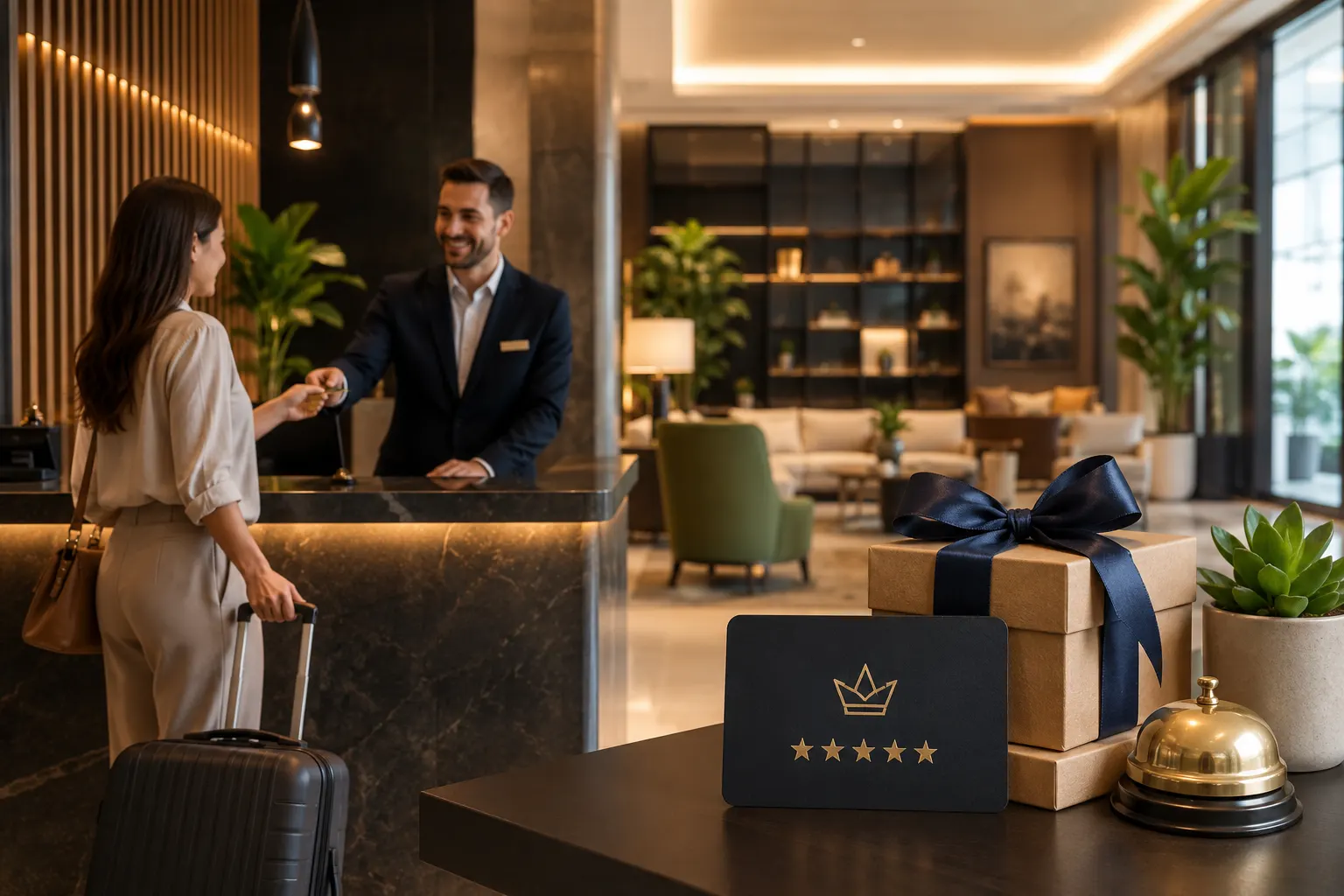
A loyalty program for hotels is a rewards system that encourages guests to return and book directly — through points, exclusive rates, tier benefits, and personalised experiences. For independent hotels, it is the single most effective tool to reduce OTA commission costs (typically 15–25% per booking), increase guest lifetime value, and build a direct relationship that no third-party platform can own.
📋 What you will learn in this guide
- What is a loyalty program for hotels?
- Why hotels need a loyalty program now
- How a hotel loyalty program works (step by step)
- Designing your tier structure and rewards
- Can independent hotels compete with chains?
- What is loyalty points exchange?
- How loyalty programs increase direct bookings
- Technology you need to run a loyalty program
- ROI: what results should you expect?
- 5 mistakes hotels make with loyalty programs
- How Propeter powers hotel loyalty
- Frequently asked questions
What is a loyalty program for hotels?
A loyalty program for hotels is a structured rewards system that incentivises guests to book directly with your property and return for future stays. Guests earn points, status, or perks through their interactions with your hotel — room bookings, dining, spa treatments, referrals, and direct booking — and redeem those rewards for free nights, upgrades, and exclusive experiences.
The concept sounds simple. The execution — particularly for independent hotels without the technology infrastructure of Marriott or Hilton — has historically been the hard part. That has changed in recent years, as purpose-built hotel loyalty platforms now make it possible for any independent property to launch a sophisticated, fully branded program.
Unlike OTA-generated bookings, where the guest relationship belongs to Expedia or Booking.com, a loyalty program creates a direct relationship between your hotel and your guest — one you own, can personalise, and can monetise repeatedly over years.
Scale is not the same as engagement
Chain programmes have enormous membership numbers, but a member who stays once a year is not the same as a loyal guest. Independent hotels have a structural advantage here: genuine personalisation.
Why hotels need a loyalty program now
The case for running a hotel loyalty program has never been stronger — and the cost of not having one has never been higher. Here is why:
At the same time, the three core problems that have always held independent hotels back remain:
Problem 1: OTA dependence is expensive
Booking.com and Expedia charge 15–25% commission on every booking. A hotel doing $2M in annual OTA revenue is paying $300,000–$500,000 per year to platforms that own the guest relationship. Every direct booking saves that commission — and loyalty programs are the most proven mechanism to shift guests from OTA to direct.
Problem 2: Guest data lives on third-party platforms
When a guest books through an OTA, the hotel receives minimal data and no permission to contact that guest post-stay. Without a loyalty program that captures direct enrolment, hotels cannot build guest profiles, trigger personalised campaigns, or create the kind of relationship that generates repeat bookings.
Problem 3: Competition from branded chains with massive loyalty programs
Marriott Bonvoy and Hilton Honors offer rewards that travellers have spent years accumulating. Many guests choose a chain property not because it is better, but because they want to earn or redeem points. A well-designed loyalty program for independent hotels does not need to out-scale Marriott — it needs to out-personalise it.
The independent hotel’s loyalty gap
The smart independents are not trying to build Marriott-scale programmes. They are joining forces through coalition networks, or launching white-label platforms that give guests the experience of a structured loyalty programme with the warmth of an independent stay. Scale without sacrificing identity.
How a hotel loyalty program works — step by step
Understanding the mechanics helps you design a program that actually drives behaviour, not just enrolments. Here is how an effective hotel loyalty program flows from guest acquisition to lifetime value:
1
Guest enrols — at checkout, booking engine, or front desk
The enrolment moment is critical. Best-in-class programs offer an immediate enrolment benefit (bonus points on first stay, instant member rate) to convert casual guests into program members on the spot. Front desk scripts, post-stay emails, and website pop-ups all serve as enrolment touchpoints.2
Guest earns points or credits across all touchpoints
Points are awarded for: room bookings (the highest earn rate), F&B spend, spa and activities, referrals, direct booking bonuses, and promotional campaigns. A typical earn rate is 10 points per £1 or $1 spent on rooms, with bonus multipliers for direct bookings (e.g. 2x points vs. OTA).3
Guest progresses through tiers — unlocking better benefits
Tier progression (Silver → Gold → Platinum → Elite) creates a “status ladder” that motivates guests to reach the next level. Each tier should offer meaningfully better benefits — not just marginally more points. The psychology of status is a more powerful retention driver than points accumulation alone.4
Hotel uses CRM to trigger personalised re-engagement
The loyalty platform integrates with your CRM to automate: post-stay thank you emails with points summary, anniversary or birthday offers, re-engagement campaigns for lapsed members (e.g. “It has been 6 months — here is a 12% member rate for your next stay”), and upsell campaigns before arrival.5
Guest redeems rewards — completing the value loop
Redemption options include: free nights, room upgrades, F&B credits, spa vouchers, exclusive experiences, and cashback. A high redemption rate signals a healthy program. Low redemption indicates guests do not find the rewards compelling — the most common failure point for hotel loyalty programs.6
Hotel measures, optimises, and grows the program
Track: repeat booking rate, direct booking share, member revenue %, OTA commission reduction, points issuance vs. redemption ratio, and guest lifetime value (loyalty members vs. non-members). Review quarterly and adjust tier thresholds, earn rates, and reward offerings based on data.
Designing your hotel loyalty tier structure and rewards
The tier structure is the backbone of your loyalty program. Get it wrong and guests either never progress (demoralising) or reach the top tier too quickly (devaluing it). Here is a proven framework for independent hotels:
🥈 Silver (Base)
- Automatic on enrolment
- Member-only rate (5% off direct)
- 10 points per $1 spent
- Points don’t expire (1 yr activity)
- Pre-arrival welcome email
🥇 Gold (Mid)
- After 3 stays or 2,000 pts
- 10% member rate discount
- Room upgrade (subject to availability)
- Early check-in (subject to availability)
- F&B welcome amenity
- 15 points per $1 spent
💎 Platinum (Upper)
- After 8 stays or 6,000 pts
- 15% member rate
- Guaranteed room upgrade
- Late checkout (up to 2pm)
- Free breakfast
- Dedicated loyalty concierge
- 20 points per $1 spent
⭐ Elite (Top)
- After 15 stays or 15,000 pts
- 20% member rate + best available
- Suite upgrade (when available)
- Complimentary breakfast daily
- Welcome gift on every stay
- Priority booking access
- Annual recognition gift
What rewards actually drive loyalty?
In practice, experiential rewards tend to outperform transactional ones in driving repeat bookings. Here is a practical ranking of common rewards by likely impact on re-booking — test it against your own guests:
| Reward type | Re-booking impact | Cost to hotel | Recommended for |
|---|---|---|---|
| Complimentary room upgrade | Very high | Low (if room available) | All tiers (Gold+) |
| Member-only direct rate | Very high | The discount itself — usually smaller than the OTA commission saved when the booking would otherwise come via an OTA | All tiers |
| Late checkout | High | Low | Gold+ |
| Free breakfast | High | Medium | Platinum+ |
| F&B / spa credit | High | Medium (incremental revenue) | All tiers |
| Local experience packages | High (differentiator) | Low–Medium | Boutique hotels |
| Points toward free nights | Medium | Medium–High | High-frequency guests |
| Points-only discounts | Low | Low | Not recommended alone |
Best practice: Never rely on points alone. A pure points program with no “surprise and delight” moments lacks the human touch that independent hotels are uniquely positioned to deliver. The combination of structured rewards + genuine personalisation is what lets independent hotel loyalty programs stand out against chain equivalents.
Can independent hotels compete with chain loyalty programs?
Yes — but not by playing the same game. Marriott Bonvoy has a vast membership and decades of data. Trying to build a program that competes on scale will fail. The winning strategy is to compete on depth of relationship, personalisation, and local experience — dimensions where independent hotels have a structural advantage over chains.
Where independent hotels win
- Genuine personalisation: A 50-room boutique hotel can remember that a guest prefers a ground-floor room facing the garden, drinks flat white without sugar, and always travels with a dog. Marriott cannot do this at scale.
- Local access: Partner with local restaurants, experiences, and cultural venues to offer rewards that chains cannot replicate — and that guests will not find on OTAs.
- Human recognition: “Welcome back, Ms. Patel — we have your usual room ready and added a birthday amenity” is a loyalty program moment worth more than 500 points.
- Agility: Independent hotels can change their loyalty program, add new rewards, or launch targeted campaigns in days — not the months it takes a chain to push through a policy change across thousands of properties.
Coalition loyalty programmes for independents
A notable development in hotel loyalty is the rise of coalition programmes that allow independent hotels to pool their membership base, creating scale without sacrificing brand identity. Platforms like iPrefer, Stash Hotel Rewards, and The Guestbook have pioneered this model — allowing guests to earn and redeem across a curated network of independent and boutique hotels.
The key insight: independent loyalty 1.0 (basic points shared across a network) largely failed because guests built loyalty to the network, not the individual property. Independent loyalty 2.0 — powered by personalisation platforms, CRM integration, and property-specific rewards — succeeds because it keeps loyalty anchored to the specific hotel guest relationship.
What is loyalty points exchange and why does it matter?
Loyalty points exchange is the ability for hotel guests to earn, redeem, or transfer points across multiple properties, partner services, or reward categories — rather than being locked into a single hotel’s program.
Points exchange capability is becoming a key differentiator. Guests increasingly expect the flexibility they enjoy with major programs: combining points with cash, transferring to airline miles, redeeming at partner restaurants or experiences, or earning across a group of hotels.
Types of points exchange in hotel loyalty programs
- Cross-property redemption: For hotel groups with multiple properties, guests earn at any property and redeem at any other. The most common form for hotel groups.
- Partner network exchange: Points earned at the hotel can be redeemed at partner restaurants, local attractions, or experience providers — extending loyalty value beyond the room.
- Airline miles transfer: Guests can convert hotel points to airline miles — a feature that significantly increases the perceived value of the program for frequent travellers.
- Points-plus-cash: Guests use a combination of points and cash to book, lowering the barrier to redemption and increasing program engagement.
- Cashback redemption: Points convert to a monetary credit applied to the guest’s bill — the simplest and most universally valued form of redemption, particularly for independent hotels.
How a hotel loyalty program increases direct bookings
Reducing OTA dependence is the highest-ROI outcome of a well-run hotel loyalty program. Here is exactly how loyalty mechanics shift guests from third-party platforms to your direct booking engine:
| Loyalty mechanism | How it drives direct bookings | OTA commission saved |
|---|---|---|
| Member-only rates | Rates shown only to signed-in members on your direct channel — giving a clear financial reason to book direct. Parity terms vary by OTA contract, so check your agreements. | Full 15–25% per booking |
| Bonus points for direct booking | Award 2x or 3x points for direct bookings vs. OTA. Guests quickly learn that loyalty value is maximised by going direct. | Full 15–25% per booking |
| Member perks only at direct booking | Upgrades, early check-in, welcome amenity — only guaranteed when booking direct. OTA bookers do not receive loyalty benefits. | Full 15–25% per booking |
| Re-engagement campaigns to past OTA guests | Capture OTA guest emails at check-in/out and enrol them in the loyalty program. Next time they book, they have a direct incentive. | Full commission on converted guest |
| Exclusive loyalty promotions | Flash sales, seasonal offers, and bonus point campaigns sent only to loyalty members via email, app, or WhatsApp — creating urgency to book direct. | Full 15–25% per booking |
Communication channel insight
In markets where WhatsApp is the default messaging app, guests often respond to WhatsApp far more readily than to email. Test both channels with your own members — for example, “Hi, it has been 6 months since your last stay — here is a member rate for this month” — and compare re-booking conversion before committing budget.
What technology does a hotel need to run a loyalty program?
Running an effective loyalty program requires connected technology, not just a spreadsheet of points. Here is the core stack:
Essential integrations
- Loyalty platform / module: The core system for managing tiers, points issuance, redemption, and member accounts. Can be standalone or bundled into a revenue management platform.
- PMS (Property Management System) integration: Automatic posting of stay data to the loyalty platform — so points are issued without manual intervention. This is non-negotiable for operational efficiency.
- Direct booking engine: Must recognise logged-in loyalty members, display member rates and apply benefits automatically. Member-only rates shown to signed-in guests are commonly treated as closed-user-group rates, but parity terms vary by OTA contract and country — check your agreements.
- CRM and guest data platform: Stores guest preferences, stay history, and communication opt-ins. Powers segmented campaigns and personalised offers.
- Email and WhatsApp automation: Triggers post-stay summaries, re-engagement sequences, birthday/anniversary offers, and member-only promotions at scale.
- Mobile app (optional but recommended): White-label mobile app for members to check points, redeem rewards, manage bookings, and receive push notifications. Usually increases engagement.
- Reporting dashboard: Real-time visibility into repeat booking rates, member revenue, points issuance vs. redemption, and OTA commission savings. Without data, optimisation is impossible.
Free vs. paid loyalty software for hotels
| Feature | Free tools | Paid platforms |
|---|---|---|
| PMS integration | ✗ Manual only | ✓ Automated |
| Tier management | △ Basic | ✓ Full multi-tier |
| Member-only rates | ✗ Usually not | ✓ Shown to signed-in members |
| CRM / segmentation | ✗ | ✓ |
| Automation / campaigns | ✗ | ✓ |
| Mobile app | ✗ | ✓ Often included |
| Points exchange | ✗ | ✓ Cross-property |
| Gamification | ✗ | ✓ |
| Analytics / ROI reporting | △ Basic | ✓ Full dashboard |
| Support / onboarding | ✗ | ✓ Vendor-supported |
ROI of a hotel loyalty program: what results should you expect?
Results depend on your guest mix, how actively you enrol guests and how compelling the rewards are, so set a baseline before launch and measure against it. The useful starting point is your own numbers: how many repeat guests you already have, what share of them book via OTAs, and what commission you pay on those bookings. The ROI calculator can help you model the direct-booking side.
How to measure your loyalty program ROI
Track these five metrics from day one — and review them monthly:
- Repeat booking rate: % of bookings from returning guests. Set a target against your pre-launch baseline.
- Direct booking share: % of total bookings via your own website or booking engine. Track the trend, not just the number.
- Member revenue contribution: Revenue from loyalty members as % of total revenue. Watch the trend over time.
- OTA commission savings: Calculate monthly: (bookings shifted direct × average commission rate). This is the clearest financial case for the program.
- Redemption rate: % of issued points redeemed. A persistently low rate means guests are not finding the rewards compelling — act on it.
5 mistakes hotels make with loyalty programs (and how to avoid them)
Mistake 1: Launching points without a clear redemption path
Many hotels issue points generously but make redemption confusing or unattractive. If guests cannot easily see what their points are worth or how to use them, program engagement collapses. Fix: define a clear, simple earn-and-burn model before launch. Publish it. Make redemption possible in under 2 clicks.
Mistake 2: Relying on points alone without experiential rewards
A points-only program from an independent hotel feels like a pale imitation of Marriott Bonvoy. It does not differentiate you. Fix: layer experiential rewards — local experiences, personalised welcome gifts, F&B credits — on top of the points structure. These cost less and drive more loyalty.
Mistake 3: Failing to promote the program at checkout
Many hotels enrol only a small share of eligible guests because front desk staff do not consistently mention the program. Fix: build loyalty enrolment into the checkout script. Train staff. Offer an instant benefit for signing up — bonus points, immediate member rate — to incentivise in-the-moment enrolment.
Mistake 4: Not connecting the loyalty platform to your PMS
Without PMS integration, points must be issued manually, guest data lives in silos, and the program creates more operational burden than revenue. Fix: only launch a program on a platform that integrates directly with your PMS. Automation is not optional — it is what makes the program scalable.
Mistake 5: Setting tier thresholds too high
If guests cannot realistically progress from Silver to Gold in a single year of occasional stays, they will disengage before experiencing the better-tier benefits that create genuine loyalty. Fix: calibrate tier thresholds to your average guest’s stay frequency. A leisure hotel might set Gold at 3 stays/year; a business hotel at 5.
How Propeter helps hotels launch a loyalty program
Propeter is a revenue management and pricing system for hotels; its loyalty module is included in the per-room price and is designed for independent hotels and hotel groups that want a structured programme without building one from scratch.
Loyalty works alongside Propeter’s direct booking engine and guest CRM, using stay data from your connected PMS.
| What you need | What Propeter provides |
|---|---|
| Tier management (Silver → Elite) | Configurable tiers and tier rules |
| Points earning and redemption | Points earn and redeem, points-plus-cash, referral rewards |
| Loyalty points exchange | Members earn and redeem across all properties in your group |
| Member-only direct booking rates | Member-only rates shown to signed-in guests; parity terms vary by OTA contract — check your agreements |
| CRM and guest segmentation | Guest profiles and targeted campaigns |
| Messaging | Email and SMS campaigns, birthday and tier rules |
| Member access | Member portal and guest app to view points and reservations |
| Gamification elements | Badges, achievements, spin-the-wheel and scratch-card rewards |
| PMS integration | Stay data from your connected PMS |
Ready to launch your hotel loyalty program?
Model the direct-booking opportunity with the ROI calculator, or book a demo to see how Propeter’s loyalty module, member rates and direct booking engine would work for your property type.
Frequently asked questions about hotel loyalty programs
What is a loyalty program for hotels?
A loyalty program for hotels is a rewards system that encourages guests to return and book directly — through points, tier benefits, exclusive rates, and personalised experiences. For independent hotels, it is the most proven mechanism to reduce OTA commission costs, increase repeat bookings, and build a direct guest relationship that generates long-term revenue.
How do I start a loyalty program for my hotel?
To start a hotel loyalty program: (1) Define your guest segments and what rewards they value. (2) Choose a loyalty platform that integrates with your PMS and booking engine. (3) Set up a points earning structure. (4) Create 3–4 membership tiers with escalating benefits. (5) Add a member-only direct booking rate. (6) Train your front desk team to enrol guests consistently. (7) Set up automated email or WhatsApp campaigns to engage members post-stay.
Can an independent hotel compete with chain loyalty programs like Marriott Bonvoy?
Yes — but by competing on personalisation, not scale. Independent hotels cannot match a global chain’s membership, but they can out-personalise chains through genuine human recognition, local experience rewards and flexibility that large brands cannot replicate.
What is the ROI of a hotel loyalty program?
It depends on your guest mix, enrolment rate and rewards, so measure against a pre-launch baseline rather than relying on industry averages. The clearest financial line is commission saved: bookings shifted from OTA to direct × average commission rate, minus the cost of member discounts and rewards. Add the value of extra repeat stays you can attribute to the programme, and compare the total with the platform cost.
What rewards should a hotel loyalty program offer?
The most effective hotel loyalty rewards are: complimentary room upgrades, member-only direct booking rates, early check-in and late checkout, free or discounted breakfast, F&B and spa credits, local experience packages, and referral bonuses. Experiential and recognition-based rewards generally drive higher repeat booking rates than points-only programs. The combination of structured points and personalised surprises delivers the best retention results.
What is loyalty points exchange in hotel programs?
Loyalty points exchange allows guests to earn and redeem points across multiple hotel properties, partner services (airlines, restaurants, local experiences), or convert points to cash or miles. For independent hotels, this is achievable through coalition networks or platforms that support cross-property redemption, giving guests the flexibility they expect from chain programs without requiring a massive multi-property portfolio.
How does a hotel loyalty program reduce OTA dependence?
A loyalty program reduces OTA dependence through: member-only rates that OTAs cannot match, bonus points for direct bookings (creating a financial incentive to bypass OTAs), exclusive perks only available via direct booking, and re-engagement campaigns to convert previous OTA bookers into direct guests. Each booking that moves from an OTA to direct saves the OTA commission (often 15–25%) on that booking, less the cost of any member discount.
Is there a free loyalty program for hotels?
Free loyalty tools for hotels exist but typically offer no PMS integration, no mobile app, basic reporting, and no automation. They can help a hotel test the concept but rarely deliver meaningful repeat booking impact on their own. Most independent hotels that are serious about direct revenue use a paid platform; measure its return through OTA commission saved and repeat stays gained.
How many tiers should a hotel loyalty program have?
Most effective hotel loyalty programs use 3–4 tiers. Fewer than 3 provides insufficient progression incentive. More than 4 risks confusing guests. Recommended: Silver (base, on enrolment) → Gold (3–5 stays) → Platinum (8–12 stays) → Elite (15+ stays or equivalent spend). Each tier must offer meaningfully better benefits — not just marginally more points — to sustain the motivation to progress.
What technology is needed to run a hotel loyalty program?
A complete hotel loyalty technology stack requires: a loyalty platform for tier and points management, PMS integration for automatic stay tracking, a direct booking engine that displays member rates, a CRM for guest segmentation and campaigns, email and WhatsApp automation, and a reporting dashboard. Optional but recommended: a white-label mobile app for member account management and push notifications. Without PMS integration, the program creates manual operational burden that undermines its ROI.
How do I measure the success of my hotel loyalty program?
Track these five metrics monthly: (1) Repeat booking rate — share of bookings from returning guests, against your baseline. (2) Direct booking share — % of total bookings via your own channel. (3) Member revenue contribution — share of total revenue from members, tracked over time. (4) OTA commission savings — bookings shifted direct × average commission rate. (5) Points redemption rate — a persistently low rate signals rewards are not compelling enough and need review.
What is the difference between a hotel rewards program and a loyalty program?
The terms are used interchangeably. A hotel rewards program refers to the specific incentive mechanism (points, free nights, perks). A hotel loyalty program is the broader system — including tiers, guest data, CRM, communications, and personalisation — designed to build lasting guest relationships. The most effective programs combine both: structured rewards within a genuine relationship-first framework that treats loyalty as an emotional bond, not just a transactional exchange.
Related guides and tools from Propeter
Loyalty module
Tiers, points and member rates for independent hotels
Direct Booking Engine
Convert loyalty members into direct bookings with member-only rates
Guest CRM and marketing
Segment loyalty members and automate personalised campaigns
ROI Calculator
Model the direct booking impact of your loyalty program
Competitive Intelligence
Watch competitor rates alongside your loyalty program
About this guide
Written by the Propeter team. Tier thresholds and earn rates shown are illustrative starting points, not benchmarks. Last reviewed: October 2026.
Related Articles
InterContinental Hotel Loyalty Program: The Complete IHG One Rewards Guide (2026)
The InterContinental hotel loyalty program operates through two connected layers: IHG One Rewards,…
Plan your loyalty programme
How Propeter supports member rates, points and tiers for direct bookers.