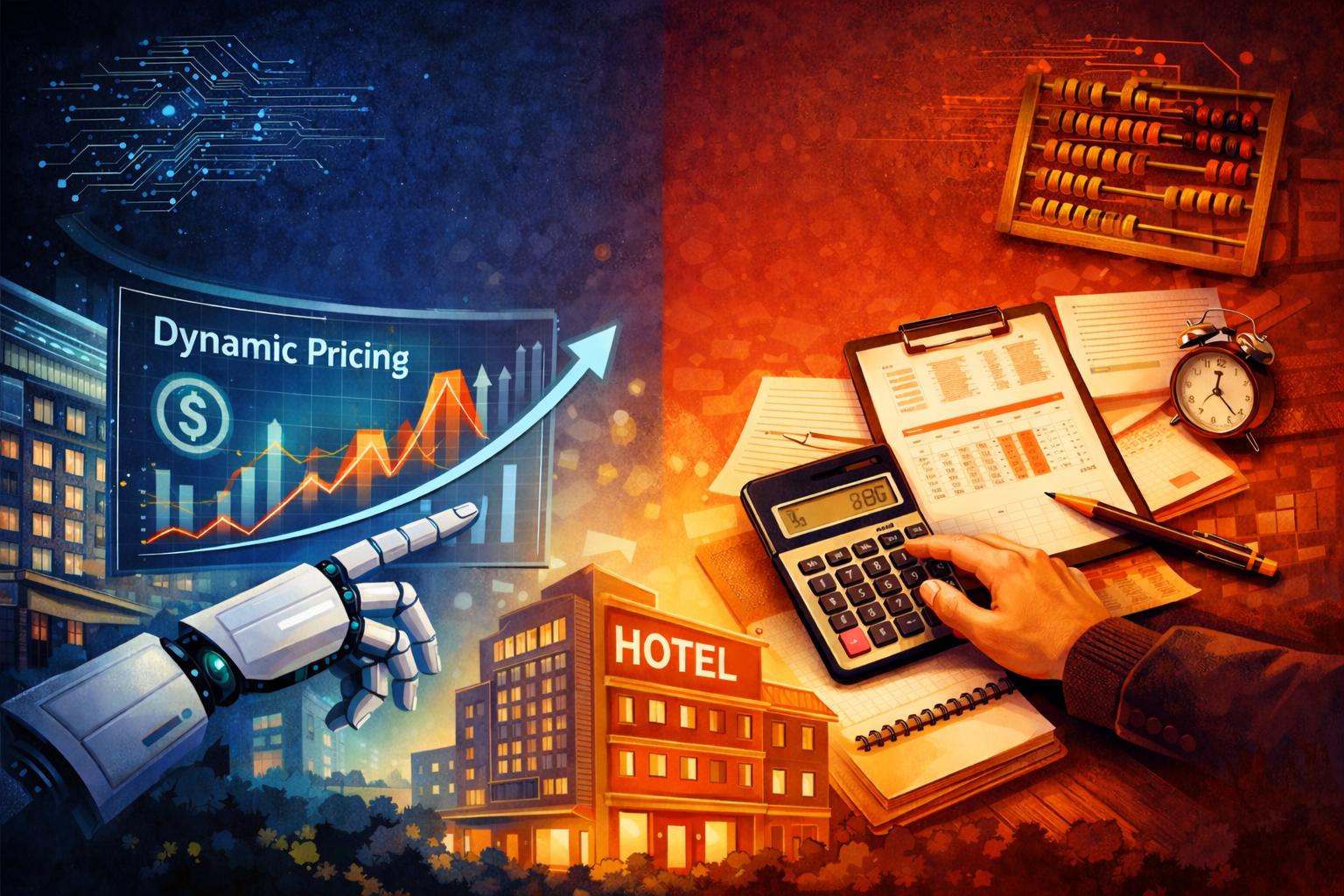
The hospitality industry is undergoing a major transformation driven by artificial intelligence. Traditional hotel revenue management relied heavily on spreadsheets, manual analysis, and reactive pricing strategies. Today, modern hotels are adopting AI-powered revenue management software to automate pricing decisions and improve demand forecasting.
AI systems can analyze thousands of market signals in real time, helping hotels adjust prices dynamically based on demand trends, competitor pricing, and booking behavior. This allows revenue managers to move from reactive pricing decisions to predictive, data-driven revenue optimization.
To understand how artificial intelligence is reshaping pricing strategies, explore our AI Revenue Management pillar guide.
Traditional vs AI Pricing
For many years, hotel pricing strategies were based on manual analysis and fixed pricing rules.
Revenue managers typically relied on:
spreadsheets and historical data
manual competitor rate checks
static pricing tiers
limited forecasting models.
While these methods provided useful insights, they often struggled to keep up with rapidly changing market conditions.
AI-powered pricing systems take a fundamentally different approach.
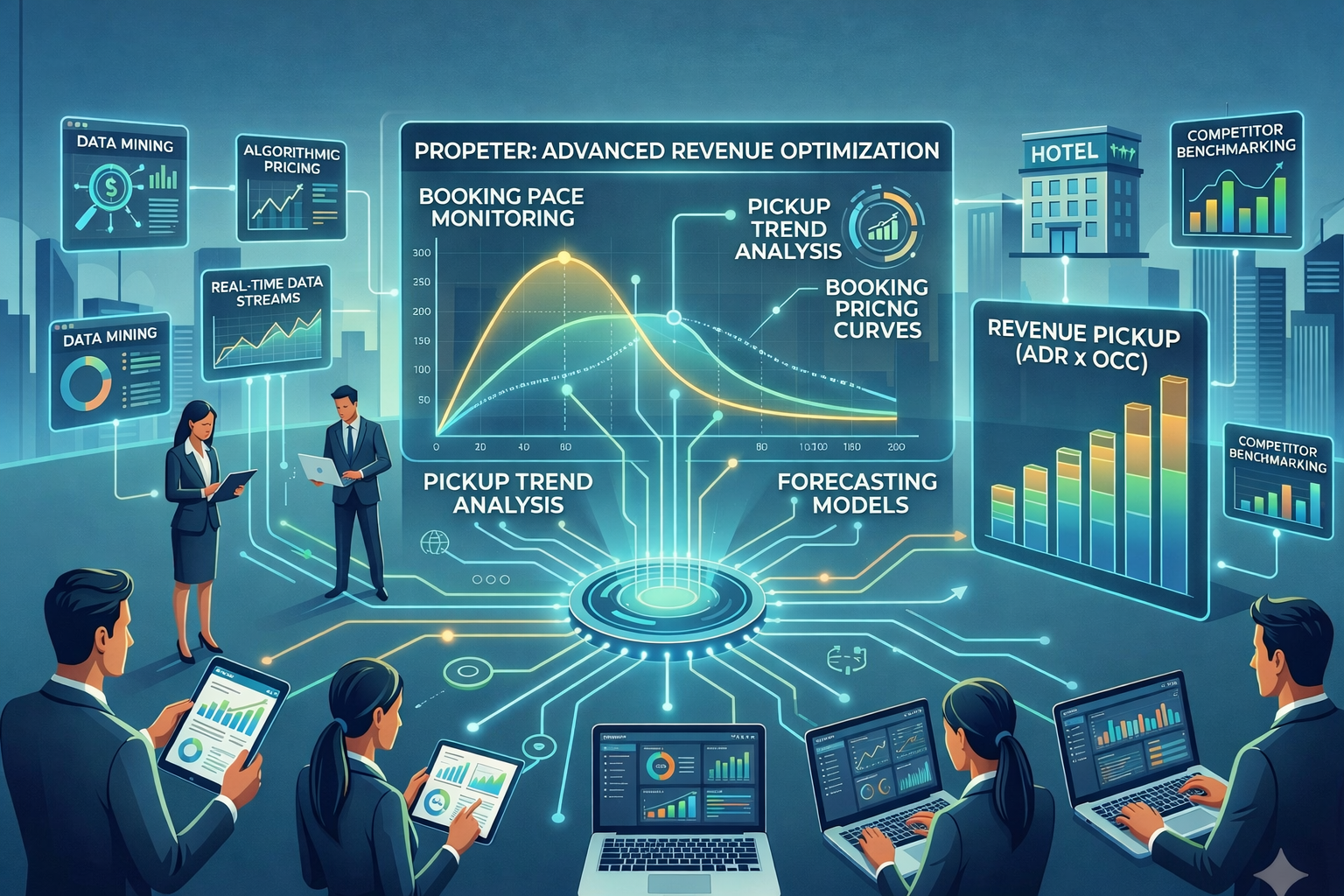
Instead of relying on static rules, AI platforms analyze real-time data across multiple demand signals, including:
booking pace
competitor pricing
market demand indicators
seasonal trends
guest booking behavior.
By continuously learning from new data, AI systems can recommend more accurate pricing strategies than manual approaches.
Demand Forecasting
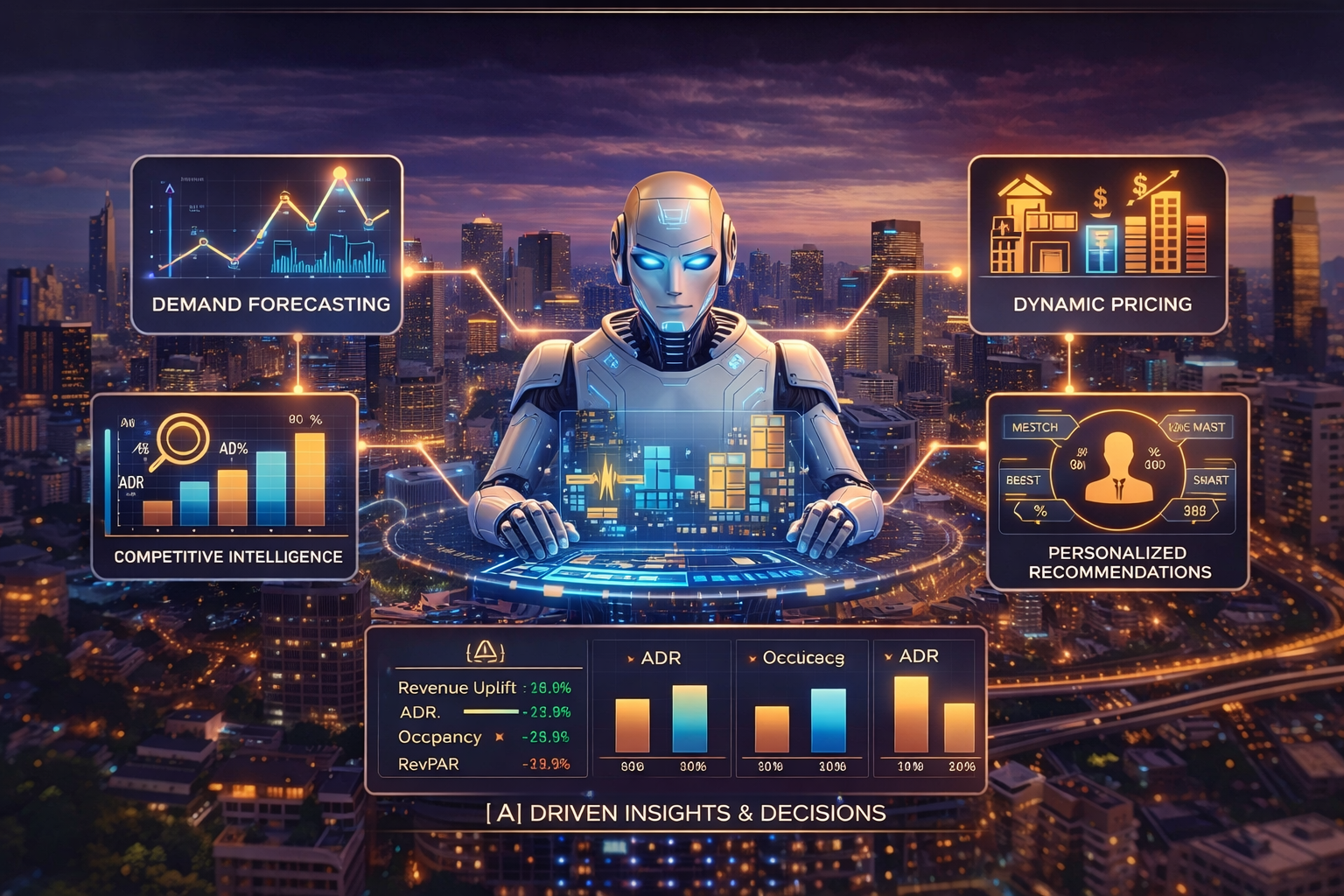
One of the most important applications of artificial intelligence in hospitality is demand forecasting.
Demand forecasting predicts future occupancy levels and booking patterns based on historical data and real-time market signals.
AI forecasting models analyze factors such as:
past booking trends
travel seasonality
local events and conferences
market demand patterns
competitor pricing movements.
This allows hotels to anticipate demand spikes earlier and adjust pricing strategies proactively.
For example, if AI forecasting predicts a surge in demand for a particular weekend, the revenue management system may recommend increasing prices before competitors react.
Accurate demand forecasting allows hotels to capture higher revenue during peak periods while avoiding overpricing during weaker demand periods.
AI Optimization Models
AI revenue management systems use advanced optimization models to determine the best possible pricing strategy.
These models evaluate multiple pricing scenarios and recommend the rate that maximizes expected revenue.
Key optimization techniques include:
Machine Learning Models
Machine learning algorithms identify patterns in booking behavior and demand trends.
Over time, these models continuously improve their predictions as more data becomes available.
Multi-Factor Pricing Models
AI pricing engines evaluate multiple demand signals simultaneously, including:
occupancy levels
competitor pricing
booking pace
market demand indicators.
These factors are combined to calculate an optimal room rate for each date.
Price Elasticity Analysis
Some AI systems also analyze how sensitive demand is to price changes.
This helps determine the price point where revenue is maximized without reducing booking volume.
AI optimization models allow hotels to move beyond simple rule-based pricing and adopt more sophisticated revenue strategies.
Automation Benefits
One of the biggest advantages of AI-powered revenue management software is automation.
AI systems can process large volumes of data and generate pricing recommendations far faster than manual analysis.
Automation provides several key benefits for hotel revenue teams.
Faster Pricing Decisions
AI systems continuously monitor market conditions and update pricing recommendations automatically.
This allows hotels to respond quickly to demand changes.
Reduced Manual Workload
Revenue managers spend less time analyzing spreadsheets and more time focusing on strategic decisions.
Automation eliminates many repetitive tasks involved in pricing management.
Improved Revenue Performance
AI-driven pricing strategies can help hotels increase revenue by identifying opportunities that manual analysis may miss.
This includes detecting demand spikes, competitor price shifts, and booking pace changes.
Greater Pricing Consistency
Automated systems apply pricing rules consistently across all room types and rate plans.
This reduces the risk of pricing errors and ensures a logical pricing hierarchy.
The Role of AI in Modern Revenue Management
AI is not replacing revenue managers—it is enhancing their capabilities.
Revenue professionals still play a critical role in setting pricing strategies, monitoring market conditions, and adjusting business rules.
AI tools simply provide better data, faster insights, and automated pricing recommendations that support smarter decision-making.
By combining human expertise with machine learning, hotels can create a more effective and scalable revenue management strategy.
Conclusion
Artificial intelligence is reshaping hotel revenue management by enabling predictive demand forecasting, automated pricing optimization, and real-time market analysis.
Hotels that adopt AI-powered revenue management software gain a significant competitive advantage through faster pricing decisions, improved forecasting accuracy, and higher revenue performance.
As the hospitality industry becomes increasingly data-driven, AI will continue to play a central role in how hotels optimize pricing and maximize profitability.
See AI Hotel Pricing in Action
Discover how Propeter’s AI-powered revenue management platform helps hotels optimize pricing automatically and improve revenue performance.