
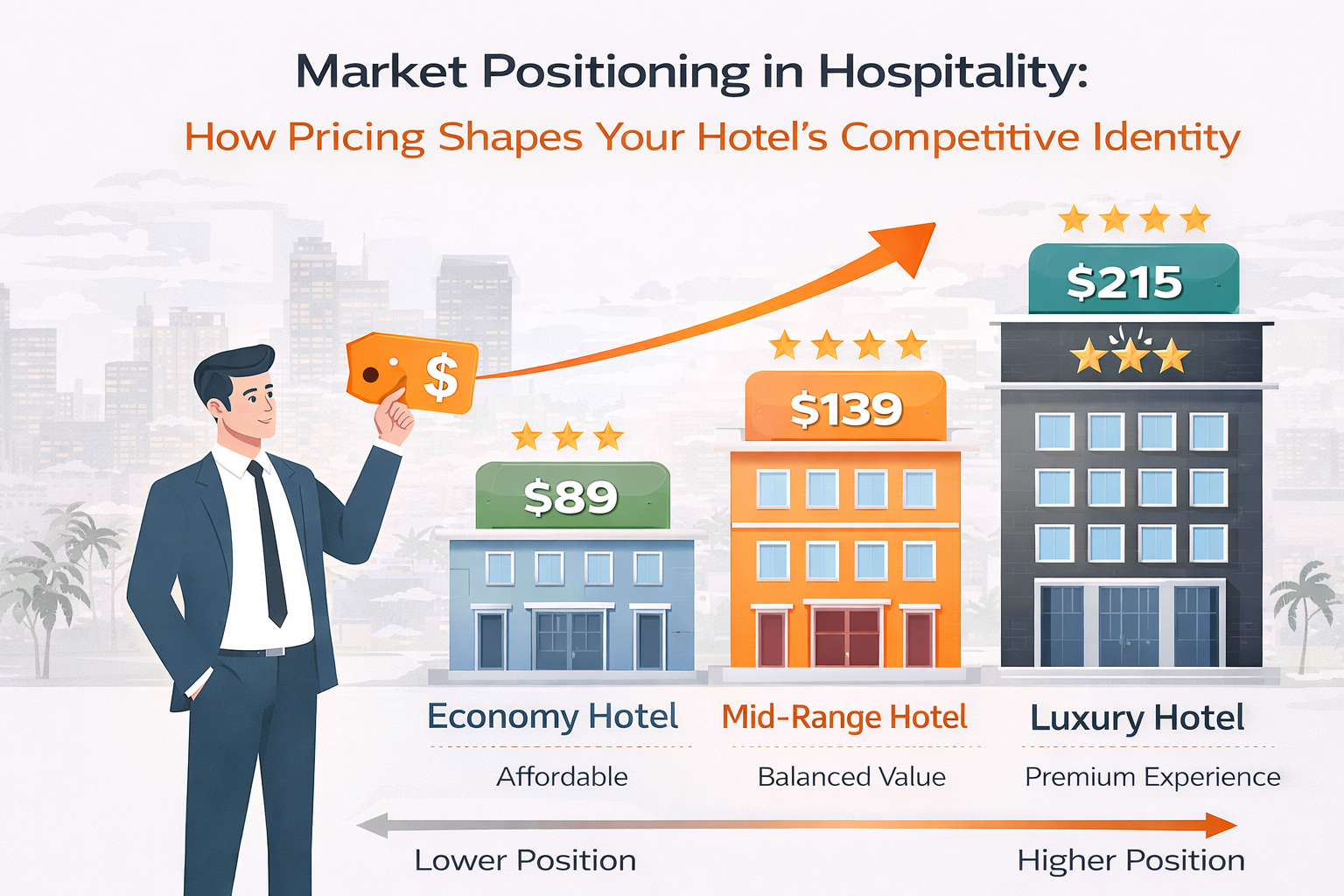
In the hospitality industry, pricing is more than just a revenue lever—it also communicates a hotel’s position within the market. Guests often use price as a signal of quality, service level, and brand experience.
Market positioning refers to how a hotel differentiates itself from competitors in terms of price, value, and brand perception.
Successful hotels align their pricing strategies with their desired market position, whether that means offering luxury experiences at premium prices or delivering competitive value to price-conscious travelers.
Understanding market positioning helps hotels attract the right guests while maintaining pricing consistency and long-term brand strength.
Premium vs Value Positioning
Hotels typically position themselves within the market along a pricing spectrum ranging from premium luxury to value-oriented accommodations.
Premium Positioning
Hotels with premium positioning often emphasize:
luxury amenities
personalized service
prime locations
high-end guest experiences.
These properties typically maintain higher room rates compared to competitors because the price reflects the perceived value of the experience.
Premium hotels focus on value differentiation rather than price competition.
Value Positioning
Value-oriented hotels target travelers seeking affordability and convenience.
These properties may compete more aggressively on pricing while still delivering reliable quality.
Characteristics of value positioning include:
competitive room rates
efficient service models
essential amenities.
Value-positioned hotels focus on attracting price-sensitive guests while maintaining operational efficiency.
Choosing the right positioning strategy is critical for attracting the right guest segment and maintaining consistent pricing strategies.
Pricing Perception
Price plays a powerful psychological role in shaping guest perception.
Travelers often associate higher prices with higher quality and superior service.
This means pricing decisions influence how guests perceive the hotel brand.
For example:
A hotel priced significantly below competitors may be perceived as lower quality.
A hotel priced slightly above competitors may signal premium positioning.
Revenue managers must balance pricing competitiveness with brand perception.
Pricing that aligns with the property’s positioning strategy helps maintain brand consistency and guest trust.
Psychological pricing techniques—such as charm pricing or strategic rounding—can further reinforce pricing perception while maintaining revenue goals.
Brand Positioning
Market positioning is closely connected to a hotel’s overall brand strategy.
Brand positioning defines how the hotel wants to be perceived in the market.
Key factors influencing brand positioning include:
target guest segments
service standards
property design and amenities
location advantages.
For example:
luxury hotels emphasize exclusivity and premium experiences.
boutique hotels focus on uniqueness and personalized service.
business hotels prioritize convenience and efficiency.
Pricing strategies must align with these brand characteristics to maintain a consistent guest experience.
Revenue management teams often work closely with marketing and brand teams to ensure pricing decisions support the broader brand positioning strategy.
Aligning Pricing Strategy with Market Position
Successful hotels integrate market positioning into their pricing strategies.
This means pricing decisions should reflect:
the hotel’s brand identity
target guest segments
competitive market conditions.
For example:
luxury properties may maintain higher prices even during weaker demand periods to protect brand perception.
midscale hotels may adjust prices more dynamically to remain competitive within their segment.
Revenue management systems help analyze competitor pricing and market demand to ensure pricing strategies align with the hotel’s positioning goals.
Why Market Positioning Matters
Strong market positioning provides several advantages for hotels.
Hotels that clearly define their positioning strategy can:
attract the right guest segments
differentiate themselves from competitors
maintain consistent pricing strategies
strengthen brand perception.
Without a clear positioning strategy, hotels risk competing solely on price, which can erode profitability and brand value over time.
Strategic positioning allows hotels to compete on value, experience, and brand differentiation rather than price alone.
Conclusion
Market positioning is a critical factor in hotel revenue management.
By aligning pricing strategies with brand identity and guest expectations, hotels can create a strong competitive identity within their market.
Whether positioned as a luxury destination or a value-driven accommodation, hotels must ensure their pricing strategy reflects the experience they offer.
Hotels that maintain clear positioning and consistent pricing strategies are better positioned to attract loyal guests, strengthen brand perception, and maximize long-term revenue performance.
Optimize Your Hotel Revenue Strategy
Discover how Propeter’s intelligent pricing engine helps hotels analyze market positioning, competitor pricing, and demand signals to optimize revenue performance.