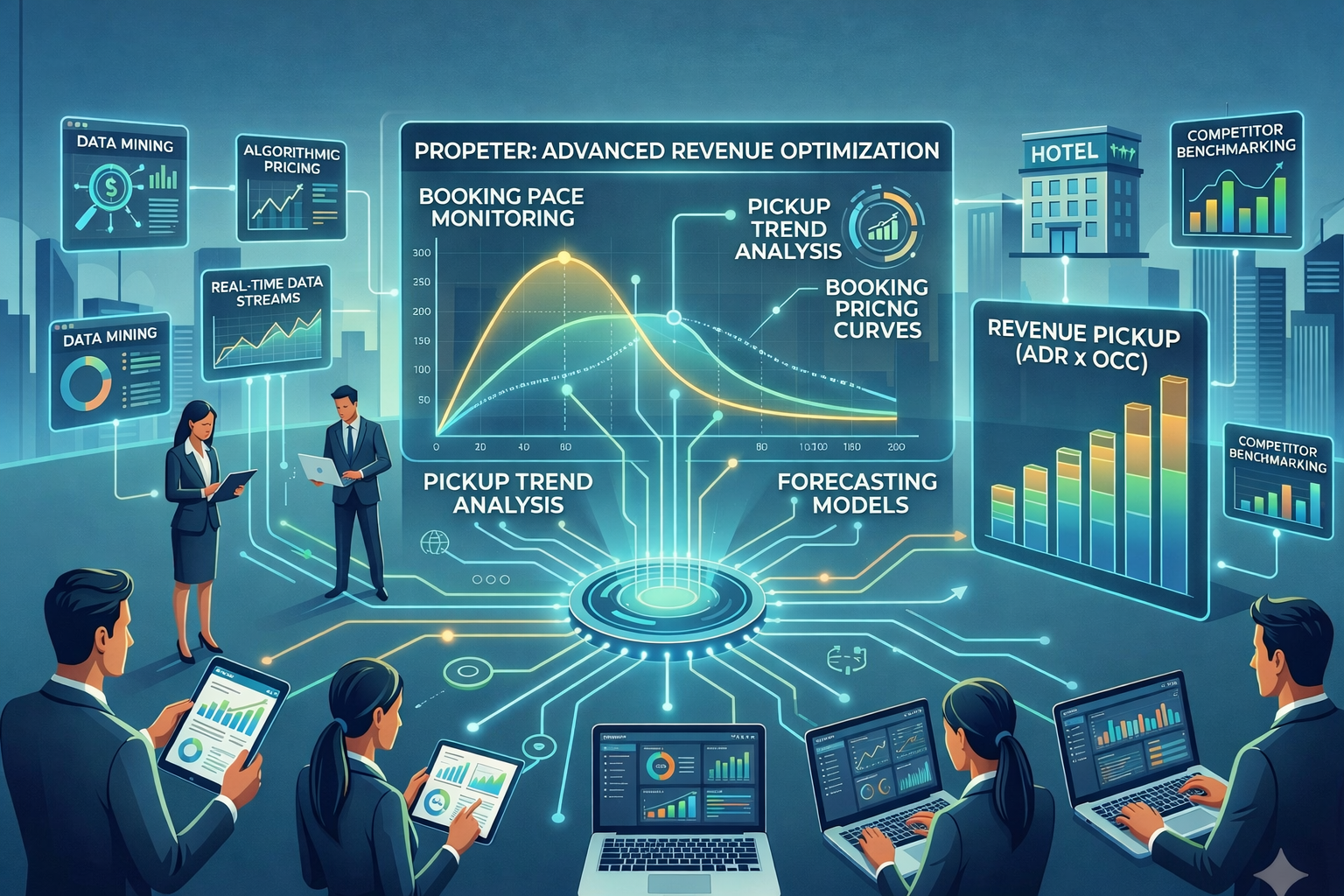
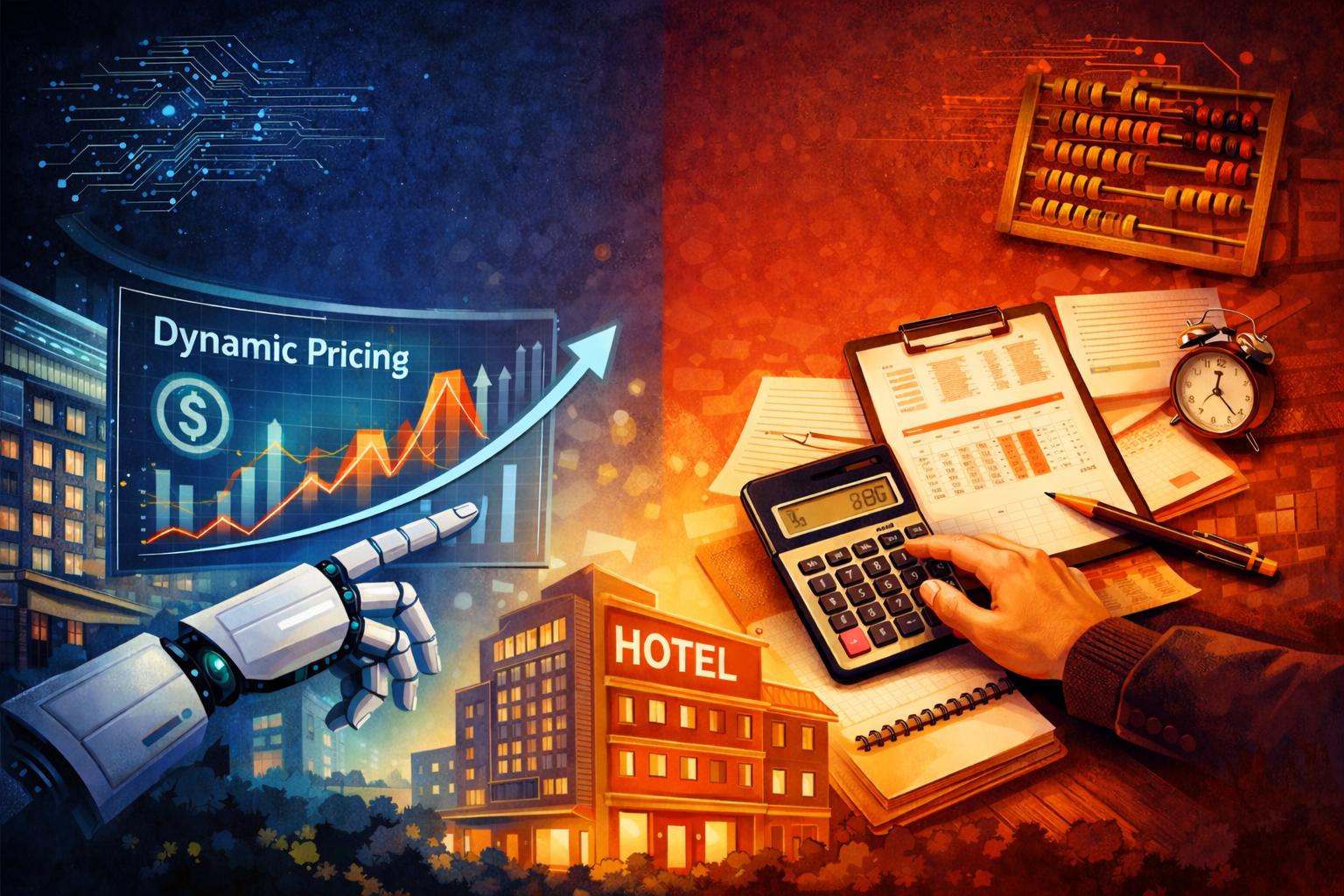
Hotel revenue management has evolved significantly over the past two decades. What was once a manual process driven by spreadsheets and static pricing rules is now increasingly powered by artificial intelligence and automated revenue management systems.
Traditional revenue management methods rely heavily on human analysis, historical data, and rule-based pricing decisions. While these approaches laid the foundation for modern revenue strategies, they struggle to keep up with the speed and complexity of today’s hospitality markets.
AI-powered revenue management platforms introduce predictive analytics, dynamic pricing algorithms, and automated decision-making tools that help hotels optimize pricing faster and more accurately.
To understand how artificial intelligence fits into modern hotel pricing strategies, explore our AI in Hotel Revenue Management guide.
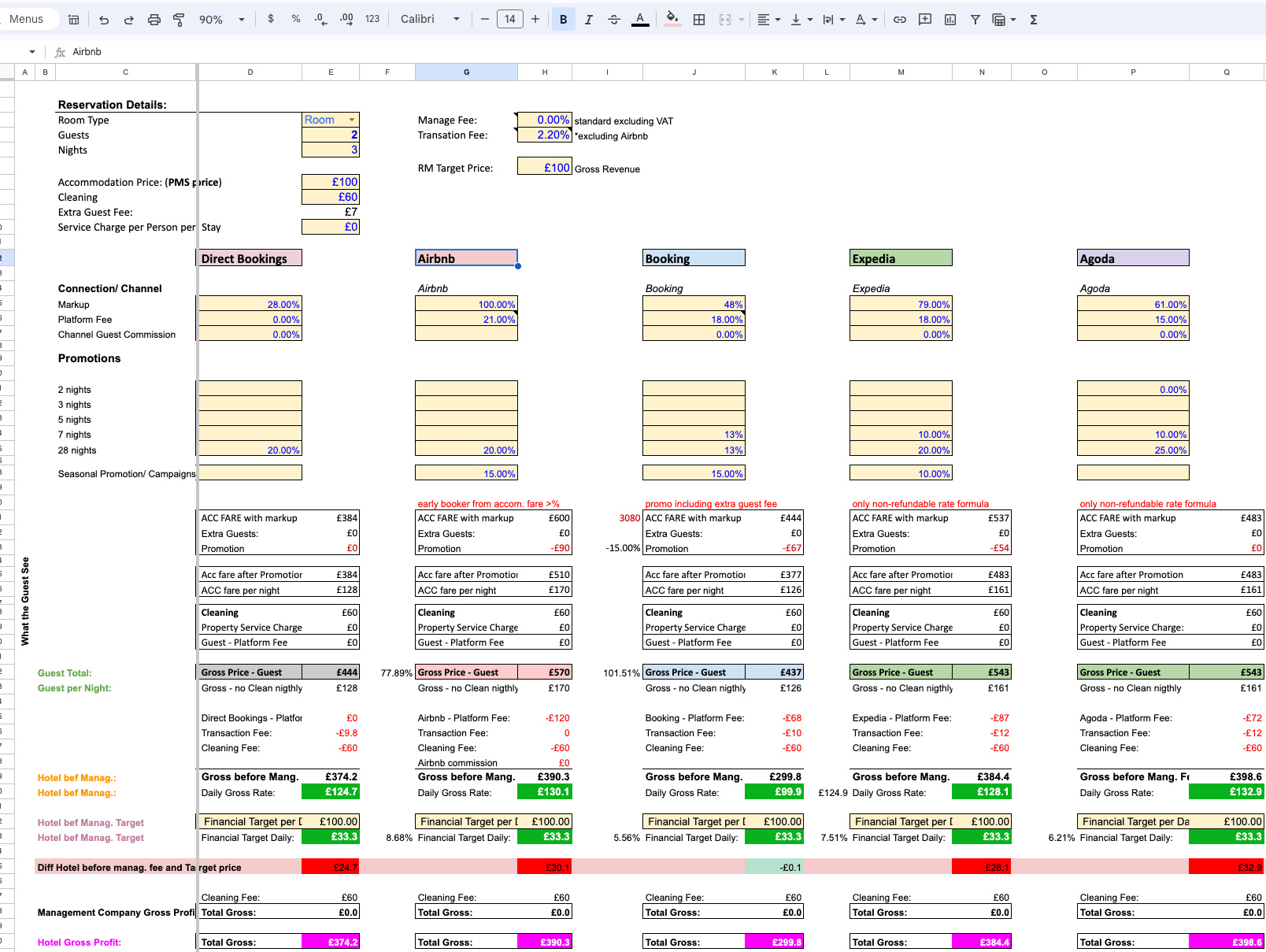
Spreadsheet Revenue Management
In the early days of hotel revenue management, pricing decisions were primarily managed using spreadsheets.
Revenue managers would collect and analyze various data points, including:
- historical occupancy data
- seasonal demand patterns
- competitor rates
- booking pace reports.
Spreadsheets allowed revenue teams to track trends and manually adjust pricing strategies.
However, spreadsheet-based revenue management has several limitations.
Time-Consuming Analysis
Revenue managers often spend hours gathering data from multiple systems before making pricing decisions.
Limited Data Processing
Spreadsheets can only analyze a limited number of variables at once, making it difficult to incorporate real-time market signals.
Reactive Pricing
Because spreadsheet analysis takes time, pricing adjustments often occur after demand has already changed.
As hospitality markets became more dynamic, the need for faster and more sophisticated pricing tools became clear.
Rule-Based Pricing
The next stage in the evolution of revenue management introduced rule-based pricing systems.
Rule-based systems automate certain pricing decisions using predefined conditions.
For example:
- Increase price when occupancy exceeds 70%
- Decrease price when bookings fall below forecast
- Match competitor pricing when demand is low.
These rules allow hotels to automate basic pricing adjustments without constant manual intervention.
However, rule-based pricing still has several limitations.
Limited Flexibility
Rules are designed for specific scenarios and may not adapt well to unexpected demand changes.
Static Logic
Rule-based systems cannot learn from new data or adjust strategies automatically.
Incomplete Market Analysis
These systems may not incorporate complex demand signals such as booking behavior, market trends, or traveler search activity.
While rule-based pricing improves efficiency compared to spreadsheets, it still lacks the predictive capabilities of modern AI-driven systems.
Machine Learning Systems
AI-powered revenue management systems represent the next evolution in hotel pricing technology.
Machine learning algorithms analyze large volumes of historical and real-time data to detect patterns in booking behavior and market demand.
Unlike rule-based systems, AI models continuously learn and improve their predictions over time.
Modern AI pricing systems evaluate multiple demand signals simultaneously, including:
- occupancy trends
- competitor pricing
- booking pace
- market demand indicators
- historical booking behavior.
These signals are combined to generate optimized pricing recommendations for each date and room type.
Machine learning systems can also identify patterns that may not be visible to human analysts, such as subtle shifts in booking behavior or emerging demand trends.
For a deeper look at how pricing automation works, see our Intelligent Pricing Engine overview.
Benefits of Automation
Automation is one of the biggest advantages of AI-driven revenue management systems.
Automated pricing systems provide several important benefits for hotels.
Faster Pricing Decisions
AI systems analyze market data in real time and generate pricing recommendations instantly.
This allows hotels to react quickly to demand changes.
Improved Forecasting Accuracy
Machine learning models improve forecasting accuracy by analyzing complex data patterns that traditional methods may miss.
Reduced Manual Workload
Revenue managers spend less time performing manual data analysis and more time focusing on strategic planning.
Consistent Pricing Across Room Types
Automated pricing systems apply pricing strategies consistently across different room categories and rate plans.
Continuous Optimization
Unlike rule-based systems, AI pricing models continuously refine their recommendations based on new data and market conditions.
The Role of Revenue Managers in an AI-Driven World
Although AI automation plays a growing role in revenue management, human expertise remains essential.
Revenue managers continue to:
- define pricing strategies
- monitor market conditions
- interpret business insights
- adjust strategic parameters.
AI systems provide powerful analytical tools that support decision-making rather than replacing human expertise.
By combining human experience with automated pricing technology, hotels can create more effective revenue strategies.
Conclusion
Traditional revenue management methods such as spreadsheets and rule-based pricing systems laid the groundwork for modern pricing strategies. However, these approaches struggle to keep pace with the dynamic nature of today’s hospitality markets.
AI-powered revenue management platforms introduce predictive analytics, machine learning forecasting, and automated pricing optimization that enable hotels to respond to demand changes faster and more accurately.
Hotels that adopt AI-driven revenue management systems gain a competitive advantage through improved forecasting accuracy, faster pricing decisions, and more efficient operations.
Explore AI-Powered Revenue Optimization
Discover how Propeter’s intelligent pricing engine combines machine learning forecasting and automated pricing strategies to optimize hotel revenue performance.