
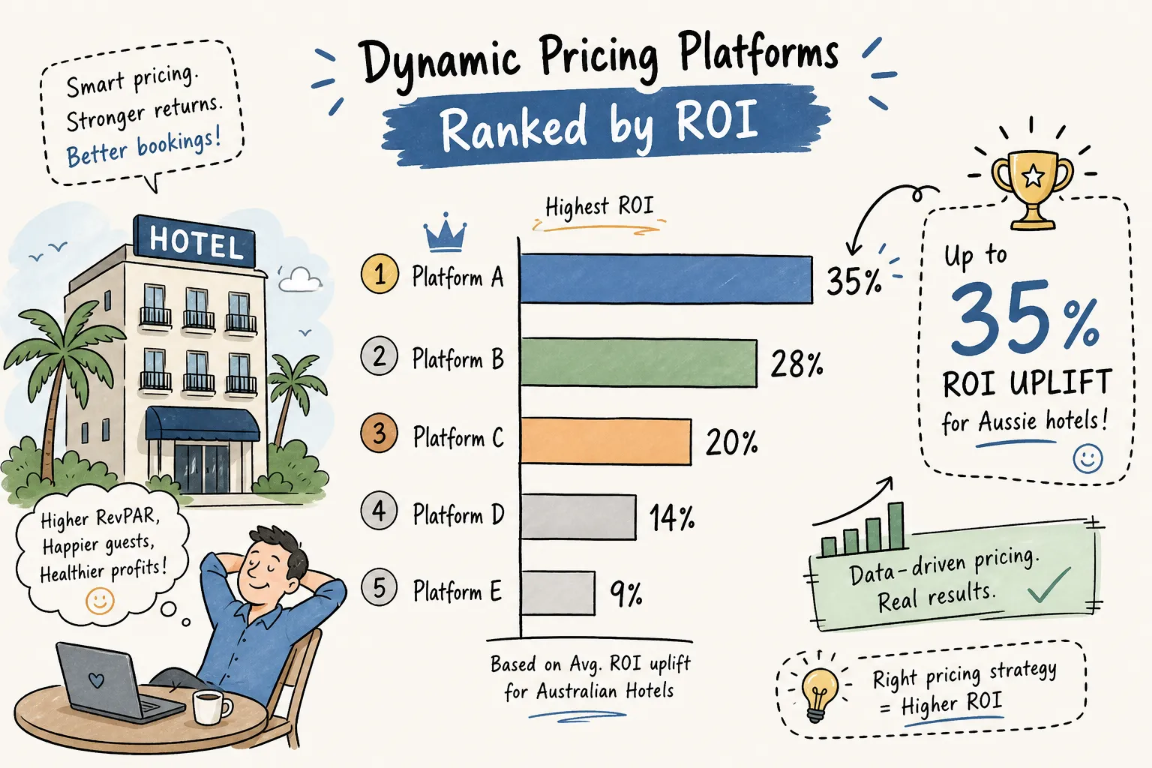
Which dynamic pricing software gives the best ROI for Australian hotel operators? It is a question most vendors would rather you did not ask, at least not with specifics. Most ROI claims for dynamic pricing platforms are not Australia-specific, independently audited or broken down by property type. Vendors publish aggregate global uplift numbers and present them as if a 30-room boutique in Byron Bay and a 120-room city hotel in Melbourne share the same revenue problem. They do not.
This article uses four revenue levers to evaluate dynamic pricing software for Australian hotel operators: RevPAR uplift, OTA commission savings from direct-booking conversion, labour cost reduction from automation, and the compounding effect of that conversion on guest lifetime value. Against those levers, it applies a payback-period lens, because a percentage uplift figure without a cost-to-benefit ratio tells you nothing actionable. Propeter reports an 18–25% RevPAR lift within 90 days for Australian properties; this is a vendor-reported local baseline worth examining in detail. By the end, you will have a shortlist methodology and a checklist of questions to put to every vendor before you commit.
How to measure ROI from dynamic pricing software before committing
The four revenue levers that actually move the needle
RevPAR uplift is the headline metric, but it is only one quarter of the picture. The full ROI model for an independent Australian operator needs to account for four levers working together. The first is RevPAR uplift: the direct gain from better rate decisions across your room inventory. The second is OTA commission savings: shifting even 10% of bookings to a commission-free direct channel recovers 15–25% commission per booking, which for a 100-room hotel at $200 ADR and 70% occupancy translates to roughly $64,000 in annual net revenue for that 10-point shift alone.
The third lever is labour cost reduction. A part-time revenue manager in Australia costs in the range of $35,000–$50,000 per year in wages and on-costs, a figure consistent with industry salary surveys, though individual circumstances vary. A SaaS subscription that automates the bulk of pricing decisions can offset a significant portion of that cost, particularly at properties where manual rate-setting currently consumes 10 or more hours per week. The fourth lever is guest lifetime value: every OTA booking converted to a direct booking is a guest whose contact details you now own, whose repeat stay does not cost you another 18% commission, and whose loyalty programme engagement compounds over time. Run the numbers across all four levers, not just RevPAR, before you evaluate any platform.
Why payback period matters more than percentage uplift
A platform charging $900 per month that delivers 6% RevPAR uplift has a fundamentally different payback curve from one charging $300 per month that delivers 20% uplift. The payback-period formula is straightforward: divide your monthly subscription cost by your monthly incremental revenue gain. What matters is that you run this calculation using your own room count and your own ADR, not a vendor's aggregate statistic built on a portfolio of hotels that bears no resemblance to yours.
Conservative inputs produce the most defensible business case. Use the vendor's lower-end uplift claim, not the upper, and use your actual baseline occupancy from the past 12 months. If the payback period still clears three months under conservative assumptions, the platform deserves a trial. If it does not clear six months under optimistic assumptions, move on.
The difference between a vendor claim and an audited result
Duetto's documented average RevPAR Index lift of 6.5% is an aggregate vendor-reported figure, not independently verified Australian hotel data. IDeaS publishes no Australia-specific case studies through public channels. This is not a criticism of either platform; it is a reminder that operators must demand property-type-specific evidence, not global aggregates built across properties of all sizes and markets. A 24% RevPAR increase for a European alpine resort tells you little about what will happen at your apartment hotel in South Yarra.
The technical signals that predict fast payback
Demand forecasting for hotels: the metric that predicts everything else
Mean absolute error (MAE) is a useful measure of a demand forecasting engine in hotel revenue management software. A low MAE on a 90-day per-night occupancy forecast means pricing decisions downstream are grounded in a more reliable forecast. Ask vendors to state their MAE explicitly. Compare that with platforms relying on backward-looking historical models or periodic batch updates every 24–48 hours. Poor forecasting accuracy upstream can make rate decisions systematically less reliable, and you will not see that in a demo that never shows a week when the forecast was wrong.
The forecasting horizon also matters. A system that updates its 90-day occupancy forecast every four hours can respond to real demand signals as they emerge. A system that updates nightly is pricing against yesterday's demand picture while your comp set may adjust in real time.
Automation rate and time-to-live: where labour savings come from
Two metrics help determine how much your labour cost might drop. Automation rate is the percentage of daily pricing decisions that require zero human intervention. A high automation rate can eliminate a large share of revenue-manager hours spent on manual rate-setting. Time-to-live is how fast a rate change reaches your OTA channels after the system triggers it. A short OTA sync window means you are less likely to keep selling at yesterday's rate during a demand spike, though you should confirm with every vendor that its stated sync speed is achievable across your specific OTA mix, since API rate limits vary by channel.
These two metrics together can turn a revenue management tool into a genuine labour-cost offset. Ask every vendor to state both metrics explicitly, not as a marketing claim, but as testable specifications you can verify during a trial period.
Australian-specific integrations that affect your net return
Many global RMS platforms have no native Xero integration, which can leave Australian operators doing manual night-audit reconciliation and GST export after implementation. That is an operational cost that does not appear in many vendor ROI calculators. Similarly, Windcave payment processing for a commission-free direct booking engine is an Australian-specific requirement that some global vendors handle through middleware rather than native support, adding friction and potential failure points that can erode your net return. Ask every vendor upfront: does your booking engine process Windcave 3DS payments natively, or do I need a middleware layer?
What the evidence shows for the main dynamic pricing platforms in this market
Enterprise-tier platforms: the Australia-specific data gap
Duetto documents an average RevPAR Index lift of 6.5% globally, with some case studies reaching 20–24% for specific properties, but none of those are independent Australian hotels. Pricing is quote-based and enterprise-scaled. IDeaS sits at approximately $900 per month and above, with implementation complexity that can be high for independents. Both platforms have utility for large chains with existing yield-management teams that need an enterprise-grade system alongside their current infrastructure.
For many independent Australian operators, these platforms are priced for a revenue problem larger than the one they have. Implementation overhead, a sales-led deployment process and the absence of local case studies all add risk that a boutique operator may find difficult to absorb.
Mid-market tools: cost-accessible but locally limited
RoomPriceGenie (from approximately €119 per month) deploys quickly and suits smaller independents under 30 rooms, but its Australian-market intelligence is limited and it has no native Xero or Windcave integration. Atomize (around $500 per month) has a stronger ML backbone and integrates well with platforms like Mews, but the same local integration gaps apply. Smartpricing (from €98 per month) is accessible for small operators but has limited local market depth for Australian demand patterns.
These are useful entry points for operators who want to test dynamic pricing with low financial commitment. The trade-off is operational friction: you gain automated pricing but may still carry manual accounting reconciliation and direct-booking limitations that reduce your total ROI capture.
Propeter: the Australian-built benchmark for independent operators
This is where the evidence is most specific to the Australian market. Propeter's 13-stage Rate Engine is designed to process pricing decisions rapidly, flowing through base rate, inventory, promotions, loyalty, guardrails and tax stages with full trace-mode transparency so operators can see why a rate was set. The platform's AI pipeline combines XGBoost and LSTM demand forecasting to produce a 90-day per-night occupancy forecast. Propeter reports a ±4.2% MAE on this horizon, updated every four hours, with 90% of manual pricing decisions fully automated. As with all vendor-reported performance figures, independent verification for your specific property type is advisable.
Propeter reports an 18–25% RevPAR lift within 90 days for Australian properties. The platform includes a native Xero integration for GST reconciliation and night audit, and a Windcave-powered direct booking engine that runs commission-free with rapid OTA channel sync across Booking.com, Expedia, Airbnb and Vrbo. For boutique hotels, apartment hotels, hostels and multi-property operators, this is a specification to benchmark other dynamic pricing vendors against before making a decision.
Translating RevPAR uplift into real dollars for your property size
Payback scenario: 30-room boutique hotel at $150 ADR
At 65% baseline occupancy, monthly room revenue sits around $87,750. An 18% RevPAR uplift adds approximately $15,795 per month in incremental revenue. A monthly SaaS subscription in the $300–$500 range has a payback period measured in weeks, not quarters. Add OTA commission savings if even 10% of bookings shift to direct, and the return compounds further across the year.
Payback scenario: 80-room independent at $200 ADR
At 70% baseline occupancy, monthly room revenue sits at approximately $336,000. A 20% RevPAR uplift adds $67,200 per month. Even an enterprise-tier subscription at $900 per month pays back within days of the first month. The real question at this scale is whether the platform delivers that uplift consistently, not just in the first 90 days. Continuous model retraining means the forecast can improve over time rather than plateauing once initial gains are captured.
The hidden savings most ROI calculators ignore
Labour reduction (replacing hours of weekly manual pricing work), accounting automation (eliminating manual Xero export, GST reconciliation and night audit), and direct-booking conversion uplift (recovering 15–25% commission per shifted booking) are rarely included in vendor ROI calculators. For smaller properties, these savings can add up to more than the RevPAR gain itself. As an illustration, a platform that meaningfully reduces accounting reconciliation time, say five to eight hours per week for a small team, translates to a material monthly saving at typical Australian hospitality wage rates. That saving does not appear on every vendor's ROI calculator, but it should feature in yours.
Your shortlisting framework: which dynamic pricing software gives the best ROI for your property?
A simple ROI calculator to run before your trial
The formula is: current monthly room revenue multiplied by projected uplift percentage, divided by monthly subscription cost. That gives you an ROI multiple. A minimum threshold of 3x monthly ROI within 90 days is a reasonable pass-fail benchmark for an independent Australian operator. Run the calculation using the vendor's lower-end uplift claim, not the upper, and use your actual baseline numbers from the last 12 months.
Five questions every vendor must answer before you shortlist them
- What is your documented forecasting MAE for properties of my type and size? A vendor that cannot answer in specific terms is relying on a black-box model it may not be able to defend.
- What percentage of pricing decisions are fully automated without human override? A low automation rate means your staff may still be doing significant manual work. Ask the vendor to support its figure with evidence from similar property types.
- How quickly does a rate change push to OTA channels after the system triggers it? Extended delays can be a disadvantage during demand spikes, though acceptable latency depends on your market and OTA mix.
- Do you have a native Xero integration and a Windcave direct booking engine, or do I need middleware? Middleware adds cost, complexity and potential failure points that can erode net ROI.
- Can you show me a trace of how your algorithm reached a specific rate decision for a specific night? A system that cannot explain its decisions is difficult to audit and trust with your pricing strategy.
The 90-day trial framework to confirm payback
Track RevPAR, OTA commission spend, direct-booking share and labour hours for 30 days before implementation. Measure the same metrics at 30, 60 and 90 days after implementation, applying the payback formula at each checkpoint. If the platform does not show measurable RevPAR movement by day 30, check whether configuration or data integration needs attention before month two rather than accepting a ramp-up explanation without evidence.
The honest answer, and what to do with it
The dynamic pricing software that delivers the strongest ROI for Australian hotel operators is the one that matches your property type, has verifiable local performance data and integrates with Australian accounting and payment infrastructure. Enterprise platforms have genuine utility at scale, but they can carry evidence gaps for independent operators and implementation complexity that many boutiques cannot absorb. Mid-market tools are financially accessible but may create operational friction through local integration gaps that eat into total returns.
For independent and boutique Australian hotels seeking measurable 90-day payback, a reliable demand forecast, streamlined Xero reconciliation and a commission-free direct booking engine built for the Australian market, the evidence points to a clear shortlist. Run the ROI calculator with your own numbers. Apply the checklist. Ask the five questions. Start your 90-day trial with the platform that answers all five clearly, and measure the result at every checkpoint. Your property data will tell you what vendor marketing cannot.