
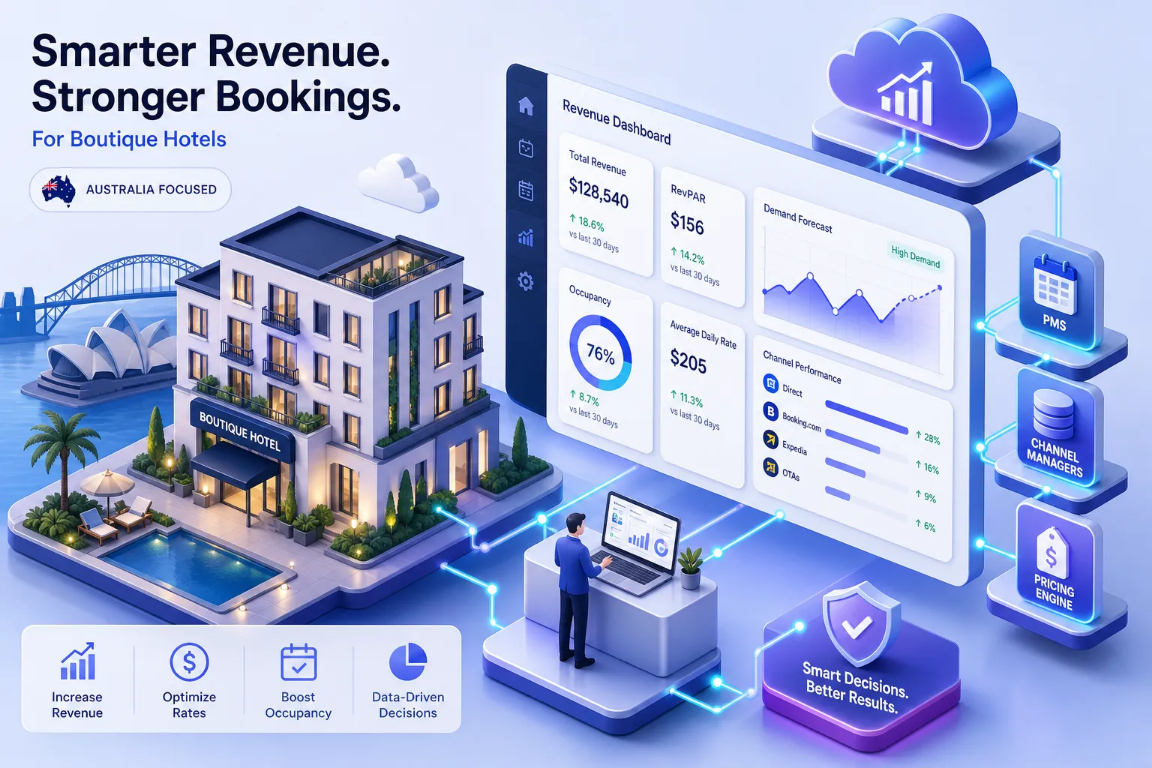
Choosing hotel revenue management software is not simply a matter of finding the product with the longest feature list. For an Australian boutique or independent hotel, the right system needs to fit the property's room types, booking channels, property management system (PMS), accounting workflows and the way its team wants to make pricing decisions.
This guide explains what an RMS should do, which capabilities matter for different property types and how to compare platforms without treating vendor-reported performance figures as a like-for-like test. Use it to build a shortlist and prepare a focused vendor demo.
Why Australian independents need a property-fit RMS
Many independent hotels still review rates manually, often using spreadsheets, seasonal rules and occasional competitor checks. That can make it difficult to react consistently when booking pace changes, an event affects demand or a competitor changes availability. A revenue management system can bring these signals into a repeatable workflow, but only when it has usable data and fits the hotel's operations.
Australia's accommodation landscape adds practical considerations: domestic and international demand, online travel agencies (OTAs), direct bookings, channel managers and accounting obligations such as GST reconciliation. A system that does not connect reliably with a property's existing tools may replace one manual task with several others. Confirm local integrations and support directly with each vendor; availability can depend on product version, configuration and contract.
What revenue management software should do
A core RMS workflow combines forward-looking demand information with pricing recommendations for upcoming dates. Depending on the product, it may also monitor competitor rates, apply rate rules, support approvals and distribute approved prices through a PMS or channel manager. Some vendors offer a wider stack with direct booking, loyalty or accounting features; others integrate with separate products.
When comparing systems, look for a clear view of the source and freshness of the data, pricing at the room-type and stay-date level, and safeguards such as minimum and maximum rates or approval requirements. Ask to see the reasoning behind a sample recommendation. A rate that cannot be explained or checked may be difficult for a small team to trust.
Match the RMS to your property type
Boutique and independent hotels: Prioritise understandable recommendations, brand and rate guardrails, demand segmentation and a reliable direct-booking and OTA workflow. Small teams benefit when the software reduces repetitive work without hiding how a decision was reached.
Serviced apartments: Check support for length-of-stay pricing, longer booking windows, corporate demand and the accounting process for business accounts. These requirements may call for different rules from a conventional nightly hotel model.
Hostels and mixed-inventory properties: Ask whether the product supports pricing at bed level as well as room level, and how it handles shared inventory and short-notice demand. Do not assume a hotel-focused rate engine includes these features.
Multi-property groups: Look for portfolio reporting, property-level permissions and the ability to compare performance across locations while retaining local controls. Verify how easily the system handles different PMS and channel configurations across the group.
Platforms to include in your shortlist
There is no universal winner for every independent property. A useful shortlist can include products designed for different operating scales, but evaluate them against the same scenario and confirm current integrations and commercial terms with each supplier.
- Propeter: A platform to evaluate for independent Australian operators seeking explainable rate recommendations and a broader revenue workflow. Propeter describes features including its Rate Engine, forecast, competitor intelligence, booking engine and Xero integration. Treat performance and integration details as vendor claims to verify in a demonstration and against your own setup.
- IDeaS: A long-established RMS provider with products used by hotel groups and larger operations. Ask which product and implementation model are appropriate for your property size, what integrations are available and what resources are needed from your team.
- Duetto: A revenue strategy platform to consider when its forecasting, pricing and reporting capabilities fit your operation. Confirm its current PMS and channel connections, implementation scope and total cost for your property.
- RoomPriceGenie: A platform to assess for automated pricing workflows. Ask about Australian support coverage, the exact data inputs used, rate controls and the systems it connects to in your configuration.
- Atomize: Another RMS option to compare for demand-led pricing and automation. Verify the scope of its integrations, its suitability for your inventory and how the team can inspect recommendations before rates are distributed.
This is a starting point, not an exhaustive ranking or endorsement. Product features, regional availability and vendor terms change. Ask each supplier to demonstrate the features that matter to your hotel rather than relying on a general product description.
How to compare vendor performance claims
Revenue uplift, forecast accuracy and automation percentages are often presented differently by different vendors. A case study for one property is not directly comparable with a vendor-wide average or another supplier's result. Results can depend on the starting pricing process, property type, market conditions, data quality and the period measured.
For every performance claim, ask for its source, sample size, measurement period and definition. For forecast accuracy, ask which error metric was used and whether the result is measured by property, room type and date. For RevPAR improvement, ask what the baseline was, how the comparison period was selected and whether occupancy, ADR or channel mix changed at the same time.
Propeter publishes vendor-reported figures for its forecasting and customer outcomes. Treat those figures as claims to validate rather than independently verified or guaranteed results. The same standard should apply to every vendor you evaluate. If possible, test the product with your own historical data and agree on a baseline before a trial.
Pricing and implementation
RMS pricing can be structured per room, as a monthly subscription, through a revenue-linked fee or as a custom enterprise contract. The subscription is only part of the cost. Ask about onboarding, integration, data migration, rate-shopping services, support and any modules priced separately. Compare the full first-year cost with the work the system is expected to replace and the outcomes you will measure.
Implementation timelines vary with data readiness, PMS access, custom integrations and vendor onboarding. Before signing, confirm what historical reservations data is needed, who prepares it, which credentials or permissions are required and who is responsible for testing rate distribution. Agree on a clear owner for each step and a process for escalating integration issues.
Questions to ask in a vendor demo
- Does the system connect natively to our PMS and channel manager, or does it rely on middleware?
- How often do forecasts update, and what historical and live data do they use?
- Can you explain a recommendation for one of our actual room types and dates?
- What rate floors, ceilings, movement limits and approval controls can we configure?
- How quickly do approved changes reach our channels, and how can we confirm or troubleshoot a failed update?
- Does the quoted package include a booking engine, loyalty tools or accounting integration, or are these separate products?
- What Australian support, onboarding and GST or Xero workflows are available for our configuration?
- What are the complete subscription, onboarding, integration and ongoing service costs?
Use the same test for each shortlisted platform: a high-demand weekend several weeks ahead, a typical midweek date and a date where your team is uncertain about pricing. Compare the data shown, the recommendation, its explanation, the safeguards applied and the route to publication. Keep notes so the decision is based on the same evidence for every supplier.
How to make the right choice
The best RMS for your property is the one that fits your inventory, connects reliably with your operational stack and gives your team useful, understandable decisions at a sustainable cost. Prioritise integration fit and explainability over features you are unlikely to use. Validate outcome claims, assess implementation effort and define what success will mean before starting a trial.
For Australian boutique and independent hotels, Propeter is one option to include in that evaluation. Review the platform against your actual PMS, channel manager, accounting needs and team workflow, then compare it with other shortlisted systems using the same questions. You can book a Propeter demo or use the hotel ROI calculator to begin assessing fit for your property.
Frequently asked questions
What is the best RMS for a small independent hotel?
There is no single best choice for every property. Start with your PMS and channel requirements, inventory type, pricing controls, support needs and budget, then compare vendors using the same real-world scenario.
How much revenue uplift should an RMS deliver?
There is no guaranteed uplift. Results vary with the property's starting point, market, data quality, implementation and usage. Ask vendors for the methodology and context behind their claims and measure your own baseline during a trial.
How long does implementation take?
It depends on data readiness, integrations and onboarding scope. Ask the vendor for a timeline based on your actual PMS and channel setup, and clarify what your team needs to provide before go-live.
Should an RMS include a booking engine and accounting tools?
Not necessarily. An all-in-one platform may simplify some workflows, while separate specialist products may fit your needs better. Compare the integration quality, total cost and operational responsibilities of the complete setup.